0
(0)
Chapter Summaries
Esther 7 — Haman Exposed and Executed
 Major Events & Flow
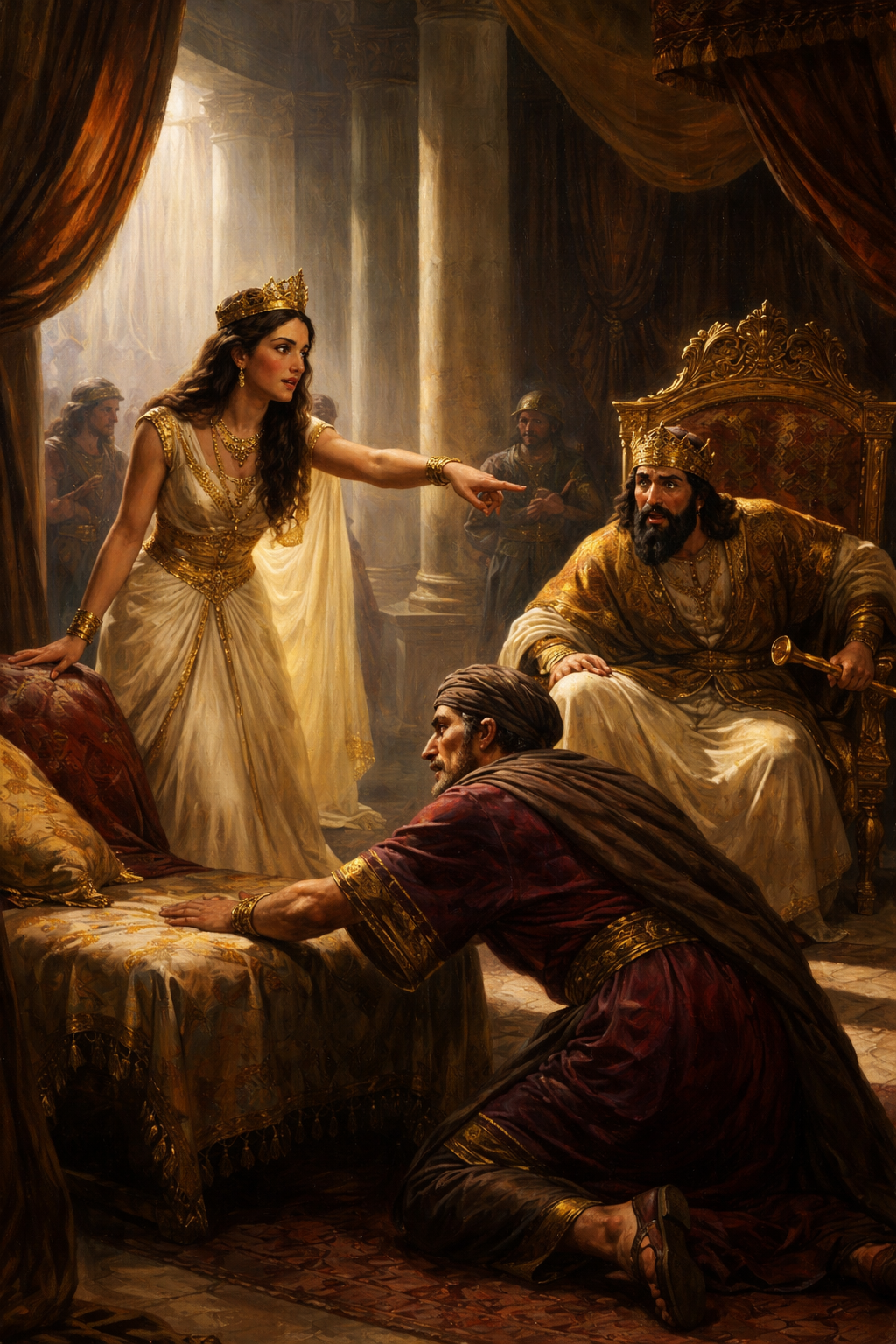
- Esther hosts her second banquet of wine for King Ahasuerus and Haman.
- At the king’s inquiry, Esther reveals her petition: “If I have found favour in thy sight… let my life be given me at my petition, and my people at my request” (Esth. 7:3).
- She exposes Haman as the adversary who plotted the destruction of the Jews.
- The king, filled with wrath, steps into the palace garden.
- Haman falls upon Esther’s couch to plead for his life, which the king interprets as an assault.
- Harbonah informs the king of the gallows Haman prepared for Mordecai.
- Haman is hanged on his own gallows.
Doctrinal / Historical Notes
- God’s name is not mentioned, yet His providence is unmistakable.
- The timing, exposure, and reversal all demonstrate divine justice.
- Haman’s end fulfills the biblical principle: “Whoso diggeth a pit shall fall therein” (cf. Prov. 26:27).
Esther 8 — Deliverance Decreed
Major Events & Flow
- Esther is given Haman’s house; Mordecai is exalted.
- Mordecai receives the king’s ring and authority.
- Esther again petitions the king, this time with tears, to reverse the decree.
- Persian law cannot be annulled, so a counter-decree is issued.
- The Jews are authorized to defend themselves.
- The decree is written “according to all that Mordecai commanded” and sent swiftly.
- The Jews rejoice; many Gentiles fear and profess themselves Jews.
Doctrinal / Historical Notes
- God does not always remove the trial, but He provides a way of deliverance through it.
- Salvation here is not passive; the Jews must act in faith upon the decree.
- Mordecai’s exaltation prefigures how God honors faithfulness in due time.
Esther 9 — Victory and the Feast of Purim
Major Events & Flow
- On the appointed day, the Jews gather and prevail over their enemies.
- God turns fear upon those who hated Israel.
- Mordecai’s authority is acknowledged throughout the empire.
- Haman’s ten sons are slain and hanged.
- Esther requests an additional day in Shushan to complete judgment.
- The Feast of Purim is established to memorialize deliverance.
Doctrinal / Historical Notes
- God’s deliverance includes judgment upon persistent enemies.
- The Jews refuse the spoil, emphasizing justice, not greed.
- Purim becomes a testimony to God’s preserving hand over Israel.
Esther 10 — Mordecai Exalted
Major Events & Flow
- King Ahasuerus imposes tribute.
- Mordecai is described as:
- “next unto king Ahasuerus”
- “great among the Jews”
- “seeking the wealth of his people, and speaking peace to all his seed”
Doctrinal / Historical Notes
- God elevates the faithful servant who sought others’ good.
- Mordecai’s life closes in honor, influence, and peace.
- The book ends not with Esther, but with faithful leadership rewarded.
Key People and Places
- Esther — Jewish queen; courageous intercessor for her people.
- Mordecai — Faithful Jew; raised from sackcloth to second-in-command.
- Haman — Agagite enemy of the Jews; embodiment of pride and hatred.
- King Ahasuerus — Persian monarch; absolute authority yet easily swayed.
- Shushan (Susa) — Capital city; center of royal and judicial action.
- Persian Empire — Gentile world power under which Israel is preserved.
Main Doctrinal and Spiritual Themes
- Divine Providence Without Overt Miracles
- God works through timing, authority, and human decisions.
- The Certainty of Divine Justice
- Pride and hatred ultimately lead to destruction.
- Intercession and Courage
- Esther’s willingness to speak illustrates sacrificial faith.
- Preservation of Israel
- God keeps His covenant people, even in dispersion.
- Reversal of Fortunes
- God humbles the proud and exalts the righteous.
Practical Applications and Lessons
- God is at work even when unseen.
Circumstances never negate His sovereignty. - Courage may require personal risk.
Esther risked her life to save others. - Pride precedes destruction.
Haman’s fall warns against self-exaltation. - Faith must act when deliverance is provided.
The Jews had to stand and defend themselves. - God honors those who seek others’ good.
Mordecai sought peace and prosperity for his people.
How useful was this post?
Click on a star to rate it!
Average rating 0 / 5. Vote count: 0
No votes so far! Be the first to rate this post.
We are sorry that this post was not useful for you!
Let us improve this post!
Tell us how we can improve this post?
Comments are closed