Daniel 5–7 forms a major turning point in the book. Daniel 5 records the fall of Babylon under Belshazzar. Daniel 6 records Daniel’s deliverance from the lions under Darius. Daniel 7 returns to prophetic revelation, showing the rise and fall of Gentile world powers and the final kingdom of the Son of man.
These chapters show that “the most high God ruled in the kingdom of men” and that no earthly empire, king, or beastly kingdom can overthrow the purpose of Jehovah.
Chapter Summaries
Daniel 5 — Belshazzar’s Feast and the Fall of Babylon
 Daniel 5 opens with Belshazzar making “a great feast to a thousand of his lords” and drinking wine before them. In pride and profanity, he commands that the golden and silver vessels taken from the temple in Jerusalem be brought into the feast. He and his nobles, wives, and concubines drink from the holy vessels and “praised the gods of gold, and of silver, of brass, of iron, of wood, and of stone” (Daniel 5:4).
This was not merely poor judgment; it was open blasphemy. The vessels belonged to the house of God. Belshazzar’s sin was not ignorance alone, for Daniel later tells him that he knew what had happened to Nebuchadnezzar, yet he had not humbled his heart.
At that moment, God interrupts the feast. “In the same hour came forth fingers of a man’s hand, and wrote over against the candlestick upon the plaister of the wall” (Daniel 5:5). The king’s countenance changes, his thoughts trouble him, “the joints of his loins were loosed,” and “his knees smote one against another” (Daniel 5:6). The proud ruler becomes a trembling sinner before the handwriting of God.
The wise men of Babylon cannot read or interpret the writing. The queen remembers Daniel, in whom was “the spirit of the holy gods” according to the Babylonian expression. Daniel is brought before Belshazzar. The king offers gifts, a scarlet robe, a chain of gold, and promotion to be third ruler in the kingdom. Daniel refuses to be bought: “Let thy gifts be to thyself, and give thy rewards to another” (Daniel 5:17).
Daniel reminds Belshazzar of Nebuchadnezzar’s humbling. Nebuchadnezzar had been lifted up in pride, but God brought him down until he knew “that the most high God ruled in the kingdom of men, and that he appointeth over it whomsoever he will” (Daniel 5:21). Belshazzar had this testimony before him, yet Daniel says, “And thou his son, O Belshazzar, hast not humbled thine heart, though thou knewest all this” (Daniel 5:22).
The writing is then interpreted:
“MENE; God hath numbered thy kingdom, and finished it.”
“TEKEL; Thou art weighed in the balances, and art found wanting.”
“PERES; Thy kingdom is divided, and given to the Medes and Persians” (Daniel 5:26–28).
That very night judgment falls. “In that night was Belshazzar the king of the Chaldeans slain. And Darius the Median took the kingdom” (Daniel 5:30–31).
Doctrinally, this chapter teaches the certainty of divine judgment, the danger of pride, and the holiness of God. God may allow men to boast for a season, but He can number a kingdom, weigh a king, and end an empire in one night.
Daniel 6 — Daniel in the Den of Lions
Daniel 6 moves into the Medo-Persian period. Darius sets over the kingdom one hundred twenty princes, with three presidents over them. Daniel is preferred above them because “an excellent spirit was in him” (Daniel 6:3). The king considers setting him over the whole realm.
This provokes envy. The presidents and princes seek occasion against Daniel concerning the kingdom, but they can find no fault. “Forasmuch as he was faithful, neither was there any error or fault found in him” (Daniel 6:4). Daniel’s public testimony was clean. His enemies finally conclude, “We shall not find any occasion against this Daniel, except we find it against him concerning the law of his God” (Daniel 6:5).
This is one of the highest testimonies a believer can have: the only charge the world can bring is that he is faithful to God.
The conspirators persuade Darius to sign a decree that no man may ask a petition of any God or man for thirty days, except of the king. The penalty is the den of lions. This decree appeals to royal pride and becomes binding according to “the law of the Medes and Persians, which altereth not” (Daniel 6:8).
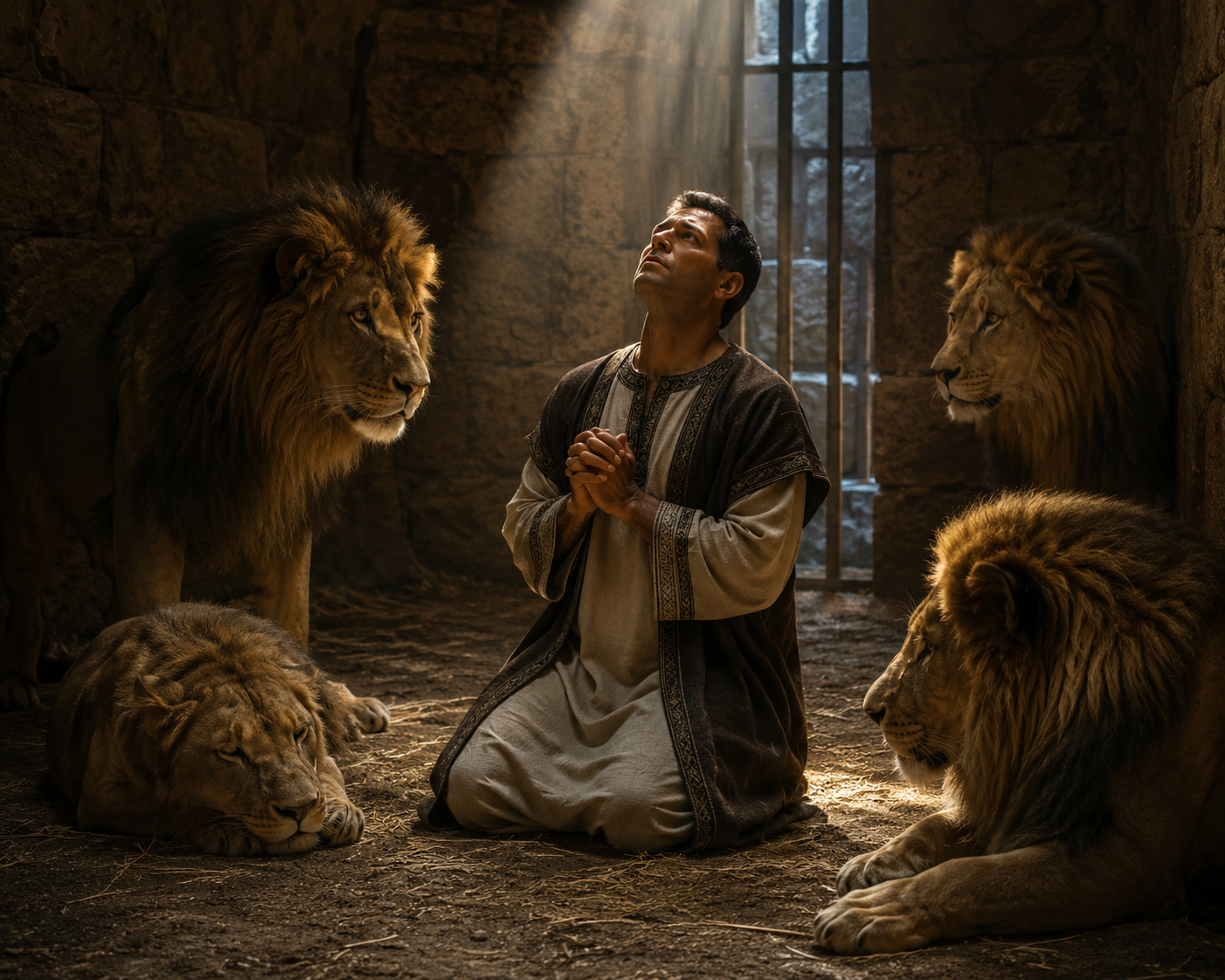
Daniel knows the writing is signed, yet he does not compromise, hide, or adjust his worship. “He went into his house; and his windows being open in his chamber toward Jerusalem, he kneeled upon his knees three times a day, and prayed, and gave thanks before his God, as he did aforetime” (Daniel 6:10).
That phrase is important. Daniel did not begin praying as a show of defiance, nor did he stop praying out of fear. He simply continued faithful as before. His obedience was settled before the crisis came.
Daniel is accused and cast into the den of lions. Darius is grieved, but trapped by his own law. The king says to Daniel, “Thy God whom thou servest continually, he will deliver thee” (Daniel 6:16). A stone is laid upon the mouth of the den and sealed.
That night the king cannot sleep. Early in the morning he goes to the den and cries, “O Daniel, servant of the living God, is thy God, whom thou servest continually, able to deliver thee from the lions?” (Daniel 6:20). Daniel answers, “My God hath sent his angel, and hath shut the lions’ mouths, that they have not hurt me” (Daniel 6:22).
Daniel is taken up from the den, “and no manner of hurt was found upon him, because he believed in his God” (Daniel 6:23). His accusers are then cast into the den, and judgment falls upon them.
Darius issues a decree honoring Daniel’s God: “he is the living God, and stedfast for ever, and his kingdom that which shall not be destroyed” (Daniel 6:26).
This chapter teaches faithfulness under civil pressure, the duty of prayer, separation from idolatrous government decrees, and God’s power to deliver. Conservative Baptists rightly see here a strong example of obeying God rather than men when human law commands disobedience to God.
Daniel 7 — The Four Beasts and the Kingdom of the Son of Man
Daniel 7 shifts from historical narrative to prophetic vision. The chapter takes place “in the first year of Belshazzar king of Babylon” (Daniel 7:1), meaning it chronologically occurs before the fall of Babylon in Daniel 5. Daniel receives a dream and visions concerning Gentile world powers.
Daniel sees “the four winds of the heaven” striving upon “the great sea” (Daniel 7:2). Four great beasts come up from the sea, “diverse one from another” (Daniel 7:3). These beasts represent kingdoms, as later stated: “These great beasts, which are four, are four kings, which shall arise out of the earth” (Daniel 7:17).
The first beast is “like a lion, and had eagle’s wings” (Daniel 7:4). This corresponds to Babylon, majestic and powerful, matching the head of gold in Daniel 2.
The second beast is “like to a bear,” raised up on one side, with three ribs in its mouth (Daniel 7:5). This corresponds to Medo-Persia, an uneven dual empire, with Persia becoming dominant.
The third beast is “like a leopard,” with four wings and four heads (Daniel 7:6). This corresponds to Greece, especially the swift conquest under Alexander and the later division of his empire.
The fourth beast is “dreadful and terrible, and strong exceedingly,” with great iron teeth (Daniel 7:7). It devours, breaks in pieces, and stamps the residue. This corresponds to Rome in its historical form and, in dispensational understanding, its final revived form in the last days. It has ten horns, which connect with the ten toes of Daniel 2 and point to a final confederation of kings.
Daniel then sees “another little horn” coming up among the ten horns. Before this little horn, three of the first horns are plucked up. This little horn has “eyes like the eyes of man, and a mouth speaking great things” (Daniel 7:8). This points to the final Antichrist, a blasphemous ruler who rises in the last days out of the final form of Gentile power.
The vision then turns from earthly beasts to the throne of God. “The Ancient of days did sit,” His garment “white as snow,” His throne “like the fiery flame,” and “the judgment was set, and the books were opened” (Daniel 7:9–10). God is not threatened by Gentile kingdoms. Heaven’s court is seated before earth’s rebellion is finished.
Daniel then sees the destruction of the beast and the coming of Christ’s kingdom. One “like the Son of man came with the clouds of heaven” and came to the Ancient of days. “And there was given him dominion, and glory, and a kingdom” (Daniel 7:13–14). His dominion is “an everlasting dominion,” and His kingdom “that which shall not be destroyed.”
This is a clear prophecy of the Lord Jesus Christ as the Son of man. From a premillennial Baptist position, this kingdom is not merely an invisible moral influence or the church gradually Christianizing the world. It is the literal, future, earthly reign of Christ, following the overthrow of Gentile world power.
Daniel is grieved and troubled by the vision. He is told that “the saints of the most High shall take the kingdom, and possess the kingdom for ever” (Daniel 7:18). The fourth beast is explained further, especially the little horn who “shall speak great words against the most High, and shall wear out the saints of the most High” (Daniel 7:25). But his rule is limited: “they shall be given into his hand until a time and times and the dividing of time” (Daniel 7:25), commonly understood as three and one-half years, corresponding to the latter half of the Tribulation.
The chapter ends with judgment given against the beast and the kingdom given to “the people of the saints of the most High” (Daniel 7:27). The final word is not Antichrist, empire, persecution, or beastly government. The final word is the everlasting kingdom of God.
Key People and Places
Daniel
A faithful Jewish prophet and servant of God in exile. In Daniel 5, he interprets the handwriting on the wall. In Daniel 6, he remains faithful in prayer despite the king’s decree. In Daniel 7, he receives a prophetic vision of Gentile world empires and the kingdom of the Son of man.
Belshazzar
The Babylonian ruler in Daniel 5. He profanes the vessels from the temple and exalts idols. Though he knew the humbling of Nebuchadnezzar, he refuses to humble his heart. He is judged by God and slain the same night.
Nebuchadnezzar
Mentioned in Daniel 5 as the earlier king of Babylon whom God humbled. His experience in Daniel 4 becomes a witness against Belshazzar, who had knowledge of God’s dealing with him but ignored it.
The Queen
She advises Belshazzar to call Daniel. Her remembrance of Daniel shows that Daniel’s testimony had endured even when the new generation of rulers did not value him.
Darius the Median
The ruler who takes the kingdom after Babylon falls. In Daniel 6, he is manipulated into signing the decree against prayer, but he later honors the living God after Daniel’s deliverance.
The Presidents and Princes
Government officials under Darius who envy Daniel and conspire against him. They represent worldly opposition to a faithful man of God.
The Ancient of Days
A title emphasizing God’s eternal majesty, holiness, and judicial authority. In Daniel 7, He sits in judgment over the beastly kingdoms of men.
The Son of Man
The Messianic figure in Daniel 7:13–14 who receives everlasting dominion. This points to the Lord Jesus Christ, who will reign over all nations.
Babylon
The great Gentile empire that conquered Jerusalem and carried away the temple vessels. In Daniel 5, Babylon falls under divine judgment.
Medo-Persia
The empire that succeeds Babylon. In Daniel 6, Daniel serves under Darius during this transition.
Jerusalem
Though Daniel is in exile, Jerusalem remains central to his prayer life. In Daniel 6:10, he prays with his windows open toward Jerusalem, showing faith in God’s covenant promises and the hope of restoration.
The Great Sea
In Daniel 7, the sea is the setting from which the beasts arise. It pictures the restless nations and Gentile powers under God’s sovereign oversight.
Main Doctrinal or Spiritual Themes
1. God Rules Over the Kingdoms of Men
A central truth in these chapters is that earthly rulers are not ultimate. Belshazzar’s feast, Darius’s decree, and the beastly empires of Daniel 7 all stand under God’s authority. Daniel 5:21 says “the most high God ruled in the kingdom of men.” This is not poetic language; it is doctrine.
Kings may boast, laws may be signed, empires may rise, and Antichrist may speak “great words,” but God rules.
2. Pride Brings Judgment
Belshazzar knew the truth but rejected it. Daniel says, “thou hast not humbled thine heart, though thou knewest all this” (Daniel 5:22). Knowledge without humility increases accountability.
God judged Belshazzar not because he lacked information, but because he sinned against light.
3. God’s Holiness Must Not Be Profaned
The use of the temple vessels in a drunken idolatrous feast shows contempt for holy things. God does not treat holy things lightly. The vessels from the house of God were not common party vessels.
This principle still matters. God’s name, God’s Word, God’s church, God’s ordinances, and God’s worship are not to be handled carelessly.
4. Faithfulness Is Possible in a Wicked Government
Daniel served under pagan rulers without becoming pagan. He was faithful in duty, excellent in spirit, and uncompromising in worship. Daniel 6 shows that a believer can be diligent in civil responsibility while still refusing to obey any law that violates God’s command.
5. Prayer Must Be Settled Before the Crisis
Daniel prayed “as he did aforetime” (Daniel 6:10). His prayer life was not a reaction to danger; it was a habit of faithfulness. The crisis revealed what was already there.
6. God Can Deliver His Servants
Daniel 6 teaches that God is able to deliver from lions. Yet the larger truth is not that God always prevents suffering, but that He is sovereign over it. Daniel was preserved alive; other faithful saints have died for the truth. In either case, God is faithful.
7. Gentile World Power Is Beastly Apart from God
Daniel 7 pictures human empires as beasts. This is not flattering, but it is accurate. Man without God may produce military strength, political order, wealth, and culture, but in rebellion against God he remains beastlike in pride, cruelty, and blasphemy.
8. The Antichrist Will Rise, But His Time Is Limited
The little horn speaks great things and persecutes the saints. This fits the broader prophetic teaching concerning the man of sin. Yet his time is measured. He is not sovereign. His dominion is taken away.
9. Christ’s Kingdom Will Literally Triumph
Daniel 7:14 says of the Son of man: “his dominion is an everlasting dominion, which shall not pass away, and his kingdom that which shall not be destroyed.”
From a conservative Baptist, premillennial, dispensational position, this points to the literal return and reign of Christ. The kingdoms of men will not evolve into the kingdom of God. Christ will receive the kingdom, judge His enemies, and reign in righteousness.
10. Israel and the Church Must Be Kept Distinct
Daniel’s prophecy concerns Israel, Gentile world powers, and the coming Messianic kingdom. While believers today may draw spiritual application, the prophetic framework should not be transferred carelessly to the Church as though Israel’s promises are erased. God’s covenant dealings with Israel remain part of His prophetic program.
Practical Applications or Lessons
1. Do Not Mistake God’s Patience for Permission
Belshazzar feasted while judgment was near. Men may mock God, misuse holy things, and praise idols for a season, but God sees. The handwriting may not appear immediately, but judgment is certain.
2. Knowledge Increases Responsibility
Belshazzar “knewest all this” (Daniel 5:22). He had the testimony of Nebuchadnezzar before him. His guilt was greater because he sinned against known truth.
A person raised around preaching, Scripture, and godly warning should not assume that familiarity equals safety.
3. Refuse to Be Bought by the World
Daniel said, “Let thy gifts be to thyself” (Daniel 5:17). He did not soften the message for reward. A faithful servant of God must not sell truth for position, money, praise, or influence.
4. Live So That Your Enemies Must Accuse Your Faith, Not Your Character
Daniel’s enemies could find no fault in his work. That is a needed lesson. Christians should be honest, punctual, diligent, and faithful. If opposition comes, let it come because of obedience to God, not because of laziness, dishonesty, or poor testimony.
5. Keep Praying When It Becomes Costly
Daniel did not close his windows, change his schedule, or hide his devotion. He prayed as before. The believer should not let culture, government, family pressure, or fear silence prayer and obedience.
6. Obey God Rather Than Men
When human law forbids obedience to God, the believer must obey God. Daniel’s example agrees with the apostolic principle in Acts 5:29: “We ought to obey God rather than men.”
7. Trust God in the Den
The den of lions was real. The danger was real. But God was there before morning came. The believer may face trials, slander, betrayal, legal pressure, or danger, but God is not absent.
8. Do Not Fear the Rise of Wicked Kingdoms
Daniel 7 shows terrifying beasts, but it also shows the throne of God. The believer should not be naïve about evil, but neither should he be fearful. The Ancient of days sits in judgment.
9. Keep Prophecy Christ-Centered
The beasts are important. The little horn is important. The empires are important. But the great climax of Daniel 7 is the Son of man receiving an everlasting kingdom. Prophecy should not merely satisfy curiosity; it should increase confidence in Christ.
10. Serve Faithfully While Waiting for the Kingdom
Daniel lived in exile, served under Gentile rulers, prayed toward Jerusalem, and believed God’s promises. That is a pattern for believers today. We are to be faithful in the present evil world while looking for the blessed hope and the coming reign of the Lord Jesus Christ.
Concluding Emphasis
Daniel 5–7 teaches that God judges pride, honors faithfulness, preserves His servants, rules over nations, and will give the kingdom to the Son of man. Babylon falls. Lions are shut. Beasts are judged. The Son of man reigns.
The conservative Baptist conclusion is clear: God’s Word is true, God’s judgment is certain, God’s servants must remain separate and faithful, and the Lord Jesus Christ will literally and gloriously reign.
Comments are closed