
Chapter Summaries
2 Kings 11 — Preservation of the Davidic Line and Restoration of Godly Rule
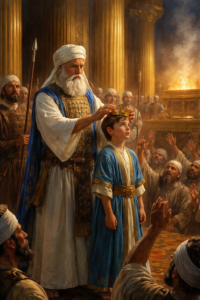 This chapter records one of the most critical preservation moments in redemptive history. After the death of King Ahaziah of Judah, Athaliah, his mother, wickedly usurps the throne and attempts to destroy all the royal seed. Her aim is to extinguish the Davidic line, through which God promised the Messiah would come (cf. 2 Samuel 7).
God intervenes quietly but powerfully. Jehosheba, sister of Ahaziah and wife of Jehoiada the priest, hides the infant Joash in the house of the LORD for six years. During Athaliah’s reign, Judah experiences apostasy and Baal worship.
In the seventh year, Jehoiada orchestrates a covenant-centered restoration. Joash is crowned king in the temple precincts, guarded by faithful Levites and captains. The people rejoice, crying, “God save the king.” Athaliah is executed outside the temple, preserving its sanctity.
Jehoiada then leads the nation in a threefold covenant: between the LORD, the king, and the people. Baal worship is destroyed, and proper temple worship is restored. This chapter highlights God’s faithfulness to His covenant promises despite satanic opposition.
2 Kings 12 — Early Faithfulness and Later Decline of Joash
Joash reigns forty years in Judah and does right in the sight of the LORD “all his days wherein Jehoiada the priest instructed him.” However, the high places remain, revealing incomplete reform.
A major focus is the repair of the temple, which had been neglected under Athaliah’s influence. After initial administrative failure, a chest system is instituted to handle freewill offerings honestly. The funds are used faithfully for repairs, showing integrity in stewardship.
Later in Joash’s reign, spiritual weakness appears. When Hazael king of Syria threatens Jerusalem, Joash buys him off with treasures from the temple. This compromise reflects declining faith and dependence on worldly solutions rather than the LORD.
2 Kings 13 — God’s Mercy to a Spiritually Weak Israel
This chapter shifts focus to the northern kingdom of Israel under Jehoahaz and Jehoash (Joash of Israel), both of whom continue in the sins of Jeroboam.
Because of persistent idolatry, the LORD allows severe oppression by Syria. Israel is reduced to a pitiful military force. Yet, when Jehoahaz seeks the LORD, God graciously provides a deliverer—not because of Israel’s righteousness, but because of His compassion and covenant mercy.
A moving scene occurs with the prophet Elisha on his deathbed. King Joash visits him, weeping. Elisha instructs him in a symbolic act involving arrows, representing victories over Syria. Joash’s half-hearted obedience results in only partial victory, illustrating the cost of limited faith.
Elisha’s death does not diminish God’s power. Even after burial, a dead man revived upon touching Elisha’s bones—testifying that the LORD’s power transcends human instruments.
Key People and Places
- Athaliah — Usurping queen of Judah; Baal worshiper who sought to destroy David’s line
- Joash (King of Judah) — Preserved child king; faithful under godly influence, later compromised
- Jehoiada the Priest — Godly leader who restored covenant worship and rightful monarchy
- Jehosheba — Courageous woman used by God to preserve the Davidic heir
- Jehoahaz (King of Israel) — Idolatrous king who cried to the LORD in oppression
- Jehoash (King of Israel) — Weak faith; limited obedience brought limited victory
- Elisha — Prophet of God; instrument of divine power even in death
- Jerusalem — Center of Davidic rule and temple worship
- House of the LORD — Place of refuge, covenant renewal, and true worship
Main Doctrinal or Spiritual Themes
- God’s Covenant Faithfulness — The Davidic line is preserved despite satanic opposition
- The Power of Godly Leadership — Jehoiada’s influence demonstrates the importance of righteous mentors
- Incomplete Obedience — Partial faith results in partial blessing
- Divine Mercy — God delivers Israel despite their continued idolatry
- Separation from False Worship — Baal worship must be destroyed for true revival
- God’s Power Beyond the Messenger — Elisha’s ministry testifies to God’s enduring power
Practical Applications or Lessons
- God is always at work preserving His promises, even when evil appears dominant
- Spiritual success often depends on continued obedience, not a strong beginning alone
- Godly counsel and accountability are vital, especially for leaders
- Compromise with the world weakens testimony and invites judgment
- Crying to the LORD in humility invites mercy, even after failure
- Half-hearted obedience limits spiritual victory
- True revival requires removing false worship, not merely adding religious activity
Comments are closed