Chapter Summaries
1 Samuel 21 — David at Nob and Gath
David flees from Saul and arrives at Nob, where Ahimelech the priest trembles to see him alone (21:1). David conceals the truth and asks for bread; the priest gives him the hallowed bread, the shewbread, according to Levitical allowance in cases of necessity (21:4–6). This moment displays God’s mercy in human extremity and the weight of priestly discretion.
David receives Goliath’s sword (21:9), a reminder of God’s past deliverance.
A dangerous detail is recorded: Doeg the Edomite is there (21:7). His presence foreshadows tragedy.
David then flees to Gath, to Achish. His fame causes fear, and to escape he feigns madness (21:13). Instead of trusting in his own strength, David humbles himself dramatically, illustrating God’s preservation of His anointed even in desperate circumstances.
1 Samuel 22 — The Cave of Adullam and the Slaughter of the Priests
David retreats to the cave of Adullam (22:1). God gathers to him “every one that was in distress… in debt… discontented” (22:2), forming the core of his future loyal men. This shows God’s ability to build strength from the weak and outcast.
David moves his family to Mizpeh of Moab for safety (22:3–4). A prophet, Gad, instructs David to leave hiding and return to Judah (22:5). David obeys immediately—an important contrast to Saul.
Meanwhile, Saul descends further into paranoia. Doeg accuses Ahimelech (22:9–10). Though the priests are innocent, Saul orders their death. His own servants refuse, but Doeg performs the slaughter (22:18), killing 85 priests and then the entire city of Nob. This shocking wickedness reveals Saul’s spiritual blindness and hardened heart toward God.
Only Abiathar, son of Ahimelech, escapes and joins David (22:20–23). David immediately accepts responsibility and becomes protector of the remaining priestly line.
1 Samuel 23 — David Saves Keilah, Saul Pursues, and Jonathan Strengthens David
David learns the Philistines attack Keilah, and he inquires of the LORD (23:2). God directs him to save them, and David obeys despite danger. After victory, Saul plots to trap David inside the walled town (23:7).
David again seeks the LORD using Abiathar’s ephod (23:9–12). God reveals the heart of the people and the intentions of Saul. David departs Keilah before the trap closes.
David hides in the wilderness of Ziph. Here Jonathan visits him and “strengthened his hand in God” (23:16), reminding David of God’s promise and encouraging faithfulness. Their covenant is renewed.
The Ziphites betray David (23:19), leading to a near capture at the “rock of divisions” (23:28). At the final moment, news of a Philistine invasion forces Saul to withdraw. God’s providence clearly protects David.
1 Samuel 24 — David Spares Saul in the Cave
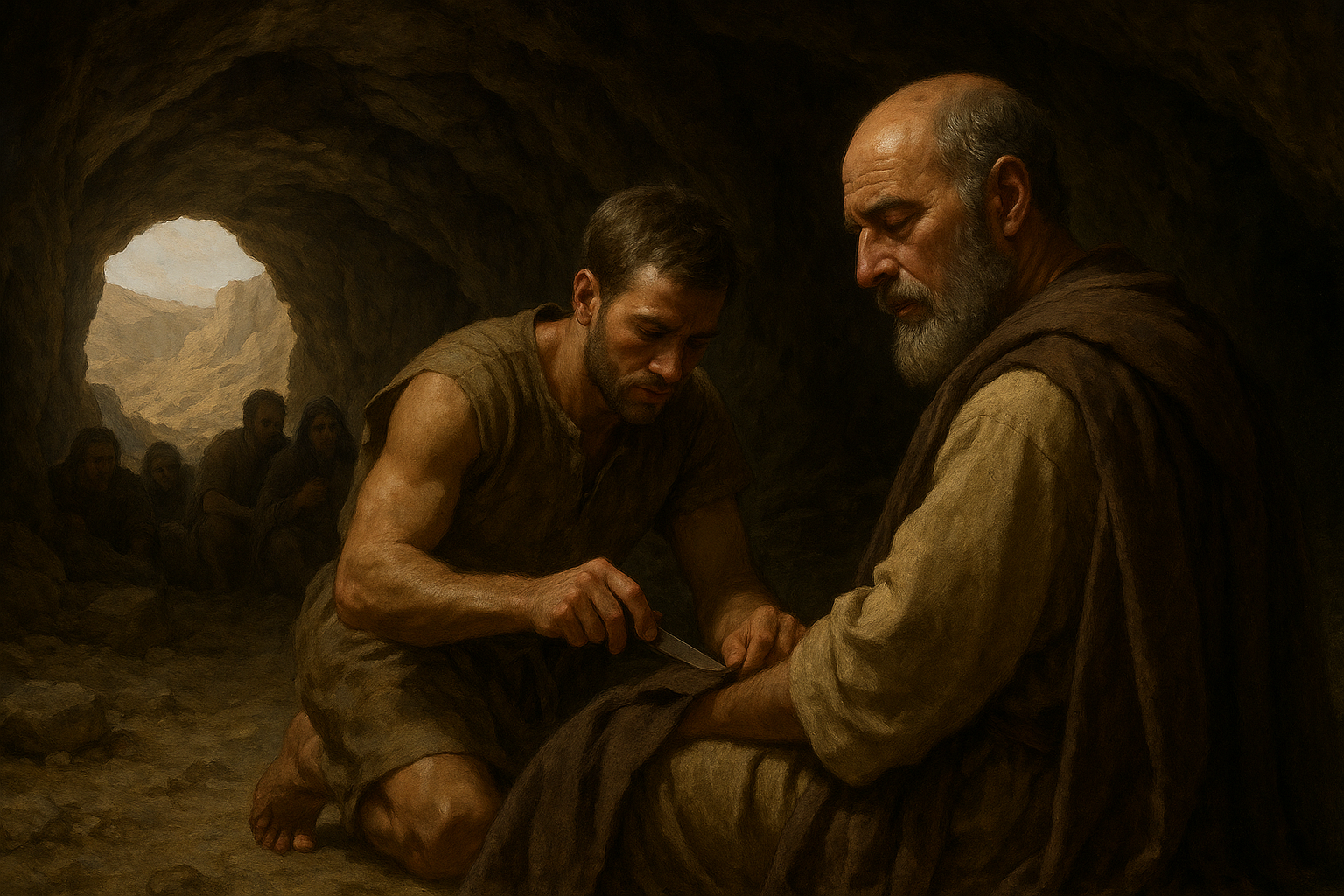
 Saul again hunts David in the wilderness of Engedi. Unknowingly, Saul enters a cave where David and his men are hiding. David’s men urge him to kill Saul (24:4), but David refuses to stretch out his hand “against the LORD’s anointed.”
David only cuts off part of Saul’s robe, but even that brings conviction (24:5). When Saul leaves, David presents the piece of the robe and pleads his innocence with humility and reverence for God’s authority (24:8–15).
Saul weeps and temporarily acknowledges David’s righteousness (24:16–20), yet his repentance is short-lived. David does not trust Saul’s emotional swings; he returns to his stronghold despite Saul’s promises.
This chapter reveals David’s spiritual integrity, his patient faith, and his refusal to grasp the kingdom by force.
Key People and Places
-
David — The anointed but not yet reigning king, walking by faith, not seizing power by fleshly means.
-
Saul — A king in spiritual decline, hardened by jealousy, fear, and disobedience.
-
Ahimelech — Priest of Nob, innocent victim of Saul’s rage.
-
Doeg the Edomite — A treacherous servant of Saul; his massacre illustrates the danger of evil ambition.
-
Abiathar — The surviving priest who brings the ephod to David.
-
Jonathan — Saul’s son, godly friend who strengthens David in the LORD.
-
Achish of Gath — Philistine ruler before whom David pretends madness.
-
Nob, Adullam, Mizpah, Keilah, Ziph, Engedi — Key locations showing David’s flight, God’s protection, and Saul’s pursuit.
Main Doctrinal or Spiritual Themes
1. God Preserves His Anointed
Despite danger, betrayal, and Saul’s rage, the LORD continually delivers David (21:10; 23:14; 23:28).
2. The Sinfulness of Human Jealousy
Saul’s jealousy evolves into full rebellion against God and unjust slaughter of His priests.
3. The Sanctity of God’s Authority Structure
David refuses to harm Saul, teaching that authority is God-given and must not be usurped through sinful means.
4. God Uses the Lowly and Broken
The distressed men at Adullam (22:2) become the foundation of David’s kingdom—an Old Testament picture of God using the humble.
5. The Importance of Seeking the LORD
David repeatedly inquires of God (23:2, 4, 10–12). Saul never does.
6. Providence Overrides Human Intent
The timely Philistine invasion (23:27) reveals God’s invisible hand directing events.
Practical Applications
1. Trust God in Times of Pressure
David’s life shows that fear must not override faith; God sustains His people through trials.
2. Spiritual Leadership Requires Restraint
Like David sparing Saul, Christians must refuse fleshly shortcuts and honor God’s order.
3. Beware a Hardened Heart
Saul illustrates how jealousy, pride, and disobedience can lead a person into destructive sin.
4. God Sees and Rewards Faithfulness
David’s obedience, humility, and mercy show what God honors in His servants.
5. Seek God Before Acting
Believers should imitate David’s discipline of asking God for direction through His Word and prayer.
Comments are closed