CHAPTER SUMMARIES
 1 Samuel 14 — Jonathan’s Courage and Saul’s Failings
Israel remains in a weakened state, with the Philistines militarily dominant (vv. 1–5). Saul lingers under a pomegranate tree at Migron, seemingly passive, while Jonathan acts in faith. Jonathan tells his armor-bearer, “there is no restraint to the LORD to save by many or by few” (v. 6), expressing bold confidence in God rather than numbers.
They climb the rocky passes of Bozez and Seneh, strike the Philistines, and the Lord causes an earthquake that throws the enemy into confusion (vv. 13–15). The Philistines turn their swords on each other, showing divine intervention. Saul finally joins the battle, and the victory grows.
Yet Saul mars the day with a rash oath: “Cursed be the man that eateth any food until evening” (v. 24). This unnecessary command weakens the troops and reflects Saul’s increasing tendency toward fleshly leadership rather than spiritual discernment.
Jonathan, unaware of the oath, eats honey and is strengthened (vv. 27–30). When the soldiers, faint with hunger, later slaughter animals improperly, Saul blames the people—though the root cause is his own foolishness (vv. 32–35).
Saul even proposes killing Jonathan for violating the oath. The people courageously intervene, declaring Jonathan has wrought salvation in Israel (vv. 43–45). This event reveals the widening contrast between Saul’s unstable leadership and Jonathan’s godly character.
1 Samuel 15 — Saul’s Rebellion and Rejection
God commands Saul to execute judgment on the Amalekites for their ancient hostility against Israel (vv. 1–3; cf. Exod. 17:8–16). The command is explicit: destroy Amalek “utterly.” This is not cruelty but divine justice on a nation long hardened against God.
Saul gathers the troops, warns the Kenites to flee, and defeats Amalek (vv. 4–7). However, he spares King Agag and the best sheep and cattle, directly contradicting God’s command (v. 9). Saul’s selective obedience is exposed as disobedience.
The Lord tells Samuel, “It repenteth me that I have set up Saul to be king” (v. 11), expressing God’s holy grief over Saul’s rebellion—not a change in God’s eternal nature, but sorrow over sin.
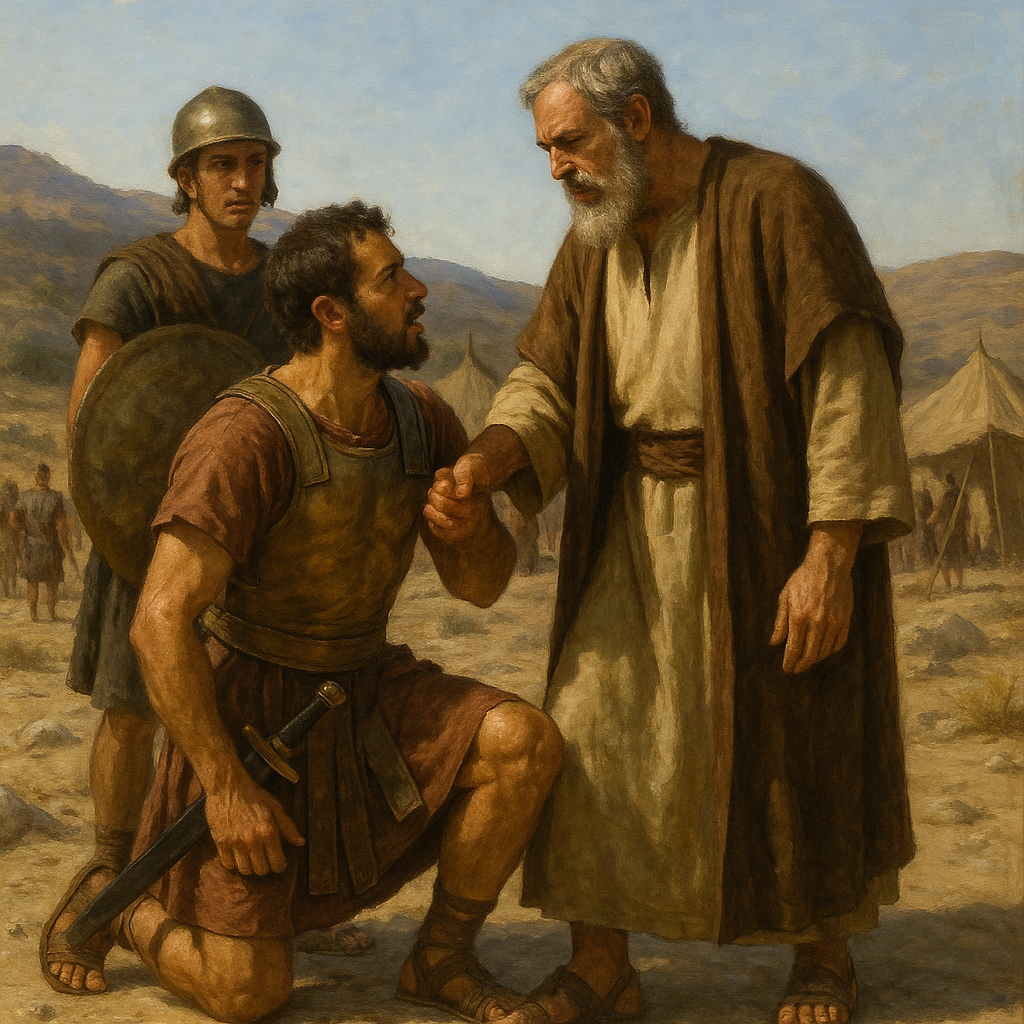
Samuel confronts Saul, who immediately denies wrongdoing: “I have performed the commandment of the LORD” (v. 13). Samuel replies with the famous question, “What meaneth then this bleating of the sheep…?” (v. 14). Saul blames “the people”—a recurring pattern of evasion and pride.
Samuel declares the central truth of the chapter:
“To obey is better than sacrifice, and to hearken than the fat of rams.” (v. 22)
Rebellion is compared to witchcraft; stubbornness to idolatry (v. 23). Saul’s outward piety cannot cover his disobedience. Samuel announces God has rejected him as king.
Saul pleads for honor before the people rather than true repentance before God (v. 30), revealing a heart more concerned with appearances than holiness.
Samuel executes Agag himself, completing the Lord’s judgment (v. 33). The chapter closes somberly: Samuel and Saul part ways, and Samuel mourns for Saul (vv. 34–35).
KEY PEOPLE AND PLACES
People
-
Jonathan — Saul’s son; a man of courage, faith, and spiritual clarity.
-
Saul — Israel’s first king; increasingly unstable, proud, and disobedient.
-
Samuel — God’s prophet; faithful, uncompromising, grieving over Saul’s failure.
-
Agag — Amalekite king spared by Saul but executed by Samuel.
-
Armor-bearer — Loyal companion to Jonathan; displays shared faith and courage.
Places
-
Migron — Where Saul waited beneath the pomegranate tree.
-
Bozez and Seneh — Sharp rocky crags Jonathan climbed in faith.
-
Gibeah/Geba — Saul’s base of operations.
-
Amalek — The land of a long-standing enemy of Israel; the site of Saul’s incomplete obedience.
MAIN DOCTRINAL OR SPIRITUAL THEMES
1. Faith vs. Fleshly Leadership
Jonathan’s faith (“no restraint to the LORD”) stands in stark contrast to Saul’s passivity and rashness. True leadership trusts God, not numbers, emotions, or human reasoning.
2. The Necessity of Complete Obedience
Partial obedience is disobedience. Saul’s error was not ignorance but selective submission to God’s Word.
3. God’s Holiness in Judgment
The destruction of Amalek was righteous judgment from a holy God. God’s justice is never arbitrary; it fulfills His promises and protects His people.
4. The Danger of Pride
Saul refused to accept responsibility, blamed others, and sought honor from the people over obedience to God.
5. Obedience Is Better Than Sacrifice
God values a submissive heart more than ritual or outward religious acts. Genuine obedience flows from love and reverence.
PRACTICAL APPLICATIONS FOR BELIEVERS TODAY
1. Trust God Even When Odds Look Impossible
Jonathan teaches that God can work “by many or by few.” Believers must act in faith, not fear.
2. Avoid Rash Decisions
Saul’s oath caused unnecessary hardship. Hasty, emotional decisions—even with good intentions—can bring spiritual damage.
3. Take Responsibility for Your Choices
Saul’s excuses were part of his downfall. A believer must confess sin honestly rather than blame others.
4. Do Not Practice Partial Obedience
Ignoring part of Scripture while obeying other parts is rebellion. The Lord requires full surrender, not selective compliance.
5. Holiness Must Matter More Than Public Image
Saul wanted Samuel to “honour” him before the people. God desires purity of heart, not the preservation of reputation.
Comments are closed