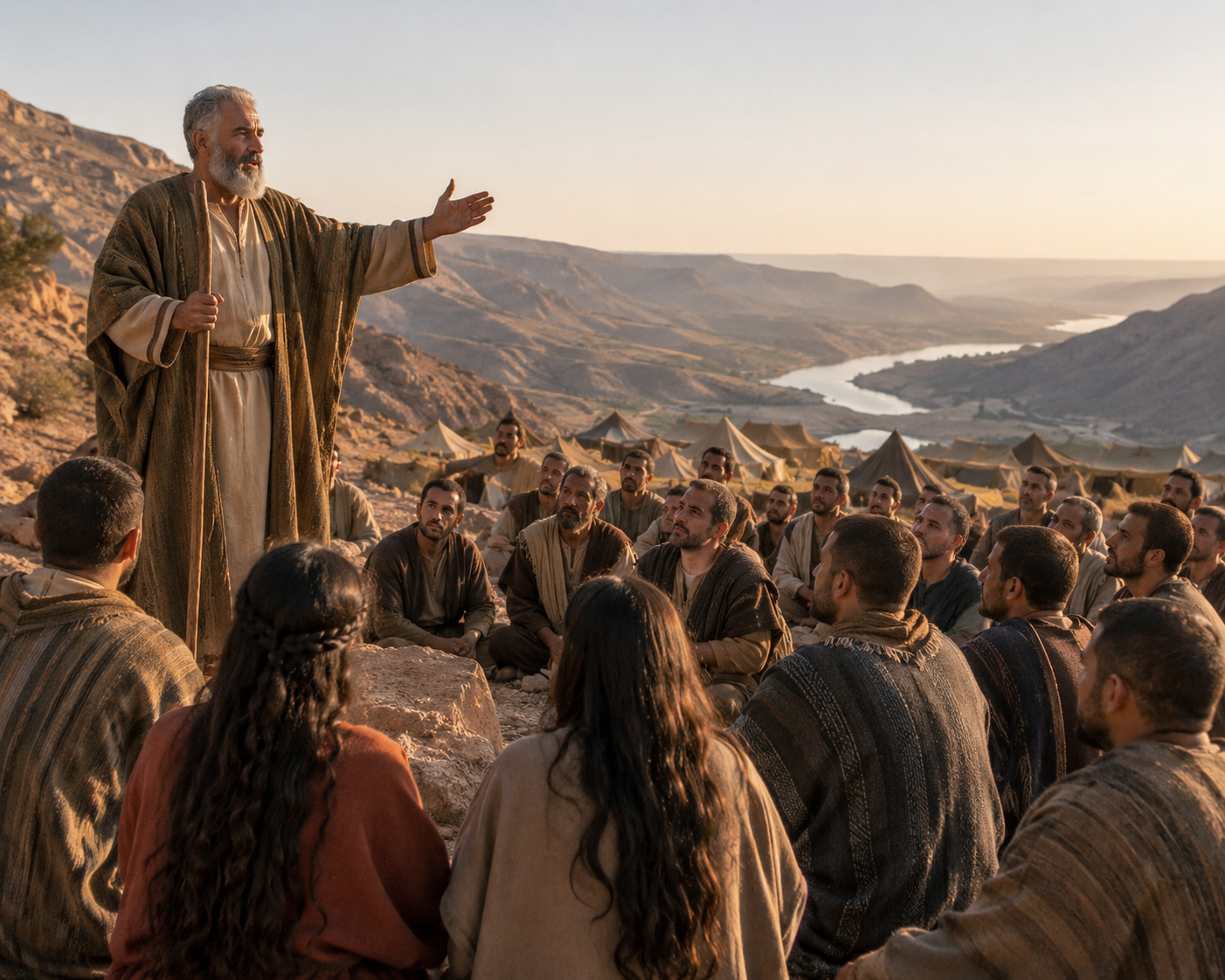
 Deuteronomy 1–2 opens Moses’ final great address to Israel before their entrance into the land which the LORD had promised to give them. The setting is explicitly given: it is “in the fortieth year, in the eleventh month, on the first day of the month” (Deuteronomy 1:3), and Moses is speaking “on this side Jordan, in the land of Moab” (Deuteronomy 1:5).
These chapters look backward over Israel’s failure at Kadesh-barnea and then trace the LORD’s direction of Israel through the wilderness toward the territory of Sihon. The dominant lessons are unmistakable: God keeps His word, unbelief produces loss, obedience must govern God’s people, and the LORD remains sovereign over nations, boundaries, battles, and inheritances.
Chapter Summaries
Deuteronomy 1 — Remembering Israel’s Unbelief and Rebellion
1. Moses begins to declare the law
Deuteronomy 1:1–5
Moses addresses Israel after the victories over Sihon king of the Amorites and Og king of Bashan are mentioned as part of the historical setting (Deuteronomy 1:4). Verse 5 states:
“On this side Jordan, in the land of Moab, began Moses to declare this law, saying,”
Moses is not presenting his own philosophy. Deuteronomy 1:3 says that he spoke:
“according unto all that the LORD had given him in commandment unto them;”
The authority behind Moses’ message is therefore the commandment of the LORD.
2. Israel had remained at Horeb long enough
Deuteronomy 1:6–8
The LORD said:
“Ye have dwelt long enough in this mount:”
— Deuteronomy 1:6
God commanded Israel to move toward the land promised to Abraham, Isaac, Jacob, and their seed.
Verse 8 says:
“Behold, I have set the land before you: go in and possess the land which the LORD sware unto your fathers, Abraham, Isaac, and Jacob, to give unto them and to their seed after them.”
This is a literal national and territorial promise to Israel. The plain wording concerns the descendants of Abraham, Isaac, and Jacob and the land God promised them. It should not be allegorically transferred to the New Testament church.
3. Moses recalls the appointment of rulers and judges
Deuteronomy 1:9–18
Israel had become so numerous that Moses could not personally bear every matter alone. Men described as “wise men, and understanding, and known among your tribes” were appointed as rulers (1:13–15).
The judges were commanded:
“Hear the causes between your brethren, and judge righteously between every man and his brother, and the stranger that is with him.”
— Deuteronomy 1:16
They were also told:
“Ye shall not respect persons in judgment; but ye shall hear the small as well as the great; ye shall not be afraid of the face of man; for the judgment is God’s:”
— Deuteronomy 1:17
This establishes a clear biblical principle of impartial judgment under God.
4. Israel comes to Kadesh-barnea
Deuteronomy 1:19–21
After traveling through the wilderness, Israel reached the mountain of the Amorites.
Moses reminded them:
“Behold, the LORD thy God hath set the land before thee: go up and possess it, as the LORD God of thy fathers hath said unto thee; fear not, neither be discouraged.”
— Deuteronomy 1:21
God’s command was clear. Israel’s problem was not a lack of divine direction.
5. Men search the land
Deuteronomy 1:22–25
The people proposed sending men ahead to search the land and report concerning the way and the cities. Moses says:
“And the saying pleased me well:”
— Deuteronomy 1:23
Twelve men went into the land, took fruit from it, and returned with this report:
“It is a good land which the LORD our God doth give us.”
— Deuteronomy 1:25
The goodness of the land was confirmed.
6. Israel refuses to enter
Deuteronomy 1:26–33
In spite of God’s command and the favorable report concerning the land, Israel rebelled.
Moses says:
“Notwithstanding ye would not go up, but rebelled against the commandment of the LORD your God:”
— Deuteronomy 1:26
Their fear centered upon the strength of the inhabitants, their cities, and the sons of the Anakims (1:28).
Moses reminded them that the LORD would fight for them and recalled God’s care in the wilderness:
“And in the wilderness, where thou hast seen how that the LORD thy God bare thee, as a man doth bear his son, in all the way that ye went, until ye came into this place.”
— Deuteronomy 1:31
Yet the central spiritual diagnosis is given in verse 32:
“Yet in this thing ye did not believe the LORD your God,”
Their rebellion was fundamentally connected with unbelief.
The passage itself speaks directly of God’s care for Israel. Applying this principle to God’s care for believers is legitimate when supported by other Scripture, but Deuteronomy 1:31 itself is specifically describing the LORD’s dealings with Israel.
7. Judgment upon the unbelieving generation
Deuteronomy 1:34–40
The LORD heard Israel’s words and was angry.
Concerning that generation He said:
“Surely there shall not one of these men of this evil generation see that good land, which I sware to give unto your fathers,”
— Deuteronomy 1:35
Caleb was specifically excepted:
“Save Caleb the son of Jephunneh; he shall see it, and to him will I give the land that he hath trodden upon, and to his children, because he hath wholly followed the LORD.”
— Deuteronomy 1:36
Joshua was also appointed to enter and to lead Israel into possession of the land (1:38).
Moses states in verse 37:
“Also the LORD was angry with me for your sakes, saying, Thou also shalt not go in thither.”
This verse should not be made to say more than it says. Elsewhere, Numbers 20:12 explicitly records the LORD’s judgment upon Moses and Aaron after Moses struck the rock:
“Because ye believed me not, to sanctify me in the eyes of the children of Israel, therefore ye shall not bring this congregation into the land which I have given them.”
Thus Israel’s rebellion and Moses’ exclusion should not be confused as though Deuteronomy 1:37 supplies the complete explanation by itself.
8. Israel presumptuously attempts battle
Deuteronomy 1:41–46
After refusing to obey when God told them to enter, the people reversed themselves and said:
“We have sinned against the LORD, we will go up and fight, according to all that the LORD our God commanded us.”
— Deuteronomy 1:41
But God now commanded them not to go:
“Go not up, neither fight; for I am not among you; lest ye be smitten before your enemies.”
— Deuteronomy 1:42
They nevertheless went presumptuously into the hill.
The Amorites defeated them and chased them “as bees do” (1:44).
This demonstrates an important truth: merely performing an action that God previously commanded does not constitute obedience when one is acting contrary to God’s present command. Their first sin was refusing to go; their next act of disobedience was going when God told them not to go.
Deuteronomy 2 — God Directs Israel Around Certain Nations and Gives Victory Over Sihon
1. Israel journeys around Mount Seir
Deuteronomy 2:1–3
Israel traveled in the wilderness around Mount Seir until the LORD said:
“Ye have compassed this mountain long enough: turn you northward.”
— Deuteronomy 2:3
Their movements were not to be determined merely by convenience. The LORD directed their journey.
2. Israel is forbidden to seize Edom
Deuteronomy 2:4–8
The children of Esau dwelling in Seir were to be treated carefully.
God commanded:
“Meddle not with them; for I will not give you of their land, no, not so much as a foot breadth; because I have given mount Seir unto Esau for a possession.”
— Deuteronomy 2:5
Israel was even commanded to buy food and water from them (2:6).
This establishes that Israel was not simply authorized to conquer whatever territory it desired. God Himself determined where Israel could and could not go.
Verse 7 also gives a remarkable summary of God’s provision:
“For the LORD thy God hath blessed thee in all the works of thy hand: he knoweth thy walking through this great wilderness: these forty years the LORD thy God hath been with thee; thou hast lacked nothing.”
3. Israel is forbidden to attack Moab
Deuteronomy 2:8–12
When Israel approached Moab, the LORD commanded:
“Distress not the Moabites, neither contend with them in battle:”
— Deuteronomy 2:9
The reason given is explicit:
“for I will not give thee of their land for a possession; because I have given Ar unto the children of Lot for a possession.”
The chapter also mentions the Emims, described as:
“A people great, and many, and tall, as the Anakims;”
— Deuteronomy 2:10
Verse 12 similarly records that the Horims formerly dwelt in Seir and that the children of Esau succeeded them.
The text demonstrates God’s sovereignty over national territories and historical possessions without requiring speculation about matters the passage does not explain.
4. Thirty-eight years from Kadesh-barnea to Zered
Deuteronomy 2:13–16
The people crossed the brook Zered.
Moses gives a precise chronological statement:
“And the space in which we came from Kadeshbarnea, until we were come over the brook Zered, was thirty and eight years; until all the generation of the men of war were wasted out from among the host, as the LORD sware unto them.”
— Deuteronomy 2:14
Verse 15 adds:
“For indeed the hand of the LORD was against them, to destroy them from among the host, until they were consumed.”
The judgment pronounced following the rebellion at Kadesh-barnea was carried out.
5. Israel is forbidden to attack Ammon
Deuteronomy 2:17–23
When Israel came near the children of Ammon, God again established a boundary:
“Distress them not, nor meddle with them: for I will not give thee of the land of the children of Ammon any possession; because I have given it unto the children of Lot for a possession.”
— Deuteronomy 2:19
The Zamzummims are also mentioned as former inhabitants, described as a people:
“great, and many, and tall, as the Anakims;”
— Deuteronomy 2:21
The passage records that the LORD destroyed them before the children of Ammon.
Once again, Scripture presents God as governing the rise, removal, and territorial possession of peoples.
6. God commands Israel to confront Sihon
Deuteronomy 2:24–25
The instructions now change dramatically.
Concerning Sihon the Amorite, king of Heshbon, God says:
“Rise ye up, take your journey, and pass over the river Arnon: behold, I have given into thine hand Sihon the Amorite, king of Heshbon, and his land: begin to possess it, and contend with him in battle.”
— Deuteronomy 2:24
Israel had been forbidden to take Edom, Moab, or Ammon. Sihon’s territory, however, was explicitly given into Israel’s hand.
This distinction is crucial: Israel’s warfare in this passage is not presented as unrestricted human aggression. The narrative repeatedly records specific divine prohibitions and specific divine authorization.
7. Moses first sends words of peace
Deuteronomy 2:26–29
Moses sent messengers from the wilderness of Kedemoth to Sihon:
“with words of peace,”
— Deuteronomy 2:26
Israel requested permission to pass through the land, promising to remain on the highway and to purchase food and water.
This detail prevents the passage from being misrepresented as though Israel attacked Sihon without any preceding request for peaceful passage.
8. Sihon refuses passage
Deuteronomy 2:30
Sihon would not permit Israel to pass.
The text explicitly states:
“But Sihon king of Heshbon would not let us pass by him: for the LORD thy God hardened his spirit, and made his heart obstinate, that he might deliver him into thy hand, as appeareth this day.”
This statement should be allowed to stand exactly as Scripture gives it.
The passage explicitly attributes the hardening of Sihon’s spirit and obstinacy of heart to the LORD in connection with delivering Sihon into Israel’s hand. The text does not discuss regeneration, saving faith, or the Calvinistic doctrine of unconditional election. Those theological ideas should therefore not be imported into this verse.
9. God delivers Sihon to Israel
Deuteronomy 2:31–37
The LORD said:
“Behold, I have begun to give Sihon and his land before thee: begin to possess, that thou mayest inherit his land.”
— Deuteronomy 2:31
Sihon came against Israel at Jahaz.
Verse 33 states plainly:
“And the LORD our God delivered him before us; and we smote him, and his sons, and all his people.”
Israel took Sihon’s cities and territory.
Yet one boundary remained explicit:
“Only unto the land of the children of Ammon thou camest not…”
— Deuteronomy 2:37
The victory did not cancel God’s earlier restrictions. Israel was still responsible to respect the boundaries the LORD had established.
Key People and Places
Moses
The servant of God who delivers this address and recounts Israel’s journey, rebellion, judgment, and victories. He repeatedly emphasizes what “the LORD our God” commanded and performed.
The LORD
The central Person throughout both chapters. He commands Israel’s movements, judges unbelief, provides for His people, determines national possessions, prohibits certain conflicts, and grants victory where He chooses.
Israel
The nation descended from Abraham, Isaac, and Jacob. These chapters recount both Israel’s failure through unbelief and God’s continued direction of the nation.
Abraham, Isaac, and Jacob
The patriarchs to whom God had sworn concerning the land (Deuteronomy 1:8).
Caleb the son of Jephunneh
Explicitly commended because:
“he hath wholly followed the LORD.”
— Deuteronomy 1:36
Joshua the son of Nun
Commanded to be encouraged because he would cause Israel to inherit the land (Deuteronomy 1:38).
The Anakims
People whose presence contributed to Israel’s fear at Kadesh-barnea (Deuteronomy 1:28).
Esau
The LORD says that Mount Seir had been given to Esau for a possession (Deuteronomy 2:5).
The children of Lot
Moab and Ammon are both connected with the children of Lot, and their territorial possessions are specifically protected from Israel in this passage (Deuteronomy 2:9, 19).
Sihon
The Amorite king of Heshbon who refused Israel passage and came against Israel in battle. The LORD delivered him into Israel’s hand.
Og
King of Bashan, mentioned in Deuteronomy 1:4 as part of the historical setting after his defeat. The fuller account follows in Deuteronomy 3.
Horeb
The mountain from which God commanded Israel to resume its journey (Deuteronomy 1:6).
Kadesh-barnea
The location associated with Israel’s refusal to enter the promised land (Deuteronomy 1:19; 2:14).
Mount Seir
The territory associated with Esau’s descendants.
Edom
The territory of the children of Esau, which Israel was forbidden to seize.
Moab
Territory Israel was forbidden to attack; Moses gives his address in the land of Moab.
Ar
A possession God says He had given to the children of Lot in connection with Moab (Deuteronomy 2:9).
Ammon
Territory belonging to the children of Ammon which Israel was forbidden to seize.
Brook Zered
A significant point in Israel’s journey. Deuteronomy 2:14 measures thirty-eight years from Kadesh-barnea until crossing it.
River Arnon
The boundary Israel was commanded to cross as the confrontation with Sihon began.
Heshbon
The kingdom and city associated with Sihon.
Kedemoth
The wilderness location from which Moses sent messengers to Sihon “with words of peace” (Deuteronomy 2:26).
Jahaz
The place where Sihon came out against Israel to battle (Deuteronomy 2:32).
Main Doctrinal or Spiritual Themes
1. The authority of God’s Word
Moses spoke “according unto all that the LORD had given him in commandment” (1:3).
The repeated issue in these chapters is not whether Israel understood God’s command. In several instances the command was plain. The issue was whether Israel would believe and obey it.
Biblical faith submits to what God has spoken.
2. Unbelief leads to disobedience
Deuteronomy 1 gives God’s own diagnosis:
“Yet in this thing ye did not believe the LORD your God,”
— Deuteronomy 1:32
Their unbelief manifested itself in rebellion:
“ye would not go up, but rebelled against the commandment of the LORD your God:”
— Deuteronomy 1:26
Faith and obedience are distinguishable, but genuine confidence in God’s word ought to produce obedience to His revealed will.
This does not mean obedience earns salvation. Salvation is by grace through faith apart from works. Rather, obedience is the proper response of those who believe God.
3. Fear must not override God’s Word
Israel saw fortified cities and formidable inhabitants. Those difficulties were real; Scripture does not deny them.
But Israel allowed what they saw to outweigh what God had said.
Moses had told them:
“fear not, neither be discouraged.”
— Deuteronomy 1:21
Biblical courage is not pretending opposition does not exist. It is believing God in the presence of opposition.
4. Presumption is not faith
Israel first refused God’s command to enter the land. Then, after judgment was pronounced, they attempted to enter when God said not to go.
They said:
“We have sinned against the LORD, we will go up and fight…”
— Deuteronomy 1:41
But God answered:
“Go not up, neither fight; for I am not among you;”
— Deuteronomy 1:42
Religious activity does not become obedience merely because it appears courageous or zealous. Obedience means doing what God says.
5. God judges rebellion
The wilderness years were not presented merely as unfortunate circumstances.
Deuteronomy 2:15 says:
“the hand of the LORD was against them, to destroy them from among the host, until they were consumed.”
God is holy. Persistent unbelief and rebellion are serious matters before Him.
6. God honors wholehearted obedience
Caleb receives one of the strongest commendations in the chapters:
“because he hath wholly followed the LORD.”
— Deuteronomy 1:36
The emphasis is not upon Caleb’s natural ability but upon his response toward the LORD.
Wholehearted faithfulness remains a worthy pattern for God’s people.
7. God’s faithfulness continues despite human failure
Israel failed badly at Kadesh-barnea, yet God’s purpose concerning the nation and the land had not been abandoned.
By Deuteronomy 2 God is again directing Israel toward the place He intends them to possess.
Human failure does not overturn God’s faithfulness.
8. God provides for His people
Moses says:
“these forty years the LORD thy God hath been with thee; thou hast lacked nothing.”
— Deuteronomy 2:7
This statement concerns God’s historical provision for Israel in the wilderness.
It also displays the character of God as faithful to provide according to His will.
9. God is sovereign over nations and boundaries
The LORD says that He had given:
- Mount Seir to Esau — Deuteronomy 2:5
- Ar to the children of Lot — Deuteronomy 2:9
- territory to the children of Ammon — Deuteronomy 2:19
- Sihon and his land into Israel’s hand — Deuteronomy 2:24
The chapter presents national boundaries and possessions as ultimately under God’s authority.
This does not authorize believers or modern nations to imitate Israel’s conquest. Israel’s commands here were specific divine commands connected with God’s dealings with that nation.
10. Israel and the Church must remain distinct
The land promise of Deuteronomy 1:8 is explicitly connected with:
“your fathers, Abraham, Isaac, and Jacob”
and:
“their seed after them.”
Nothing in these chapters identifies the church as replacing Israel or converts Israel’s promised territory into a merely spiritual symbol.
A plain, grammatical reading preserves the distinction between Israel’s national promises and God’s program for the New Testament church.
11. God’s sovereignty never removes man’s responsibility
Sihon’s hardening is explicitly attributed to God in Deuteronomy 2:30. Yet the chapter also records Sihon’s actual refusal to allow Israel passage.
Scripture records both divine sovereignty and human action without suggesting that one cancels the other.
The passage should not be used to teach Calvinistic regeneration or unconditional election, because those matters are not being discussed in the context.
Practical Applications or Lessons
Believe what God has said
Israel’s great failure was summarized by the words:
“ye did not believe the LORD your God.”
A believer should never allow circumstances, numbers, opposition, or fear to become more authoritative than God’s written Word.
Obey while obedience is required
Israel’s experience warns against delayed obedience.
When God commanded them to enter, they refused. When He commanded them not to enter, they went.
The lesson is not merely, “Do something for God.” The lesson is: do what God says.
Do not mistake presumption for courage
Running ahead without God’s authorization is no more spiritual than refusing to move when He commands.
Biblical faith rests upon God’s Word rather than personal determination.
Remember God’s past faithfulness
Moses repeatedly caused Israel to look backward.
They had seen God lead them, carry them, provide for them, and fight for them.
Remembering God’s demonstrated faithfulness strengthens confidence in His Word.
Fear of man can produce rebellion against God
Israel focused upon:
- stronger people,
- fortified cities,
- physical stature,
- and intimidating opposition.
Their observations may have described genuine dangers, but those dangers did not nullify God’s promise.
Believers likewise must not permit fear of men to replace fear of God.
God expects impartial judgment
Deuteronomy 1:17 declares:
“Ye shall not respect persons in judgment;”
Leadership, pastoral judgment, church discipline, and personal dealings should be governed by truth rather than wealth, influence, friendship, intimidation, or popularity.
Follow the LORD wholly
Caleb’s testimony is brief but powerful:
“he hath wholly followed the LORD.”
A divided heart will continually compromise. The biblical standard is wholehearted devotion to God.
Respect boundaries God has established
Israel could not simply take Edom, Moab, or Ammon because those lands seemed convenient.
God said, in effect, that certain territory was not theirs.
This provides a sound principle: God’s people should not attempt to obtain through fleshly ambition something God has not given them.
The specific territorial commands themselves belong to Israel’s historical situation; the broader moral lesson must not erase that original meaning.
God’s delays are not evidence of God’s failure
Thirty-eight years passed between Kadesh-barnea and the crossing of Zered (2:14).
That period fulfilled God’s judgment upon the rebellious generation. The passing of time did not mean God had forgotten His word.
God’s timetable is not defeated by human impatience.
Peace should not be confused with weakness
Before the battle with Sihon, Moses sent:
“words of peace”
— Deuteronomy 2:26
Israel’s willingness to seek peaceful passage did not contradict their later obedience when Sihon opposed them and God commanded possession.
There is no biblical virtue in unnecessary conflict.
Victory comes from the LORD
Regarding Sihon:
“the LORD our God delivered him before us;”
— Deuteronomy 2:33
Israel fought, but the text gives the LORD the decisive credit.
God’s servants should likewise resist the temptation to glorify human strength when God deserves the glory.
Overall Message of Deuteronomy 1–2
Deuteronomy 1–2 contrasts unbelief with faith, rebellion with obedience, presumption with submission, and human fear with confidence in the LORD.
Chapter 1 reminds Israel why the previous generation lost the privilege of entering the land: despite God’s promise, provision, and power, they “did not believe the LORD.”
Chapter 2 shows the LORD still directing Israel with precision. He tells them where to travel, whom not to attack, which boundaries to respect, and when battle is authorized. Edom, Moab, and Ammon were not Israel’s to take; Sihon’s land was explicitly given into their hand.
The controlling truth is therefore not merely that Israel must advance. It is that Israel must believe and obey the revealed Word of the LORD.
God’s people are safest neither standing still nor moving forward merely according to human judgment. They are safest believing what God has said and obeying what God has commanded.
Comments are closed