Chapter Summaries
Jeremiah 9
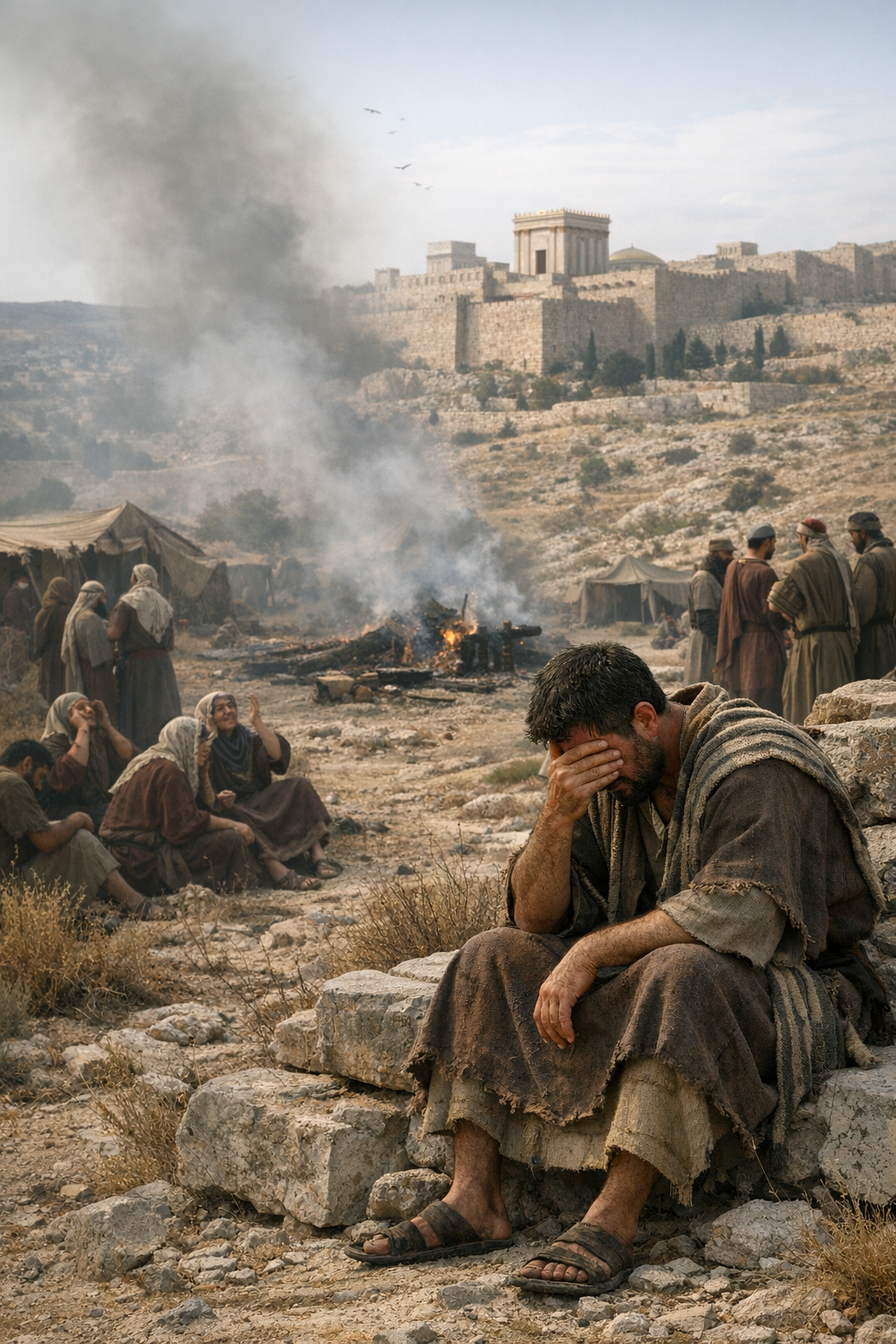
 Jeremiah 9 continues the prophet’s lament over Judah’s moral and spiritual collapse. The chapter opens with deep sorrow: “Oh that my head were waters, and mine eyes a fountain of tears” (Jer. 9:1). Jeremiah is not coldly announcing judgment; he is brokenhearted over a people destroyed by sin. This is one of the striking marks of a true man of God. He does not merely denounce wickedness; he grieves over it.
The Lord describes the people as deceitful, treacherous, and corrupt. Their tongues are compared to a bent bow ready to shoot lies (Jer. 9:3). Truth has fallen in the streets of Judah, and neighbor cannot trust neighbor. Sin is not presented here as a few isolated offenses, but as a culture of falsehood, slander, oppression, and refusal to know the Lord. The heart of the matter is found in the repeated thought that they “know not me, saith the LORD” (Jer. 9:3, 6). Their outward religious identity could not hide their inward alienation from God.
Because of this, the Lord says He will “melt them, and try them” (Jer. 9:7). Judgment is not arbitrary; it is the holy response of God to covenant-breaking sin. The land itself would bear the marks of divine chastening. Mountains would become desolate, and the habitations in the wilderness would become a place of mourning because the people had forsaken God’s law and walked after the imagination of their own heart (Jer. 9:12–14). This shows that national ruin is tied to spiritual rebellion.
The chapter also includes a call for mourning women to prepare lamentation (Jer. 9:17–20), emphasizing the certainty and severity of the coming judgment. Death would enter everywhere. Yet the chapter closes with one of the great doctrinal statements of Scripture concerning true glorying: “Let not the wise man glory in his wisdom, neither let the mighty man glory in his might, let not the rich man glory in his riches” (Jer. 9:23). Rather, the one thing worth glorying in is understanding and knowing the Lord, who exercises “lovingkindness, judgment, and righteousness, in the earth” (Jer. 9:24). This is a powerful corrective to fleshly pride. Men boast in intellect, power, and wealth, but God values a true knowledge of Himself. The final verses warn that outward circumcision without inward obedience is worthless. Judah had the sign of the covenant in the flesh, but their heart was uncircumcised (Jer. 9:25–26). This anticipates the repeated biblical truth that God desires reality, not empty form.
Jeremiah 10
Jeremiah 10 begins with a clear warning against learning “the way of the heathen” (Jer. 10:2). Judah was surrounded by pagan peoples, and there was constant pressure to adopt their fears, customs, and idolatries. The chapter strongly contrasts the vanity of idols with the majesty of the living God. The idol is cut from the forest, worked by craftsmen, adorned with silver and gold, and fastened so it cannot move (Jer. 10:3–5). It must be carried because it cannot walk; it cannot speak, do evil, or do good. This is a plain exposure of idolatry’s absurdity. Men make their gods, then bow before what their own hands have made.
By contrast, the Lord is “great, and thy name is great in might” (Jer. 10:6). He is the true King of nations. He made the earth by His power, established the world by His wisdom, and stretched out the heavens by His discretion (Jer. 10:12). The chapter presents a high view of God’s sovereignty and creative authority. He is not a tribal deity among others. He is the living God, the everlasting King, before whom the earth trembles (Jer. 10:10). This direct comparison between idols and the Lord is meant to show the foolishness of apostasy. To leave the true God for idols is not sophistication; it is spiritual insanity.
The chapter then turns back to impending judgment. Jeremiah speaks of the daughter of Zion being cast out of the land (Jer. 10:17–18). The nation would go into affliction because of its sin. Jeremiah again responds with personal grief: “Woe is me for my hurt!” (Jer. 10:19). He recognizes the blow of divine chastisement, yet he also understands the justice of God in it. The pastors, or shepherds, are especially blamed: “For the pastors are become brutish, and have not sought the LORD” (Jer. 10:21). Because leaders were spiritually foolish and prayerless, the flock was scattered. This is an important principle. When leadership departs from the Lord, the people suffer.
The chapter closes with a humble and often-quoted prayer: “O LORD, I know that the way of man is not in himself: it is not in man that walketh to direct his steps” (Jer. 10:23). This is a profound statement on human insufficiency. Man is not self-sufficient; he needs divine rule and guidance. Jeremiah asks the Lord to correct him “with judgment; not in thine anger” (Jer. 10:24). That is, he seeks measured chastening rather than consuming wrath. He also asks that God’s fury be poured upon the heathen that know Him not (Jer. 10:25). The prayer shows both reverence for God’s chastening hand and confidence that the Judge of all the earth does right.
Jeremiah 11
Jeremiah 11 centers on the broken covenant. The Lord commands Jeremiah to proclaim “the words of this covenant” (Jer. 11:2), bringing the people back to the solemn obligations given to their fathers when God brought them out of Egypt. The covenant relationship carried blessings for obedience and curses for disobedience, and Judah had violated it. The people had not listened, though God had risen early and protested unto them (Jer. 11:7). This language shows divine patience. The Lord was not sudden in judgment. He warned repeatedly, but they hardened their necks and refused to hear.
The result is that the curses of the covenant would come upon them (Jer. 11:8). A conspiracy is said to be found among the men of Judah and the inhabitants of Jerusalem (Jer. 11:9–10). This conspiracy is not merely political; it is spiritual rebellion against the Lord. They had returned to the iniquities of their forefathers and gone after other gods to serve them. Because of this, God declares that coming disaster will not be averted. Even when they cry, He will not hear them in that hour (Jer. 11:11). This is a solemn truth: persistent rebellion can bring a person or nation to the point where judgment is settled and ritual appeals will not reverse it.
The Lord exposes the emptiness of Judah’s religion. They had many altars and many offerings, but these could not save them in the day of trouble (Jer. 11:12–13, 15). The nation had become like an olive tree once called “green, fair, and of goodly fruit,” but now marked out for fiery judgment because of evil (Jer. 11:16–17). A privileged people had corrupted themselves under covenant light.
The chapter then narrows to a personal threat against Jeremiah. The men of Anathoth, his own hometown, sought his life, saying, “Prophesy not in the name of the LORD, that thou die not by our hand” (Jer. 11:21). This reveals how far apostasy had progressed. The people no longer simply ignored God’s message; they wanted to silence God’s messenger. Jeremiah learned by the Lord’s revelation of their plot against him, and the Lord promised judgment on the men of Anathoth (Jer. 11:18–23). This section shows the cost of faithful preaching. The true prophet may suffer rejection, hatred, and danger, even from those closest to him.
Key People and Places
Jeremiah
The prophet of the Lord, called to preach to Judah during a time of deep rebellion. In these chapters he is both preacher and mourner, combining bold truth with brokenhearted grief.
The LORD (Jehovah)
The central figure throughout the passage. He is holy, just, patient, sovereign over creation, and righteous in judgment. He alone is the true God in contrast to idols.
Judah
The southern kingdom, under covenant obligation to the Lord, yet guilty of deceit, idolatry, and covenant-breaking.
Jerusalem
The capital city and religious center of Judah. Though it had the temple and covenant privileges, it had become polluted by sin and hypocrisy.
The fathers / forefathers of Judah
The earlier generations who received the covenant after the Exodus. Jeremiah 11 uses that covenant history to show the seriousness of present disobedience.
The pastors (shepherds)
The leaders of the people in Jeremiah 10:21. These include rulers, priests, prophets, and others responsible for guiding the nation. Their failure to seek the Lord contributed to national ruin.
The mourning women
Mentioned in Jeremiah 9:17–20 as those called to take up lamentation over the coming judgment.
The men of Anathoth
People from Jeremiah’s hometown who plotted to kill him for his preaching. Their hostility reveals the hardness of the nation.
Anathoth
Jeremiah’s hometown, a priestly city in the land of Benjamin. It becomes the setting for personal opposition against the prophet.
Egypt
Mentioned in connection with the covenant deliverance in Jeremiah 11. God had brought Israel out of the “iron furnace,” making their disobedience even more serious.
The heathen / nations
Used especially in Jeremiah 10 as a contrast to God’s covenant people. Judah had wrongly learned their ways instead of remaining separate.
Main Doctrinal or Spiritual Themes
1. The grief of the godly over sin
Jeremiah’s tears in chapter 9 show that true holiness does not become hard and mechanical. A faithful servant of God hates sin and grieves over its consequences.
2. The deceitfulness and depth of human sin
These chapters describe sin not merely as outward failure, but as inward corruption: lies, treachery, refusal to know God, stubbornness, and heart rebellion. This agrees with the broader biblical doctrine of man’s fallen nature.
3. The holiness and justice of God
God’s judgments are not unfair or excessive. Judah had received truth, covenant light, warnings, and mercy, yet chose rebellion. Therefore divine judgment is shown as righteous.
4. The emptiness of outward religion without heart obedience
Circumcision, offerings, altars, and temple connection could not protect a people whose hearts were far from God. External form without inward reality is offensive to the Lord.
5. The folly of idolatry
Jeremiah 10 gives one of Scripture’s clearest exposures of idols as lifeless, helpless, and man-made. False religion is shown as vanity when compared with the living Creator.
6. The greatness and sovereignty of God
The Lord is the Maker of heaven and earth, the King of nations, and the everlasting God. His rule is universal, and all men are accountable to Him.
7. The covenant accountability of God’s people
Jeremiah 11 stresses that privilege increases responsibility. Judah was not judged because God forgot His covenant, but because they broke it.
8. The failure of spiritual leadership
When pastors or shepherds do not seek the Lord, people are scattered. Leadership matters greatly in the spiritual condition of a nation or congregation.
9. The cost of faithful preaching
Jeremiah’s persecution in chapter 11 shows that a man who speaks God’s truth may face personal danger, rejection, and betrayal. Faithfulness does not guarantee ease.
10. The necessity of knowing God above all else
Jeremiah 9:23–24 teaches that the highest glory of a man is not wisdom, might, or riches, but knowing the Lord in truth.
Practical Applications or Lessons
1. God’s people should weep over sin, not treat it lightly
Jeremiah’s example rebukes a careless spirit. Believers should never become entertained by the very sins that bring God’s judgment.
2. Knowing about God is not the same as knowing God
Judah had religious heritage, ceremonies, and sacred associations, yet did not truly know the Lord. A person may have outward religion and still be spiritually far from God.
3. Truthfulness matters in daily life
Jeremiah 9 shows a society corrupted by lies and deceit. Christians should be known for honesty, reliability, and truth in speech.
4. Never trade the true God for the idols of the age
Modern people may not bow to carved images, but they often idolize money, power, pleasure, politics, self, or success. Anything that displaces God in the heart becomes an idol.
5. Human ability is a poor object of confidence
“Let not the wise man glory in his wisdom…” is still needed today. Education, strength, influence, and wealth cannot save the soul or secure God’s favor.
6. Spiritual leaders must seek the Lord personally
Jeremiah 10:21 is a warning to pastors, teachers, and fathers. Leadership without prayer, Scripture, and dependence upon God leads others astray.
7. Correction from God is better than abandonment by God
Jeremiah’s prayer in 10:24 teaches that chastening, though painful, is a mercy when it is meant to restore. Believers should submit humbly when the Lord corrects them.
8. Repeated rejection of truth hardens the heart
Judah heard the warnings again and again, yet refused to obey. The more truth is resisted, the more dangerous the condition becomes.
9. Religious activity cannot substitute for obedience
Altars, offerings, and rituals could not cancel rebellion. In the same way, church attendance or outward profession cannot replace repentance and true submission to God.
10. Faithful servants should expect opposition
Jeremiah’s trouble at Anathoth reminds believers that standing for the truth may bring criticism, loneliness, or even hostility. The answer is not compromise, but perseverance in obedience.
11. The best thing a man can pursue is a true knowledge of God
Jeremiah 9:24 is central: to understand and know the Lord is greater than earthly success. This should shape priorities in ministry, family life, and personal devotion.
Comments are closed