Chapter Summaries
Jeremiah 24
Jeremiah 24 opens with a vision the LORD showed Jeremiah “after that Nebuchadrezzar king of Babylon had carried away captive Jeconiah” and others from Jerusalem to Babylon. The prophet sees two baskets of figs set before the temple of the LORD. One basket has very good figs, even like the figs that are first ripe; the other has very naughty figs, which could not be eaten, they were so bad.
The good figs represent the Jews already carried away into Babylon. This would have sounded surprising, because many in Judah likely thought those taken away were under special judgment while those remaining in Jerusalem were more secure. But God declares the opposite. He says of the captives, “I will acknowledge them that are carried away captive of Judah… for their good.” He would “set mine eyes upon them for good,” would “bring them again to this land,” and would “give them an heart to know me, that I am the LORD.” This is a strong passage on divine chastening with redemptive purpose. The captivity was severe, but for the remnant it would become a means of purification, humbling, and eventual restoration.
The bad figs represent Zedekiah, his princes, and the residue left in Jerusalem and in Egypt. Though still in the land, they were morally rotten and ripe for judgment. God says He would deliver them “to be removed into all the kingdoms of the earth for their hurt,” and make them “a reproach and a proverb, a taunt and a curse.” The lesson is plain: outward circumstances do not always tell the whole story. Those under God’s chastening may actually be objects of His saving mercy, while those enjoying temporary ease may be nearest destruction.
Historically, this chapter fits the period after the deportation under Jeconiah (Jehoiachin) and before Jerusalem’s final fall. Doctrinally, it shows God’s sovereign discrimination among His covenant people. He knows the difference between a remnant He will restore and a rebellious mass He will judge. It also points toward the new covenant truth of an inward work of grace: “I will give them an heart to know me.”
Jeremiah 25
Jeremiah 25 is a major turning point in the book because it gives a broad summary of Jeremiah’s ministry and announces the coming seventy years of Babylonian domination. The word came “in the fourth year of Jehoiakim,” which was also “the first year of Nebuchadrezzar king of Babylon.” Jeremiah reminds the people that he had spoken to them for many years, rising early and speaking, but they had not hearkened. The LORD had also sent “all his servants the prophets,” but Judah refused to listen. Their great sin was stubborn refusal of repeated warning.
Because of this persistent rebellion, God says He will send for “Nebuchadrezzar the king of Babylon, my servant.” That title is striking. Nebuchadnezzar was a pagan king, yet God calls him “my servant” because the LORD was using him as an instrument of judgment. This does not make Nebuchadnezzar righteous, but it does show the absolute sovereignty of God over kings and nations. Babylon would devastate Judah and surrounding lands, and the land would become “an astonishment,” serving the king of Babylon seventy years.
At the end of those seventy years, however, God would punish Babylon also. The LORD uses nations, but He also judges them for their pride, cruelty, and sin. Babylon was no exception. So the prophecy contains both near judgment on Judah and later judgment on Babylon.
The second half of the chapter expands the scope from Judah to the nations. Jeremiah is given the symbolic cup of the wine of God’s fury and commanded to make the nations drink it. The list includes Jerusalem and Judah, Egypt, Edom, Moab, Ammon, Tyre, Zidon, Arabia, Elam, Media, and many others, ending with “the king of Sheshach” (understood by many conservative interpreters as a cipher for Babylon). The message is universal: when God arises in judgment, no nation can claim immunity. “The LORD shall roar from on high” and plead with all flesh.
This chapter teaches that God’s patience is not endless. Long-suffering despised leads to certain judgment. It also teaches that God governs world history. The rise of empires, the fall of kingdoms, and the chastening of His own people all stand under His sovereign hand.
Jeremiah 26
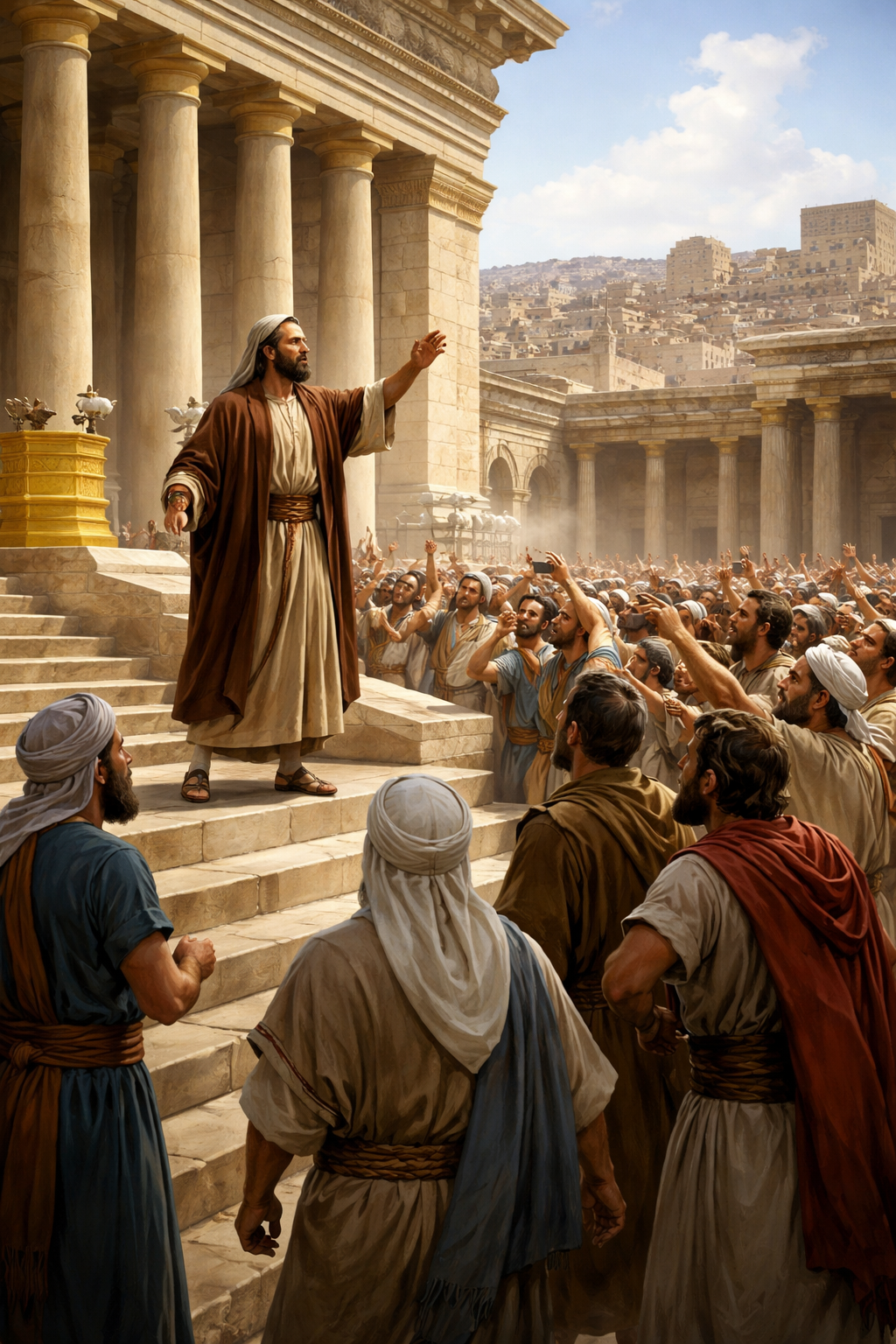
Jeremiah 26 returns to a temple message from “the beginning of the reign of Jehoiakim.” The LORD commands Jeremiah to stand in the court of the LORD’s house and speak “all the words that I command thee… diminish not a word.” That is a vital statement on faithful preaching. God’s messenger is not free to soften, trim, or edit the message to avoid offense.
Jeremiah’s sermon is simple and severe: if Judah will not hearken, walk in God’s law, and listen to His servants the prophets, then the LORD will make “this house like Shiloh,” and the city a curse to all nations. Shiloh had once been a central place of worship, but it was brought low because of sin. So the presence of the temple in Jerusalem was no guarantee of safety. Religious privilege without repentance only increases guilt.
The priests, prophets, and people seize Jeremiah and say, “Thou shalt surely die.” They interpret his warning as treason and blasphemy. The princes of Judah come and hear the matter. Jeremiah answers boldly that the LORD sent him, and he urges the people to “amend your ways and your doings.” He then places himself in their hands but warns that if they kill him, they will bring innocent blood upon themselves because he truly has spoken the LORD’s words.
Some of the elders remember the case of Micah the Morasthite, who prophesied in the days of Hezekiah that Zion would be plowed like a field. Hezekiah did not kill Micah; he feared the LORD and sought His favor. That historical example helps spare Jeremiah. The chapter then mentions Urijah the son of Shemaiah, another prophet who spoke similar words. Unlike Jeremiah, Urijah fled into Egypt, was brought back by King Jehoiakim, and was killed with the sword. This contrast highlights both the danger of the times and God’s special preserving hand upon Jeremiah. The chapter closes by noting that “the hand of Ahikam… was with Jeremiah,” so that he was not delivered into the hands of the people to be put to death.
This chapter is one of the clearest Old Testament examples of the cost of faithful preaching. Jeremiah stood nearly alone, spoke without compromise, faced a death sentence, and yet was preserved by God’s providence.
Key People and Places
Jeremiah – The prophet of the LORD, called to preach repentance, judgment, and eventual restoration to Judah.
Nebuchadrezzar (Nebuchadnezzar) – King of Babylon, called by God “my servant” in the sense that he was used as an instrument of divine judgment.
Jeconiah (Jehoiachin/Coniah) – The king carried away captive to Babylon; his deportation marks the setting of Jeremiah 24.
Zedekiah – The final king of Judah; associated in Jeremiah 24 with the bad figs, representing those left for judgment.
Jehoiakim – King of Judah during key prophecies in Jeremiah 25–26; a wicked ruler who opposed the word of God.
Priests and false prophets – Religious leaders who resisted Jeremiah’s preaching and sought his death instead of repenting.
Princes of Judah – Civil leaders who heard Jeremiah’s case in chapter 26.
Micah the Morasthite – Earlier prophet whose bold preaching in Hezekiah’s day became a precedent that helped spare Jeremiah.
Hezekiah – Former king of Judah who responded humbly to prophetic warning, in contrast to Jehoiakim.
Urijah the son of Shemaiah – A prophet who proclaimed a similar message and was slain by Jehoiakim.
Ahikam the son of Shaphan – A protector of Jeremiah; God used him to preserve the prophet’s life.
Jerusalem – Capital city of Judah and center of temple worship; under imminent judgment because of persistent sin.
The temple / the LORD’s house – The place where Jeremiah delivered his warning; it symbolized great privilege, but privilege without obedience brought heavier accountability.
Babylon – The empire raised up by God to chasten Judah and later judged by God for its own wickedness.
Egypt – A place some fled to for supposed safety; also under God’s judgment.
Shiloh – Former religious center destroyed because of Israel’s sin; used as a warning that sacred places do not protect impenitent people.
Main Doctrinal or Spiritual Themes
1. God’s sovereign rule over nations
Jeremiah 25 strongly emphasizes that the LORD rules over kings, empires, and world events. Nebuchadnezzar is called God’s servant because God is directing history for His own purposes. This is a foundational Bible doctrine: the LORD is not reacting helplessly to events; He governs them.
2. Chastening versus destruction
Jeremiah 24 shows a distinction between those God chastens for their good and those He abandons to judgment. The good figs were not good because they were naturally better people, but because God had gracious purposes toward them. This is consistent with the pattern that God disciplines His true people in order to restore them.
3. The necessity of a changed heart
“I will give them an heart to know me” is a crucial statement. External religion alone cannot save. The people needed inward renewal. This points forward to the broader Bible truth that man’s deepest need is not merely reform but a heart turned Godward.
4. The certainty of judgment after rejected light
Judah had heard Jeremiah and many prophets repeatedly. Their judgment came not because they lacked warning, but because they despised it. The greater the light rejected, the greater the guilt.
5. Religious form without obedience is worthless
Jeremiah 26 makes clear that the temple itself would not save a disobedient people. Possessing sacred institutions, orthodox forms, or historic privileges is no substitute for repentance and submission to God’s word.
6. Faithful preaching must not be diluted
“Diminish not a word” is a timeless charge. God’s servant must deliver the whole counsel of God, not only what is pleasant or popular. True preaching warns as well as comforts.
7. God preserves His servants until their work is done
Jeremiah was threatened with death, yet the LORD raised up Ahikam and used even remembered history to spare him. This does not mean God’s servants never suffer martyrdom, but it does show that their lives are in God’s hands.
8. God judges the instruments He uses
Babylon was used by God, yet Babylon itself would be punished. God is never morally compromised by using wicked men or nations for His purposes. He remains righteous and judges all sin.
Practical Applications or Lessons
1. Do not judge God’s favor merely by outward conditions
Those already in captivity looked like the most forsaken, yet God said He regarded them “for their good.” Sometimes painful providences are part of God’s sanctifying work.
2. Repeated warnings should not be taken lightly
Judah had many opportunities to repent. The danger of hearing truth over and over is becoming hardened to it. A believer should respond tenderly and quickly when God convicts.
3. A right heart matters more than outward privilege
Church attendance, heritage, knowledge, and religious association are not enough by themselves. God desires truth in the inward parts. Every person must know the LORD personally.
4. Preachers must tell the truth without trimming the message
Jeremiah was commanded not to lessen the word. Ministers and teachers today must not soften doctrine, ignore sin, or avoid unpopular truth to keep peace.
5. God’s people should expect opposition when standing for truth
Jeremiah’s message stirred hostility from religious leaders. Faithfulness often brings resistance, especially when truth exposes sin and false security.
6. Past examples of godly response should guide present conduct
The elders remembered Micah and Hezekiah. It is wise to remember how godly men in Scripture responded humbly to rebuke instead of attacking the messenger.
7. God can use unlikely means to preserve and help His servants
Ahikam’s intervention reminds believers that God’s providence often works through specific people, timely memories, legal processes, or unexpected defenders.
8. Nations as well as individuals are accountable to God
Jeremiah 25 broadens the message from Judah to the world. No nation is beyond the reach of divine justice. Power, wealth, and military might do not shield a people from God’s moral government.
9. Temporary success in sin is not lasting safety
The leaders remaining in Jerusalem may have looked stronger than the captives, but God declared otherwise. Present advantage is no proof of divine approval.
10. Repentance is still the right response to warning
Even in chapter 26, Jeremiah’s message still held out mercy if the people would amend their ways. God’s warnings are not cruel; they are gracious calls to turn before judgment falls.
Comments are closed