
Overview of Genesis 1–3 KJV
Genesis 1–3 establishes the biblical foundation for creation, mankind, marriage, work, moral responsibility, sin, death, divine judgment, and the first promise of redemption. The account presents Adam and Eve as real people living in a real garden and experiencing a real fall into sin.
Chapter Summaries
 Genesis 1 — God Creates the Heavens and the Earth
Genesis opens with the direct declaration:
“In the beginning God created the heaven and the earth” (Genesis 1:1).
God is present before the created order. The chapter does not attempt to prove His existence; it declares Him to be the Creator. Later Scripture explains that creation was accomplished by God’s word and that the visible universe was not made from preexisting visible material (Psalm 33:6–9; Hebrews 11:3).
The earth was “without form, and void,” darkness was upon the deep, and “the Spirit of God moved upon the face of the waters” (Genesis 1:2). Scripture does not state that the earth became this way through a previous judgment, nor does Genesis 1 identify a lengthy interval between verses 1 and 2. Such proposals should not be presented as established facts.
Day One — Light
God commanded, “Let there be light,” and light came into existence. God divided the light from the darkness, calling the light Day and the darkness Night. The repeated expression “the evening and the morning” begins the clear progression of the creation days.
Day Two — The Firmament
God made the firmament, dividing the waters beneath it from the waters above it. He called the firmament Heaven.
Day Three — Land, Seas, and Vegetation
God gathered the waters together so that dry land appeared. He called the dry land Earth and the gathered waters Seas.
God then commanded the earth to bring forth grass, herbs yielding seed, and fruit trees producing fruit “after his kind.” The phrase “after his kind” emphasizes an orderly creation in which living things reproduce according to the boundaries established by God. The passage does not define these “kinds” according to modern biological classifications.
Day Four — Lights in the Firmament
God made lights in the firmament to divide day from night and to serve:
“for signs, and for seasons, and for days, and years” (Genesis 1:14).
He made “two great lights”—the greater light to rule the day and the lesser light to rule the night—and He made the stars also. The heavenly bodies are created objects under God’s authority; they are not gods and are not to be worshiped.
Day Five — Creatures of the Sea and Air
God created “great whales,” every living creature that moves in the waters, and every winged fowl after its kind. He blessed them and commanded them to be fruitful and multiply.
Day Six — Land Animals and Man
God made land animals after their kinds. He then declared:
“Let us make man in our image, after our likeness: and let them have dominion” (Genesis 1:26).
The plural language—“us” and “our”—is consistent with the fuller biblical revelation of the Trinity, although Genesis 1 alone does not completely explain that doctrine. The Spirit is explicitly present in Genesis 1:2, while later Scripture teaches that all things were made through the Son (John 1:1–3; Colossians 1:16).
God created mankind distinctly from the animals:
“So God created man in his own image, in the image of God created he him; male and female created he them” (Genesis 1:27).
Men and women equally bear God’s image. The chapter does not fully define everything included in that image, but it clearly distinguishes mankind from the rest of earthly creation and gives humanity a special relationship and responsibility before God.
God blessed the man and woman, commanding them to be fruitful, multiply, replenish the earth, subdue it, and exercise dominion over other living creatures. Dominion is delegated authority under the Creator, not permission for wasteful or cruel treatment of His creation.
God provided plants and fruit for man’s food and green herbs for the animals. This describes God’s provision at creation; it should not be turned into a universal dietary command for every later period without considering the rest of Scripture.
At the end of the sixth day:
“God saw every thing that he had made, and, behold, it was very good” (Genesis 1:31).
Death, human sin, shame, and the curse described in Genesis 3 were not part of this declared “very good” condition.
Genesis 2 — Adam, Eden, and the Creation of Woman
Genesis 2 completes the account of the creation week and then supplies details about Adam, the Garden of Eden, and the creation of the woman that were not included in Genesis 1. The chapter does not say that this was a separate creation.
The Seventh Day
The heavens, the earth, and all their host were finished. God rested on the seventh day, blessed it, and sanctified it.
God’s rest does not indicate weariness, because God does not become faint or tired (Isaiah 40:28). It means that His work of creation was completed. The seventh day later became the basis for Israel’s Sabbath command (Exodus 20:8–11). Genesis 2 establishes that God blessed and sanctified the day; the specific Sabbath requirements given to Israel appear later in Scripture.
The Formation of Adam
Genesis gives a personal description of man’s creation:
“And the LORD God formed man of the dust of the ground, and breathed into his nostrils the breath of life; and man became a living soul” (Genesis 2:7).
Man possesses a physical connection to the ground, but his life came directly from God. Human life is therefore neither accidental nor insignificant.
The Garden of Eden
The LORD God planted a garden eastward in Eden and placed the man there. The garden contained trees that were pleasant to the sight and good for food. Two trees receive special mention:
- The tree of life
- The tree of knowledge of good and evil
A river went out of Eden and divided into four heads: Pison, Gihon, Hiddekel, and Euphrates. Genesis associates these rivers with Havilah, Ethiopia, and Assyria. The KJV does not identify Eden’s location according to modern national boundaries, so a precise modern location should not be claimed as biblical certainty.
God placed Adam in the garden “to dress it and to keep it” (Genesis 2:15). Therefore, meaningful work existed before the fall. The curse did not create work; it brought sorrow, thorns, sweat, and eventual death into man’s labor.
God gave Adam generous liberty to eat from the trees of the garden, with one prohibition:
“But of the tree of the knowledge of good and evil, thou shalt not eat of it” (Genesis 2:17).
The warning was unmistakable:
“for in the day that thou eatest thereof thou shalt surely die.”
Genesis does not describe Adam as lacking the ability to understand the command. God established the boundary, stated the consequence, and held man responsible for obedience.
The Creation of Woman and the First Marriage
God said:
“It is not good that the man should be alone; I will make him an help meet for him” (Genesis 2:18).
God brought the animals to Adam, and Adam named them. Yet “for Adam there was not found an help meet for him.” No animal could provide the companionship and union for which man was created.
God caused a deep sleep to fall upon Adam, took one of his ribs, and made a woman. Scripture explicitly says the woman was made from the man; it does not explain every physical detail of how God performed this miracle.
Adam recognized their unique relationship:
“This is now bone of my bones, and flesh of my flesh” (Genesis 2:23).
The chapter then establishes the foundation of marriage:
“Therefore shall a man leave his father and his mother, and shall cleave unto his wife: and they shall be one flesh” (Genesis 2:24).
Marriage is presented as God’s design involving a man and his wife in a one-flesh union. Jesus later cited this passage and declared, “What therefore God hath joined together, let not man put asunder” (Matthew 19:4–6).
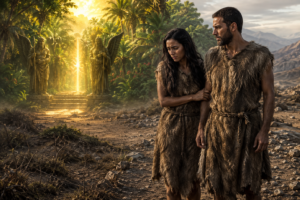
Adam and his wife were both naked and were not ashamed. Their relationship contained no sinful lust, corruption, exploitation, or shame.
Genesis 3 — Temptation, Sin, Judgment, and the Promise of Redemption
Genesis 3 records mankind’s fall from innocence into sin. It explains the entrance of shame, suffering, conflict, physical death, and separation from Eden.
The Serpent’s Temptation
The serpent is described as “more subtil than any beast of the field which the LORD God had made.” Genesis 3 calls the tempter the serpent. Later Scripture identifies “that old serpent” as “the Devil, and Satan” (Revelation 12:9).
The serpent began by questioning God’s word:
“Yea, hath God said?” (Genesis 3:1).
The woman repeated the prohibition but included the words, “neither shall ye touch it.” God’s recorded command in Genesis 2:17 prohibited eating. Scripture does not explicitly explain why the woman included touching or who first used that wording.
The serpent then directly contradicted God:
“Ye shall not surely die” (Genesis 3:4).
He suggested that disobedience would open their eyes and make them “as gods, knowing good and evil.” The temptation attacked confidence in God’s truth and goodness.
The woman saw that the tree was:
- Good for food
- Pleasant to the eyes
- Desired to make one wise
She took its fruit and ate. She gave it to her husband “with her,” and he ate. The verse does not explicitly state that Adam heard the entire earlier conversation with the serpent, so that detail should not be assumed.
The New Testament distinguishes their involvement:
“Adam was not deceived, but the woman being deceived was in the transgression” (1 Timothy 2:14).
Nevertheless, both disobeyed God, and Romans 5 places particular responsibility upon Adam as the man through whom sin entered the world.
Shame and Hiding
Their eyes were opened, and they knew they were naked. They sewed fig leaves together and made themselves aprons.
When they heard the voice of the LORD God, they hid among the trees. Adam explained that he was afraid because he was naked. God questioned Adam, the woman, and then pronounced judgment.
Adam pointed to the woman God had given him. The woman pointed to the serpent who had beguiled her. Their explanations did not remove their personal responsibility.
Judgment Upon the Serpent
God cursed the serpent above the cattle and beasts of the field. He pronounced continuing enmity between the serpent and the woman and between their respective seeds.
Genesis 3:15 contains the first biblical promise of a coming victory over the serpent:
“it shall bruise thy head, and thou shalt bruise his heel.”
Conservative Christians commonly call this the first Gospel promise. Genesis alone does not identify the promised individual by name, but the doctrine is consistent with later Scripture’s revelation that Christ came through a woman and defeated the works and power of the devil (Galatians 4:4; Hebrews 2:14; 1 John 3:8).
Consequences for the Woman
God told the woman that her sorrow and conception would be multiplied and that she would bring forth children in sorrow. He also said:
“thy desire shall be to thy husband, and he shall rule over thee” (Genesis 3:16).
The verse explicitly describes conditions following the fall. It must not be used to justify cruelty, abuse, or sinful domination. The full biblical responsibilities of husbands and wives are explained in later passages such as Ephesians 5:22–33 and 1 Peter 3:1–7.
Consequences for Adam
God addressed Adam because he had hearkened to his wife and eaten from the forbidden tree. The ground—not Adam personally—is explicitly said to be cursed:
“cursed is the ground for thy sake” (Genesis 3:17).
Adam would eat through sorrow, contend with thorns and thistles, and obtain bread through the sweat of his face. His body would eventually return to the ground:
“for dust thou art, and unto dust shalt thou return” (Genesis 3:19).
Genesis does not fully explain every aspect of “thou shalt surely die.” Romans 5:12 states that sin and death entered the world through one man, while Ephesians 2:1 describes sinners as spiritually “dead in trespasses and sins.” Genesis 3 explicitly includes the sentence of eventual physical death and mankind’s loss of access to the tree of life.
Eve, Clothing, and Expulsion
Adam named his wife Eve:
“because she was the mother of all living” (Genesis 3:20).
God made “coats of skins” for Adam and Eve and clothed them. The text does not explicitly state how the skins were obtained, whether God killed the animals directly, or whether this was a formal sacrifice. Those ideas may be suggested by the circumstances, but they must not be presented as statements made by the passage.
God then prevented man from eating from the tree of life and living forever in his fallen condition. He sent Adam out of Eden to till the ground and “drove out the man.”
Cherubims and a flaming sword were placed east of the garden “to keep the way of the tree of life.” Access to the garden and its life-giving tree was now barred.
Key People and Places
God
The eternal Creator and sovereign Lord. Genesis 1 principally uses “God,” while Genesis 2:4 introduces the combined name “LORD God.” He creates, commands, blesses, provides, judges, and promises the ultimate defeat of the serpent.
The Spirit of God
Explicitly present at creation, moving “upon the face of the waters” (Genesis 1:2).
Adam
The first man, formed from the dust and given life directly by God. He was placed in Eden, given responsibility, received God’s command, named the animals, received the woman as his wife, and knowingly ate the forbidden fruit.
The Woman/Eve
Created by God from Adam’s rib as a suitable helper and wife. She was deceived by the serpent and ate the forbidden fruit. Adam later named her Eve because she was “the mother of all living.”
The Serpent
A creature described as subtle that questioned and contradicted God’s word. Later Scripture connects the old serpent with the Devil and Satan.
The Cherubims
Heavenly beings stationed east of Eden with a flaming sword to guard the way to the tree of life. The passage does not provide a physical description of them.
Heaven, Earth, and Seas
Names God gave to parts of the created order. Everything within them exists because of His command and power.
Eden and the Garden
Eden was the region in which God planted the garden. The garden contained abundant trees, the tree of life, and the tree of knowledge of good and evil.
Pison
The first river named. It surrounded the land of Havilah, where Genesis mentions gold, bdellium, and onyx stone.
Havilah
A land associated with the Pison River. Genesis 2 does not provide a certain identification with a modern location.
Gihon
The second river, said to surround “the whole land of Ethiopia.”
Ethiopia
The land named in the KJV in association with the Gihon River. The passage does not establish its boundaries according to a modern map.
Hiddekel
The third river, described as going “toward the east of Assyria.”
Assyria
A geographical reference used to describe the direction of the Hiddekel River.
Euphrates
The fourth river named. Scripture gives no additional geographical description of it in this chapter.
Main Doctrinal or Spiritual Themes
God Is the Creator
God alone created the heavens, the earth, life, and mankind. Creation belongs to Him and remains accountable to Him. Exodus 20:11 confirms the six-day creation pattern:
“For in six days the LORD made heaven and earth, the sea, and all that in them is.”
Creation by Divine Command
God repeatedly speaks, and creation responds. The universe is the result of God’s will and power, not an uncontrolled or purposeless accident.
The Triune God
Genesis 1 explicitly mentions God and the Spirit of God. Its plural wording—“Let us make man in our image”—is consistent with, but does not alone fully establish, the doctrine of the Trinity. The New Testament reveals the Son’s active role in creation (John 1:1–3; Colossians 1:16).
The Historical Creation of Man
Adam was formed from the dust, and Eve was made from Adam. Jesus and the apostles treat Adam, Eve, and their marriage as historical realities (Matthew 19:4–6; Romans 5:12–19; 1 Corinthians 15:45; 1 Timothy 2:13–14).
The Image of God
Both male and female were created in God’s image. This gives every human life dignity and moral significance. The image of God does not make man divine; man remains a creature accountable to his Creator.
Marriage and the Family
God created the woman for the man and established the first marriage. The foundational pattern is a man leaving his parents, cleaving to his wife, and becoming one flesh with her.
Work and Stewardship
Adam received work before sin entered the world. Productive labor is good, but the fall brought pain, frustration, thorns, and sweat into human labor.
The Authority of God’s Word
God’s command was clear. The serpent questioned, distorted, and contradicted it. The fall demonstrates the danger of judging God’s word by human desire rather than judging human desire by God’s word.
The Nature of Sin
The first human sin was a deliberate violation of God’s command. The fruit itself was not presented as inherently evil; eating it was sinful because God had prohibited it.
Sin involved unbelief, misplaced desire, disobedience, and the attempt to obtain something outside God’s will. It immediately produced shame, fear, hiding, and blame.
The Fall and Universal Sin
Genesis 3 records the historical entrance of human sin and death. Romans 5:12 explains:
“Wherefore, as by one man sin entered into the world, and death by sin.”
Adam’s fall affected the human race. All people are consequently born into a fallen world and personally become sinners (Romans 3:23).
Divine Judgment
God did not overlook or redefine disobedience. His judgment affected the serpent, the woman, the man, the ground, human labor, childbirth, relationships, physical life, and access to Eden.
God’s Mercy and Promised Redemption
Judgment did not eliminate hope. God promised that the woman’s seed would bruise the serpent’s head. The complete identity and work of the Deliverer are revealed progressively in later Scripture and fulfilled in Jesus Christ.
Human Attempts Cannot Reverse the Fall
Adam and Eve made aprons, but their efforts did not restore their lost condition or reopen Eden. Genesis does not explicitly equate the fig leaves with a doctrine of salvation by works, but the chapter clearly demonstrates that human action could not undo their disobedience.
Practical Applications or Lessons
Believe God’s Word
The serpent’s opening strategy was, “Yea, hath God said?” Believers must recognize attempts to question, weaken, revise, or contradict the plain teaching of Scripture.
Handle Scripture Accurately
The woman’s wording included a restriction not found in God’s recorded command. Scripture does not say that this added wording caused her sin, but the difference reminds believers to represent God’s words accurately.
Do Not Judge God by Immediate Appearances
The forbidden fruit appeared desirable, but its appearance did not change God’s command. Something may look attractive, useful, pleasurable, or intellectually appealing and still be sinful.
Accept Personal Responsibility
Adam blamed the woman, and the woman blamed the serpent. Although other people and circumstances can influence us, each person remains responsible before God for his own choices.
Honor Human Life
Every person bears the image of God. Human value is not based upon age, health, intelligence, wealth, nationality, race, or social usefulness.
Honor God’s Design for Marriage
Marriage originated with God. Husbands and wives should approach marriage as a covenantal one-flesh union under God’s authority rather than merely a human arrangement for personal convenience.
Practice Faithful Stewardship
Human dominion is exercised under God’s ownership. Believers should use creation responsibly and avoid both worshiping nature and abusing what God has made.
Recognize the Goodness of Work
Work is not itself a curse. Adam had responsibilities before the fall. Christians should perform honest work faithfully while recognizing that frustration and weariness are part of life in a fallen world.
Understand the Seriousness of Sin
One act of disobedience brought consequences that Adam and Eve could not reverse. No sin is harmless merely because it appears small or because its consequences are not immediately visible.
Refuse the Blame-Shifting Pattern
Confession agrees with God about sin. Spiritual restoration requires honest acknowledgment rather than excuses, comparisons, or accusations against others.
Maintain Biblical Modesty
Before the fall, Adam and Eve were naked and unashamed. After sin, they recognized their nakedness, made coverings, and were subsequently clothed by God. While Genesis 3 does not give a complete biblical standard of dress, it establishes that nakedness and shame became connected following the fall.
Remember the Certainty of Death
“Unto dust shalt thou return” remains a solemn reminder that physical life is temporary. Death entered through sin, and every person needs the eternal life offered through Jesus Christ.
Look to Christ for Victory
The promised seed of the woman points forward to the One who would defeat the serpent. Christ bore sin’s penalty, died, rose bodily from the grave, and provides salvation to everyone who repents and believes the Gospel.
Rest in God’s Completed Work
God finished His creation and rested. Believers should worship the Creator, acknowledge their dependence upon Him, and resist living as though everything depends upon unending human effort.
Comments are closed