 The Fall of Tyre and the Judgment of Egypt
Ezekiel 27–29 continues God’s judgments upon the nations. The focus moves especially upon Tyre, the wealthy maritime city, and then upon Egypt, the ancient power that had often tempted Israel to trust in man instead of the LORD.
These chapters show that no amount of wealth, trade, military power, beauty, or worldly influence can protect a nation when God rises in judgment. Tyre was like a splendid merchant ship, but God would sink her. Egypt was like a great river monster boasting in the Nile, but God would drag him out and humble him.
Chapter Summaries
Ezekiel 27 — The Lamentation for Tyre
Ezekiel 27 is a funeral lament over Tyre. The LORD tells Ezekiel:
“Now, thou son of man, take up a lamentation for Tyrus” — Ezekiel 27:2
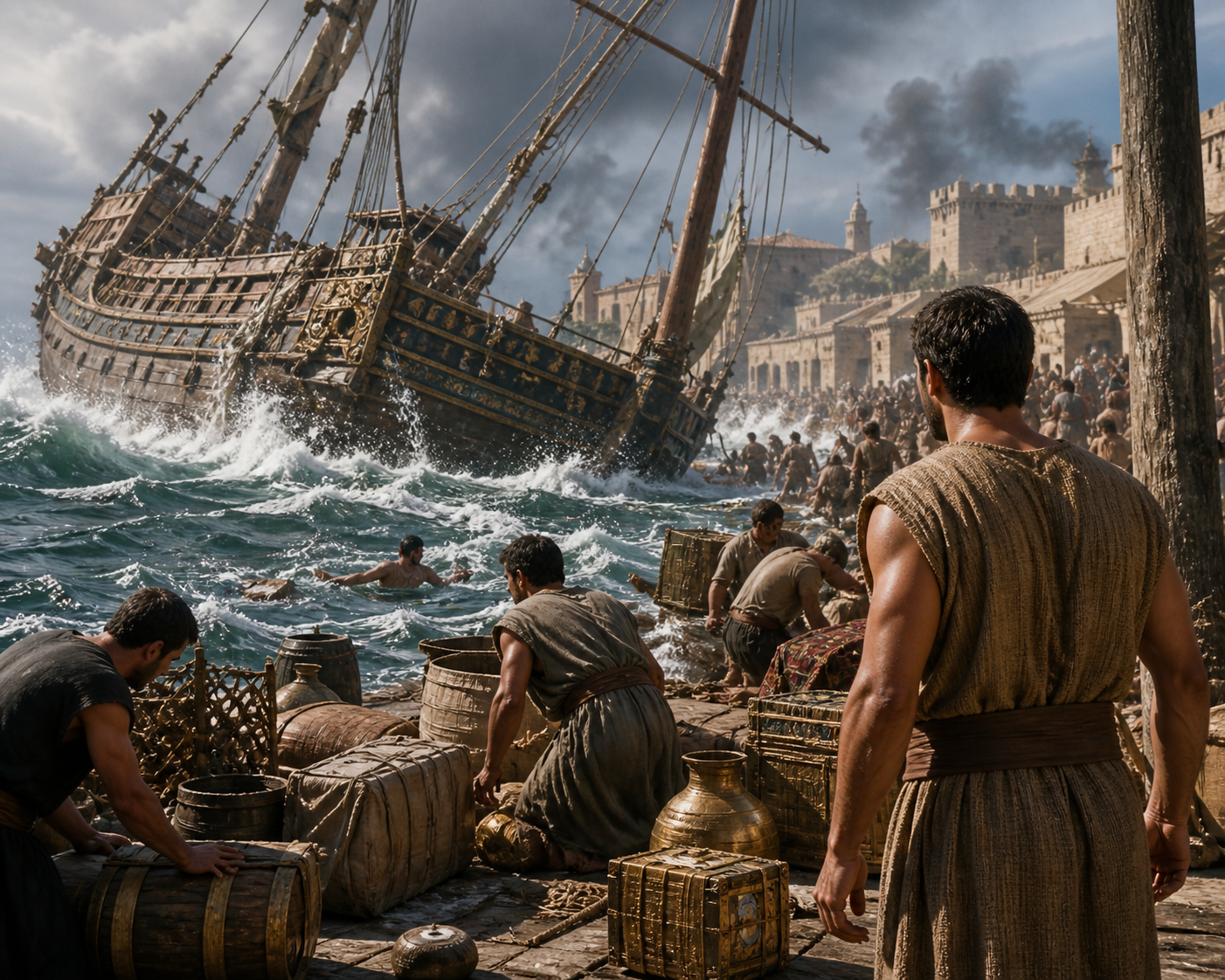
Tyre was a powerful Phoenician city known for shipping, commerce, wealth, and influence. In this chapter, Tyre is pictured as a magnificent ship. She says:
“I am of perfect beauty” — Ezekiel 27:3
That statement reveals the pride of Tyre. She trusted in her beauty, wealth, trade, and international connections.
The chapter describes Tyre’s greatness in detail. Her ships were built with the finest materials. Her sailors, pilots, merchants, and soldiers came from many nations. Her trade reached across the ancient world. Many peoples brought goods to her markets: silver, iron, tin, lead, horses, ivory, ebony, precious stones, fine linen, spices, wheat, honey, oil, balm, wine, wool, lambs, rams, goats, and many other treasures.
Tyre was commercially successful, internationally connected, and outwardly beautiful. Yet all of this could not save her.
The turning point comes when the great “ship” of Tyre is broken:
“Thy rowers have brought thee into great waters: the east wind hath broken thee in the midst of the seas.” — Ezekiel 27:26
The “east wind” is a picture of destructive judgment. Tyre’s wealth, merchandise, sailors, pilots, and military men would fall into the sea. The nations that profited from her would mourn, not necessarily because they loved righteousness, but because their source of gain was gone.
The chapter closes with Tyre becoming a terror and ceasing to exist as she once did:
“Thou shalt be a terror, and never shalt be any more.” — Ezekiel 27:36
Main Thought of Ezekiel 27
Tyre was rich, beautiful, and powerful, but she was proud and godless. God shows that worldly greatness can disappear suddenly when judgment comes.
Ezekiel 28 — The Prince of Tyre, the King of Tyre, and Zidon
Ezekiel 28 contains a judgment against the ruler of Tyre, a deeper lamentation over the “king of Tyrus,” and a judgment against Zidon. It ends with a promise of future restoration for Israel.
The Prince of Tyre
The chapter begins:
“Son of man, say unto the prince of Tyrus, Thus saith the Lord GOD; Because thine heart is lifted up…” — Ezekiel 28:2
The prince of Tyre was proud. He said:
“I am a God, I sit in the seat of God, in the midst of the seas” — Ezekiel 28:2
But God immediately corrects him:
“Yet thou art a man, and not God” — Ezekiel 28:2
This is one of the strongest rebukes of human pride in the book. The ruler of Tyre had wisdom, riches, trade, and power, but his heart was lifted up because of those things. He forgot that he was only a man.
God declares that strangers, “the terrible of the nations,” would come against him. His death would prove that he was not God:
“Wilt thou yet say before him that slayeth thee, I am God? but thou shalt be a man, and no God” — Ezekiel 28:9
The lesson is plain: human rulers may exalt themselves, but God can bring them down.
The King of Tyre
Beginning in verse 11, Ezekiel takes up a lamentation upon the “king of Tyrus.” The language rises beyond an ordinary earthly ruler:
“Thou sealest up the sum, full of wisdom, and perfect in beauty.” — Ezekiel 28:12
“Thou hast been in Eden the garden of God” — Ezekiel 28:13
“Thou art the anointed cherub that covereth” — Ezekiel 28:14
“Thou wast perfect in thy ways from the day that thou wast created, till iniquity was found in thee.” — Ezekiel 28:15
Many conservative interpreters see here both the earthly king of Tyre and a deeper reference to Satanic pride behind him. The immediate historical subject is Tyre’s ruler, but the language strongly points beyond a mere man. The chapter gives insight into the pride, corruption, and fall of a created being who exalted himself against God.
The key issue is pride:
“Thine heart was lifted up because of thy beauty, thou hast corrupted thy wisdom by reason of thy brightness” — Ezekiel 28:17
This matches the great biblical truth that pride leads to destruction. Beauty, wisdom, position, and privilege are all dangerous when they become occasions for self-exaltation.
Judgment Against Zidon
The LORD then turns to Zidon:
“Son of man, set thy face against Zidon, and prophesy against it” — Ezekiel 28:21
Zidon was another Phoenician city north of Israel. God would be glorified in judgment:
“I will be glorified in the midst of thee” — Ezekiel 28:22
The surrounding nations had been “a pricking brier” and “a grieving thorn” to Israel. God would judge them and eventually gather Israel again.
Promise to Israel
The chapter closes with hope:
“When I shall have gathered the house of Israel from the people among whom they are scattered… then shall they dwell in their land” — Ezekiel 28:25
Even while God judges the nations, He remembers His covenant people. Israel’s restoration would show that the LORD is holy, faithful, and sovereign.
Main Thought of Ezekiel 28
Pride brings rulers, kingdoms, and even angelic beings into ruin. But God remains sovereign, and His purposes for Israel will stand.
Ezekiel 29 — Judgment Against Pharaoh and Egypt
Ezekiel 29 begins a section of judgment against Egypt. Egypt had long been a powerful nation and a temptation to Israel. Many in Judah had looked to Egypt for help against Babylon, but Egypt was a false hope.
The chapter begins:
“Son of man, set thy face against Pharaoh king of Egypt” — Ezekiel 29:2
Pharaoh is described as:
“the great dragon that lieth in the midst of his rivers” — Ezekiel 29:3
The word “dragon” here refers to a great creature or monster associated with the Nile. Pharaoh boasts:
“My river is mine own, and I have made it for myself.” — Ezekiel 29:3
This was blasphemous pride. Egypt depended on the Nile River, but Pharaoh acted as though he owned it and had made it. Like the prince of Tyre, Pharaoh exalted himself.
God declares that He will put hooks in Pharaoh’s jaws and bring him out of the rivers. This pictures God dragging Egypt out of its place of strength and exposing its weakness.
Egypt had also failed Israel. The LORD says:
“Because they have been a staff of reed to the house of Israel” — Ezekiel 29:6
A reed may look like a staff, but it breaks when leaned upon. Egypt had promised support but could not truly deliver. Instead of strengthening Israel, Egypt became a source of injury and disappointment.
God announces severe judgment:
“The land of Egypt shall be desolate and waste” — Ezekiel 29:9
Egypt would be humbled for forty years:
“No foot of man shall pass through it, nor foot of beast shall pass through it, neither shall it be inhabited forty years.” — Ezekiel 29:11
Afterward, Egypt would be restored, but not to its former greatness:
“It shall be the basest of the kingdoms” — Ezekiel 29:15
This is important. God did not say Egypt would cease forever as a people, but that it would never again be the great empire it once was. Egypt’s pride would be permanently broken.
The chapter ends by explaining that God would give Egypt to Nebuchadnezzar king of Babylon as wages for his army’s service against Tyre:
“I have given him the land of Egypt for his labour wherewith he served against it” — Ezekiel 29:20
God even rules over pagan kings and uses them to accomplish His judgments.
The final verse gives a promise of hope to Israel:
“In that day will I cause the horn of the house of Israel to bud forth” — Ezekiel 29:21
The “horn” speaks of strength, dignity, and renewed power. Even in judgment, God points forward to restoration.
Main Thought of Ezekiel 29
Egypt was proud, unreliable, and self-confident. God would humble Egypt and prove that He alone is the LORD.
Key People and Places
Ezekiel
The prophet and priest in exile. He faithfully declares God’s word of judgment against the nations. His message shows that the LORD rules not only Israel, but all nations.
Tyre / Tyrus
A wealthy Phoenician city on the Mediterranean coast. Tyre was famous for trade, shipping, wealth, and commercial influence. In Ezekiel 27, it is pictured as a beautiful ship brought to ruin.
The Prince of Tyre
The earthly ruler of Tyre. He is condemned for pride, self-exaltation, and claiming godlike status. God reminds him that he is “a man, and not God.”
The King of Tyre
The subject of Ezekiel 28:11–19. The language includes the earthly king but appears to reach beyond him to the Satanic pride and corruption behind such rebellion against God.
Zidon / Sidon
A Phoenician city north of Tyre. Like Tyre, it was judged by God. It had been a thorn to Israel and would learn that the LORD is God.
Pharaoh
The king of Egypt. He is pictured as a great creature in the Nile, boasting in his river and power. God judges him for pride and for being a false support to Israel.
Egypt
An ancient world power south of Israel. Egypt often represents worldly strength, bondage, and false security. Judah was tempted to trust Egypt instead of trusting the LORD.
Babylon / Nebuchadnezzar
The empire and king God used as instruments of judgment. Nebuchadnezzar’s army would be given Egypt as a reward for service against Tyre.
Israel
God’s covenant nation. Though under chastening, Israel is not forgotten. God promises future gathering, restoration, and renewed strength.
The Seas
In Ezekiel 27, the seas represent Tyre’s commercial strength and international reach. But the very waters that carried her wealth become the place of her ruin.
The Nile River
The source of Egypt’s agricultural life and national pride. Pharaoh boasted in it, but God showed that even Egypt’s greatest natural strength belonged to Him.
Main Doctrinal or Spiritual Themes
1. God Rules Over All Nations
These chapters are not only about Israel. God judges Tyre, Zidon, Egypt, and Babylon’s role in world events. The LORD is not a local deity. He is the sovereign God of heaven and earth.
Repeatedly the purpose of judgment is:
“They shall know that I am the LORD.”
God’s rule extends over kings, empires, economies, armies, and trade routes.
2. Pride Brings Destruction
Tyre said:
“I am of perfect beauty.”
The prince of Tyre said:
“I am a God.”
Pharaoh said:
“My river is mine own, and I have made it for myself.”
Each statement reveals the same sin: pride. Pride makes man forget his creaturely place before God. Pride turns blessings into idols. Pride takes credit for what God has allowed.
A conservative Baptist application is clear: man is never safe when he begins to exalt himself instead of glorifying God.
3. Wealth Cannot Save
Tyre had ships, merchants, soldiers, craftsmen, luxury goods, and international influence. But none of it could stop the judgment of God.
Ezekiel 27 is a powerful warning against trusting riches. Tyre’s wealth made her famous, but it could not make her secure.
The New Testament truth agrees:
“For the love of money is the root of all evil” — 1 Timothy 6:10
Riches are not sinful in themselves, but trusting in riches is deadly.
4. Human Wisdom Can Be Corrupted
The ruler of Tyre was wise in business and politics, but his wisdom was corrupted by pride. Ezekiel 28:17 says:
“Thou hast corrupted thy wisdom by reason of thy brightness.”
Intelligence, success, and skill are dangerous when separated from humility before God. A man may be clever and still be spiritually blind.
5. Satanic Pride Lies Behind Worldly Rebellion
Ezekiel 28 gives a glimpse of deeper spiritual rebellion. The proud king of Tyre becomes a picture of more than human arrogance. The language about Eden, the anointed cherub, created perfection, and iniquity being found in him points to the fall of Satan.
This reminds believers that earthly pride and rebellion are not merely political or economic issues. There is a spiritual war behind the world’s rebellion against God.
6. False Security Will Fail
Egypt was a “staff of reed” to Israel. Judah leaned on Egypt for help, but Egypt broke under the pressure.
This is a major biblical lesson: anything trusted in place of God will eventually fail. Nations, leaders, money, alliances, health, and human plans are weak reeds if they replace the LORD.
7. God Uses Even Pagan Nations to Accomplish His Will
Nebuchadnezzar was not a godly king, yet God used him as an instrument of judgment. This does not mean Babylon was righteous. It means God is sovereign even over unrighteous rulers.
God can use one nation to judge another, and He remains just in doing so.
8. Judgment and Mercy Are Both Present
These chapters are heavy with judgment, but hope is not absent. Ezekiel 28 and 29 both include promises concerning Israel’s future restoration.
God chastens His people, but He does not forget His covenant promises.
Practical Applications or Lessons
1. Do Not Trust in Wealth or Success
Tyre had everything the world admires: trade, luxury, influence, beauty, and reputation. Yet it fell.
A church, family, or individual must not measure spiritual security by money, buildings, numbers, influence, or reputation. God is not impressed by outward greatness when the heart is lifted up.
2. Pride Must Be Judged in the Heart Early
The prince of Tyre’s great sin began in the heart:
“Thine heart is lifted up.”
Pride does not have to speak loudly at first. It begins when a person starts thinking more highly of himself than he ought to think.
Believers should ask God to search their hearts for pride, self-sufficiency, and secret boasting.
3. Remember That Man Is Not God
God’s rebuke to the prince of Tyre is needed in every generation:
“Yet thou art a man, and not God.”
Modern man often acts as though he controls life, morality, truth, and destiny. But every ruler, preacher, businessman, scholar, and laborer is still only a man before God.
Humility is not weakness. It is reality.
4. Be Careful What You Lean On
Egypt was a broken reed. Israel leaned on Egypt and was hurt.
Believers must be careful not to lean on worldly supports in place of prayer, obedience, Scripture, and faith in God. Human help may have its place, but it must never replace trust in the LORD.
5. God Can Break What Men Think Is Unbreakable
Tyre seemed too wealthy to fall. Egypt seemed too ancient and powerful to be humbled. Yet both were judged.
No nation, business, movement, or ruler is beyond the reach of God. The believer should not fear worldly power more than he fears God.
6. Beauty and Ability Must Be Used for God’s Glory
Ezekiel 28 shows that beauty, wisdom, and brightness can become occasions for pride. Gifts are not safe unless surrendered to God.
Talent without humility becomes dangerous. Influence without holiness becomes corrupt. Knowledge without submission to God becomes destructive.
7. God’s People Should Not Envy the Prosperity of the Wicked
Tyre prospered greatly before it fell. Egypt seemed strong before it was humbled.
The believer must not envy worldly success. Some prosperity is only temporary decoration on a sinking ship.
Psalm 73 teaches the same truth: the wicked may seem to prosper, but their end must be considered.
8. God Keeps His Promises to Israel
Even in chapters of judgment upon Gentile nations, God speaks of gathering Israel and causing her strength to bud again.
This reminds us that God is faithful. His chastening is real, but His covenant purposes do not fail.
9. National Sin Has National Consequences
These chapters deal with nations, rulers, economies, and cities. God judges public pride, national arrogance, dishonest confidence, and rebellion.
A nation that forgets God may continue for a time, but it cannot escape divine accountability forever.
10. The LORD Alone Deserves Glory
The repeated lesson is that men and nations must know:
“I am the LORD.”
Tyre gloried in her beauty. Pharaoh gloried in his river. But God alone deserves glory.
The safest place for any person, church, or nation is humble submission to the LORD.
Summary of Ezekiel 27–29
Ezekiel 27 mourns the fall of wealthy Tyre, pictured as a beautiful merchant ship destroyed in the sea. Ezekiel 28 condemns the pride of Tyre’s ruler, gives a deeper glimpse of Satanic pride and corruption, judges Zidon, and promises future restoration to Israel. Ezekiel 29 turns to Egypt, condemning Pharaoh’s arrogance and Egypt’s failure as a false support to Israel.
The central message is clear: God brings down proud nations, exposes false security, judges worldly power, and remains faithful to His covenant purposes.
These chapters warn every generation not to trust in riches, rulers, military power, commerce, wisdom, or human alliances. The LORD alone is God, and all men and nations must answer to Him.
Comments are closed