 Exodus 9–11 records the closing stages of the LORD’s judgments upon Egypt before the death of the firstborn. The plagues intensify, Pharaoh repeatedly refuses to let Israel go, and the LORD repeatedly demonstrates both His absolute authority over Egypt and His deliberate distinction between the Egyptians and the children of Israel.
A major emphasis of these chapters is stated plainly in Exodus 9:14: “that thou mayest know that there is none like me in all the earth.” These events are not presented merely as natural disasters. The KJV text attributes them directly to the LORD, who announces them beforehand, determines their extent, distinguishes Israel from Egypt, and brings them to an end according to His word.
Chapter Summaries
Exodus 9 — Murrain, Boils, and Hail
1. The plague upon the livestock — Exodus 9:1–7
The LORD again commands Moses to go to Pharaoh with the familiar message:
“Let my people go, that they may serve me.”
— Exodus 9:1
Pharaoh is warned that if he continues to refuse, the hand of the LORD will be upon Egypt’s livestock in the field. The text specifically mentions:
- horses,
- asses,
- camels,
- oxen,
- sheep.
The judgment is called “a very grievous murrain” in Exodus 9:3.
The LORD explicitly distinguishes Israel from Egypt:
“And the LORD shall sever between the cattle of Israel and the cattle of Egypt: and there shall nothing die of all that is the children’s of Israel.”
— Exodus 9:4
The LORD also appoints the time: “To morrow the LORD shall do this thing in the land” (9:5).
When the plague comes, Exodus 9:6 states that “all the cattle of Egypt died,” while “of the cattle of the children of Israel died not one.”
The wording must be handled carefully. Later verses in the same chapter refer to Egyptian cattle that could still be brought in from the field before the hail (9:19–21). Therefore, Exodus 9:6 should not be used to claim that every individual animal belonging to every Egyptian was extinct. The directly stated certainty is that the LORD brought a devastating judgment upon the Egyptian livestock addressed in the plague while preserving Israel’s cattle.
Pharaoh sends to investigate and discovers:
“there was not one of the cattle of the Israelites dead.”
— Exodus 9:7
Nevertheless:
“the heart of Pharaoh was hardened, and he did not let the people go.”
The evidence before Pharaoh is unmistakable, but he refuses obedience.
2. The plague of boils — Exodus 9:8–12
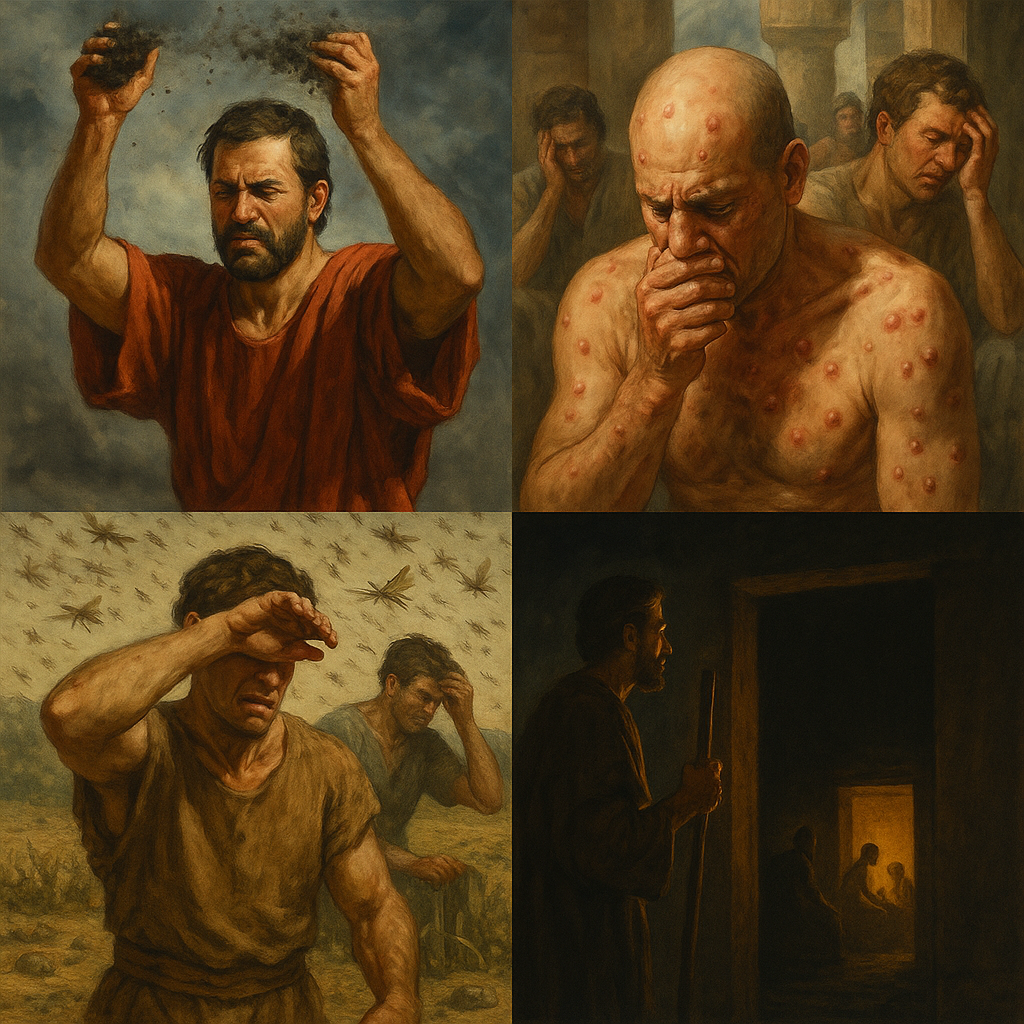
The LORD commands Moses and Aaron to take handfuls of ashes from the furnace. Moses scatters them toward heaven before Pharaoh.
They become:
“a boil breaking forth with blains upon man, and upon beast.”
— Exodus 9:10
The magicians, who earlier attempted to oppose Moses, now cannot even stand before him:
“And the magicians could not stand before Moses because of the boils; for the boil was upon the magicians, and upon all the Egyptians.”
— Exodus 9:11
Their inability to stand is explicit. Scripture does not state what they thought about the plague, so conclusions about their personal repentance or beliefs would go beyond the text.
Verse 12 then says:
“And the LORD hardened the heart of Pharaoh, and he hearkened not unto them.”
This is an important doctrinal statement. The same chapter also says Pharaoh himself “sinned yet more, and hardened his heart” (9:34).
Therefore, Scripture presents both truths:
- the LORD hardened Pharaoh’s heart;
- Pharaoh was personally responsible for his sinful refusal.
The Bible gives no warrant for removing either truth in order to make the other easier to explain.
3. The plague of hail — Exodus 9:13–35
Moses is commanded to rise early and stand before Pharaoh.
This warning contains one of the clearest explanations in the plague narrative concerning God’s purpose:
“For I will at this time send all my plagues upon thine heart, and upon thy servants, and upon thy people; that thou mayest know that there is none like me in all the earth.”
— Exodus 9:14
The LORD then declares concerning Pharaoh:
“And in very deed for this cause have I raised thee up, for to shew in thee my power; and that my name may be declared throughout all the earth.”
— Exodus 9:16
God’s supremacy, power, and name are central to the passage.
Yet even before the hail falls, God gives a warning that permits people to act upon His word:
“Send therefore now, and gather thy cattle, and all that thou hast in the field.”
— Exodus 9:19
A remarkable distinction then appears among Pharaoh’s servants:
“He that feared the word of the LORD among the servants of Pharaoh made his servants and his cattle flee into the houses:”
— Exodus 9:20
But:
“he that regarded not the word of the LORD left his servants and his cattle in the field.”
— Exodus 9:21
This is one of the strongest practical lessons in the chapter: what a person believes about God’s word is demonstrated by what he does with it.
Moses stretches forth his rod, and:
“the LORD sent thunder and hail, and the fire ran along upon the ground.”
— Exodus 9:23
The hail destroys men, beasts, herbs, and trees that are exposed in the field.
Again, God distinguishes Israel:
“Only in the land of Goshen, where the children of Israel were, was there no hail.”
— Exodus 9:26
Pharaoh then declares:
“I have sinned this time: the LORD is righteous, and I and my people are wicked.”
— Exodus 9:27
Those words are true. Yet Moses tells Pharaoh:
“I know that ye will not yet fear the LORD God.”
— Exodus 9:30
Here the expression “not yet” is explicitly present in the KJV text and therefore may properly be used concerning Pharaoh’s fear of God at this point.
The flax and barley are smitten, while the wheat and rie are not, because:
“they were not grown up.”
— Exodus 9:32
This gives information about the stage of the crops. Scripture does not give a calendar date here, so a more precise dating based upon agricultural reconstruction should be identified as historical inference rather than biblical certainty.
When the storm ceases, Pharaoh again sins:
“he sinned yet more, and hardened his heart, he and his servants.”
— Exodus 9:34
His confession under judgment did not result in continued obedience.
Exodus 10 — Locusts and Thick Darkness
1. The purpose of the signs — Exodus 10:1–2
The LORD tells Moses:
“Go in unto Pharaoh: for I have hardened his heart, and the heart of his servants, that I might shew these my signs before him:”
— Exodus 10:1
There is also an explicitly stated purpose involving future generations:
“And that thou mayest tell in the ears of thy son, and of thy son’s son, what things I have wrought in Egypt, and my signs which I have done among them; that ye may know how that I am the LORD.”
— Exodus 10:2
God intended His works in Egypt to be remembered and taught.
Biblical truth is not merely to be experienced by one generation; God’s works and words are to be communicated faithfully to the generation that follows.
2. The plague of locusts — Exodus 10:3–20
Moses and Aaron again confront Pharaoh:
“Thus saith the LORD God of the Hebrews, How long wilt thou refuse to humble thyself before me? let my people go, that they may serve me.”
— Exodus 10:3
The issue is now explicitly described as Pharaoh’s refusal to “humble” himself before God.
The threatened locusts will consume what the hail left behind.
Pharaoh’s servants begin urging him:
“How long shall this man be a snare unto us? let the men go, that they may serve the LORD their God: knowest thou not yet that Egypt is destroyed?”
— Exodus 10:7
When Moses and Aaron are brought back, Pharaoh asks who will go.
Moses answers comprehensively:
“We will go with our young and with our old, with our sons and with our daughters, with our flocks and with our herds will we go.”
— Exodus 10:9
Pharaoh attempts to restrict the command:
“go now ye that are men, and serve the LORD.”
— Exodus 10:11
Moses does not accept the compromise.
The LORD then brings the locusts through an east wind:
“For they covered the face of the whole earth, so that the land was darkened.”
— Exodus 10:15
They consume the remaining vegetation.
Pharaoh again confesses:
“I have sinned against the LORD your God, and against you.”
— Exodus 10:16
He asks Moses to forgive his sin “only this once” and to entreat the LORD.
Moses does so. The LORD sends a strong west wind which carries the locusts:
“into the Red sea.”
— Exodus 10:19
Yet:
“the LORD hardened Pharaoh’s heart, so that he would not let the children of Israel go.”
— Exodus 10:20
3. Three days of darkness — Exodus 10:21–29
Without another recorded warning to Pharaoh in the text, the LORD commands Moses:
“Stretch out thine hand toward heaven, that there may be darkness over the land of Egypt, even darkness which may be felt.”
— Exodus 10:21
The result is:
“a thick darkness in all the land of Egypt three days.”
— Exodus 10:22
The Egyptians:
“saw not one another, neither rose any from his place for three days.”
— Exodus 10:23
But again the LORD makes a distinction:
“but all the children of Israel had light in their dwellings.”
Pharaoh offers another compromise. Israel may leave, but the flocks and herds must remain.
Moses refuses:
“Our cattle also shall go with us; there shall not an hoof be left behind.”
— Exodus 10:26
Moses explains that the animals are necessary for serving the LORD, and:
“we know not with what we must serve the LORD, until we come thither.”
This is not Moses negotiating the terms of obedience. God determines how He is to be served.
Pharaoh finally tells Moses:
“Get thee from me, take heed to thyself, see my face no more; for in that day thou seest my face thou shalt die.”
— Exodus 10:28
Moses replies:
“Thou hast spoken well, I will see thy face again no more.”
— Exodus 10:29
The statement should be allowed to stand exactly as Scripture gives it without constructing an unnecessary sequence of events beyond what the text states.
Exodus 11 — The Final Plague Announced
1. One plague more — Exodus 11:1–3
The LORD tells Moses:
“Yet will I bring one plague more upon Pharaoh, and upon Egypt.”
— Exodus 11:1
The result will be decisive:
“afterwards he will let you go hence: when he shall let you go, he shall surely thrust you out hence altogether.”
The Israelites are instructed to request valuables from their Egyptian neighbors:
“jewels of silver, and jewels of gold.”
— Exodus 11:2
The KJV uses the word “borrow” in this command.
The text then explicitly states:
“And the LORD gave the people favour in the sight of the Egyptians.”
— Exodus 11:3
It also says:
“Moreover the man Moses was very great in the land of Egypt, in the sight of Pharaoh’s servants, and in the sight of the people.”
No further explanation for precisely how they regarded Moses should be added beyond this statement.
2. The death of the firstborn announced — Exodus 11:4–8
Moses declares:
“Thus saith the LORD, About midnight will I go out into the midst of Egypt:”
— Exodus 11:4
The judgment will reach throughout Egyptian society:
“And all the firstborn in the land of Egypt shall die, from the firstborn of Pharaoh that sitteth upon his throne, even unto the firstborn of the maidservant that is behind the mill; and all the firstborn of beasts.”
— Exodus 11:5
This will produce:
“a great cry throughout all the land of Egypt, such as there was none like it, nor shall be like it any more.”
— Exodus 11:6
Once again, the LORD explicitly distinguishes Israel:
“But against any of the children of Israel shall not a dog move his tongue, against man or beast.”
— Exodus 11:7
The stated purpose is:
“that ye may know how that the LORD doth put a difference between the Egyptians and Israel.”
That distinction must be respected doctrinally. Israel is Israel. The passage is not teaching that the Church replaces Israel or that every physical promise given to Israel in Egypt automatically applies to the New Testament Church.
The protection described here was specifically promised to the children of Israel in this historical situation.
Moses tells Pharaoh that Pharaoh’s servants will eventually come to him saying:
“Get thee out, and all the people that follow thee.”
— Exodus 11:8
Moses then leaves Pharaoh:
“in a great anger.”
The anger is explicitly stated. Scripture does not elaborate upon every inward motive behind it, so unnecessary psychological reconstruction should be avoided.
3. The closing explanation — Exodus 11:9–10
The LORD had told Moses:
“Pharaoh shall not hearken unto you; that my wonders may be multiplied in the land of Egypt.”
— Exodus 11:9
The chapter concludes:
“And Moses and Aaron did all these wonders before Pharaoh: and the LORD hardened Pharaoh’s heart, so that he would not let the children of Israel go out of his land.”
— Exodus 11:10
The stage is now set for Exodus 12 and the final plague.
Key People and Places
The LORD — The sovereign Actor throughout these chapters. He sends the judgments, establishes their limits, distinguishes Israel from Egypt, controls their beginning and ending, and declares His purpose beforehand.
Moses — God’s appointed spokesman before Pharaoh. He faithfully delivers the LORD’s commands and refuses Pharaoh’s attempts to modify the terms of Israel’s departure.
Aaron — Accompanies Moses in confronting Pharaoh and participates in the execution of God’s commands.
Pharaoh — King of Egypt who continually refuses the LORD’s command. Scripture explicitly attributes hardening both to Pharaoh’s own actions and to the LORD.
Pharaoh’s servants — Some fear the word of the LORD and protect their servants and cattle before the hail (9:20). Later they urge Pharaoh to allow Israel to leave (10:7).
The magicians — Egyptian magicians who are themselves afflicted by the boils and are unable to stand before Moses (9:11).
The Egyptians — The people of Egypt upon whom these judgments fall. Exodus 11:3 says the LORD gives Israel favor in their sight.
The children of Israel — God’s covenant people whom He is bringing out of Egypt. The LORD repeatedly makes an observable distinction between them and the Egyptians.
Egypt — The land upon which the plagues fall and in which the LORD publicly demonstrates His power.
Goshen — The area where the children of Israel dwell. Exodus 9:26 explicitly says there was no hail there.
Red Sea — The sea into which the LORD drives the locusts in Exodus 10:19.
Main Doctrinal or Spiritual Themes
1. The absolute supremacy of the LORD
The central theological declaration is:
“that thou mayest know that there is none like me in all the earth.”
— Exodus 9:14
The chapters reveal the LORD’s authority over:
- disease,
- human health,
- animals,
- hail,
- fire,
- vegetation,
- wind,
- locusts,
- darkness,
- life and death.
The text presents Jehovah as sovereign over the whole created order.
2. God’s purpose is the declaration of His name
Exodus 9:16 states:
“that my name may be declared throughout all the earth.”
God’s dealings with Pharaoh are not merely about Pharaoh. They publicly reveal who God is.
Biblical ministry likewise must be centered upon making God known rather than exalting man.
3. God’s judgment is righteous
Pharaoh himself acknowledges:
“the LORD is righteous, and I and my people are wicked.”
— Exodus 9:27
Although Pharaoh does not continue in obedience, the statement itself accords with the truth of the passage.
God never becomes unrighteous because His judgments are severe. His holiness determines what justice is; fallen man does not sit in judgment over God.
4. Human responsibility and divine hardening are both taught
Exodus refuses to eliminate either side.
Concerning Pharaoh:
“he sinned yet more, and hardened his heart”
— Exodus 9:34
Yet Scripture also says:
“the LORD hardened the heart of Pharaoh”
— Exodus 9:12
Both are inspired statements.
This does not require a Calvinistic doctrine in which Pharaoh is treated as a man regenerated or condemned through some arbitrary irresistible mechanism. The text plainly presents Pharaoh as a responsible ruler who repeatedly rejects revealed commands while also showing God’s sovereign judicial action upon him.
We should affirm exactly what Scripture states without constructing a philosophical system beyond the text.
5. God distinguishes Israel from Egypt
This appears repeatedly:
- Israel’s cattle are spared — 9:4–7.
- Goshen is spared from hail — 9:26.
- Israel has light in its dwellings — 10:23.
- Israel is distinguished during the threatened death of the firstborn — 11:7.
Exodus 11:7 states the principle directly:
“that ye may know how that the LORD doth put a difference between the Egyptians and Israel.”
This reinforces the biblical distinction of Israel as a real, identifiable people in God’s historical dealings.
It should not be spiritualized into a denial of national Israel or used to teach that the Church has replaced Israel.
6. God’s Word must be feared and acted upon
Exodus 9:20–21 gives a remarkably practical contrast.
One group:
“feared the word of the LORD”
and acted accordingly.
The other:
“regarded not the word of the LORD”
and left their servants and cattle exposed.
The dividing issue was their response to what God had said.
True reverence toward Scripture produces action.
7. God determines the terms of acceptable service
Pharaoh repeatedly tries to modify obedience.
He proposes:
- only certain Israelites should go;
- later, the people may go while their livestock remain.
Moses refuses these compromises.
His statement is decisive:
“there shall not an hoof be left behind.”
— Exodus 10:26
Man does not have authority to rewrite God’s commands in order to make obedience more convenient.
8. The works of God are to be taught to succeeding generations
Exodus 10:2 specifically says Israel is to tell these things:
“in the ears of thy son, and of thy son’s son.”
Parents have a biblical responsibility to teach their children what God has said and what God has done.
Christian homes should not assume that biblical truth will somehow transfer automatically from one generation to another.
9. Confession without continuing obedience is insufficient
Pharaoh says:
“I have sinned.”
— Exodus 9:27
And again:
“I have sinned against the LORD your God, and against you.”
— Exodus 10:16
Yet afterward he resumes his resistance.
The text therefore demonstrates that words uttered under the pressure of judgment do not necessarily represent enduring submission to God’s Word.
This should not be confused with teaching salvation by works. Salvation is by grace through faith, apart from works. Rather, the passage warns against mistaking temporary distress over consequences for genuine submission to what God has spoken.
Practical Applications or Lessons
Take God’s warnings seriously
The Egyptians who “feared the word of the LORD” acted before the hail came.
Faith takes God at His word before the judgment becomes visible.
Do not continually resist known truth
Pharaoh receives warning after warning, evidence after evidence, and opportunity after opportunity.
Yet his heart becomes increasingly characterized by resistance.
“How long wilt thou refuse to humble thyself before me?”
— Exodus 10:3
A believer should respond quickly when Scripture exposes sin rather than cultivating resistance to conviction.
Never bargain with clear obedience
Pharaoh repeatedly tries to reduce God’s demand.
Moses repeatedly refuses.
The principle is plain: when God has clearly spoken, obedience is not a negotiation.
There must be no deliberate reservation of some cherished area of life from God’s authority.
Fear God’s Word more than circumstances
Exodus 9:20 does not merely say some Egyptians feared the storm. It specifically says they:
“feared the word of the LORD.”
The hail had not fallen when they acted.
That is an excellent pattern for biblical faith: God’s Word is sufficient reason to respond.
Teach God’s works to your children
God specifically wanted what happened in Egypt rehearsed to future generations.
Parents and churches should deliberately teach:
- what God has said,
- what God has done,
- who God is,
- why He must be obeyed.
Do not mistake temporary remorse for spiritual change
Pharaoh’s repeated admissions of sin did not end his rebellion.
A person may dislike the consequences of sin without truly submitting to God’s Word.
The believer should seek genuine confession and forsaking of sin, not merely relief from unpleasant consequences.
Remember that God is not obligated to compromise His holiness
Pharaoh’s political position did not alter God’s command.
Neither power, culture, public opinion, nor human authority changes what God has said.
“the LORD is righteous”
— Exodus 9:27
That remains true whether men submit to Him or resist Him.
Recognize God’s sovereign control without denying man’s responsibility
Exodus 9–11 gives no permission to make Pharaoh an innocent victim of divine sovereignty.
Nor does it permit man to diminish God’s authority in order to defend human responsibility.
The KJV teaches both facts plainly:
- Pharaoh hardened his heart.
- The LORD hardened Pharaoh’s heart.
- Pharaoh sinned.
- God’s purpose was accomplished.
The safest doctrinal position is to affirm every statement Scripture makes and refuse to go beyond it.
Keep Israel and the Church distinct
The physical distinctions in Goshen were promises and acts directed toward the children of Israel in Egypt.
They should not be turned into a promise that Christians will never experience disease, storms, financial loss, persecution, or other physical suffering.
God certainly cares for His Church, but Exodus 9–11 is describing His historical dealings with Israel and Egypt. Sound dispensational interpretation preserves that distinction.
Overall Emphasis
Exodus 9–11 presents a progressively unmistakable confrontation between the word of the LORD and the stubborn refusal of Pharaoh.
Again and again God demonstrates:
His Word is certain.
His judgments are righteous.
His power is unequaled.
His authority cannot be negotiated.
His purposes cannot be defeated.
His distinction concerning Israel is deliberate.
And His name will be declared.
The great question posed to Pharaoh remains searching:
“How long wilt thou refuse to humble thyself before me?”
— Exodus 10:3
These chapters therefore call the reader not merely to marvel at God’s power in Egypt, but to fear the word of the LORD, humble himself before God, and obey what God has plainly spoken.
Comments are closed