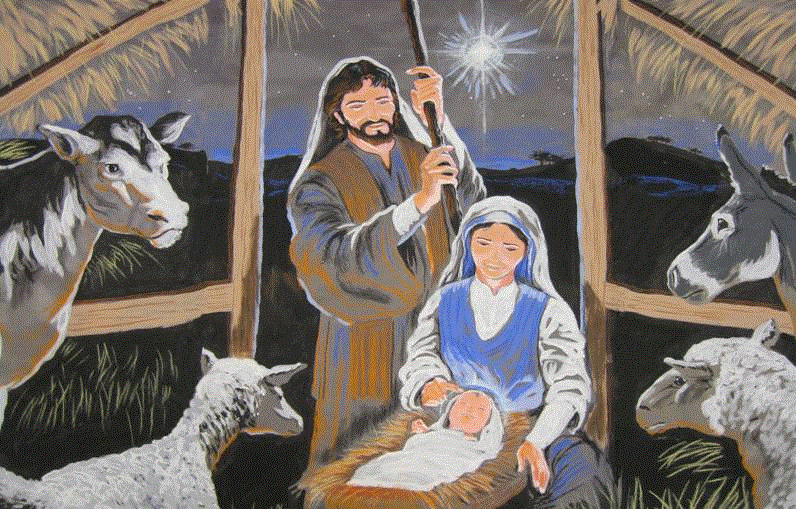
I recently came across a Jewish shepherding tradition that stopped me in my tracks.
According to some historical reflections,
shepherds would carefully set apart
unblemished lambs intended for sacrifice
At birth, these lambs were closely guarded,
often wrapped and placed temporarily
in feeding troughs to keep them from injury,
preserving them as spotless offerings.
Scripture doesn’t explicitly record this practice.
And it’s important to say that plainly.
But the moment I read it,
my mind went immediately to Luke 2,
and it changed the way I read the Christmas story.
Because if shepherds truly understood
what it meant to recognize an unblemished lamb,
then suddenly it makes perfect sense
why they were among the first to see the Messiah.
Luke tells us the angel gave them a very specific sign,
“You will find a baby wrapped in swaddling cloths
and lying in a manger.” (Luke 2:12)
Not a palace.
Not a throne.
Not a royal nursery.
A feeding trough.
Wrapped in cloth strips.
An infant placed where animals feed.
To most people, even to us,
that scene would have looked ordinary,
maybe even disappointing.
But to shepherds?
Men whose lives revolved around animals,
birth, inspection, and care?
That sign would have spoken
a language they understood.
They knew what it meant
to look for something fragile.
They knew what it meant
to guard what was set apart.
They knew how to examine
what was without blemish.
So when heaven announced
the birth of a Savior and pointed them,
not to power, but to humility,
they were ready to recognize Him.
I’m thinking this is probably
why the shepherds didn’t arrive confused.
Luke says they “went with haste”.
This detail matters.
They didn’t wander.
They didn’t hesitate.
They didn’t question whether the sign made sense.
They knew exactly what they were looking for.
And when they saw Him, they didn’t debate theology.
They worshiped. Then they testified.
From the very beginning,
Jesus is placed in the world of sacrifice, not spectacle.
His story doesn’t start with miracles or sermons, it starts with positioning.
He is wrapped.
He is laid down.
He is seen by shepherds before kings.
Long before the cross, the language of offering is already being spoken.
Later, Scripture will call Him, the Lamb of God who takes away the sin of the world, the Passover Lamb, the One without blemish or spot.
But perhaps the shepherds saw something that night others would miss, not because they knew everything, but because they knew enough.
Enough to recognize that God’s salvation would not arrive looking powerful.
Enough to believe that holiness could be wrapped in weakness.
Enough to understand that what is set apart often arrives quietly.
Whether or not every detail of that shepherding tradition can be historically proven, the theology remains unmistakable, God chose witnesses who knew how to recognize a lamb.
And maybe that’s the invitation for us, too.
To stop looking for God only in the impressive.
To recognize Him in the humble.
To understand that salvation may come wrapped in ways we don’t expect, but always exactly as promised.
The shepherds saw Him because they knew what they were looking at.
And the unblemished Lamb had been marked from the beginning.
Comments are closed