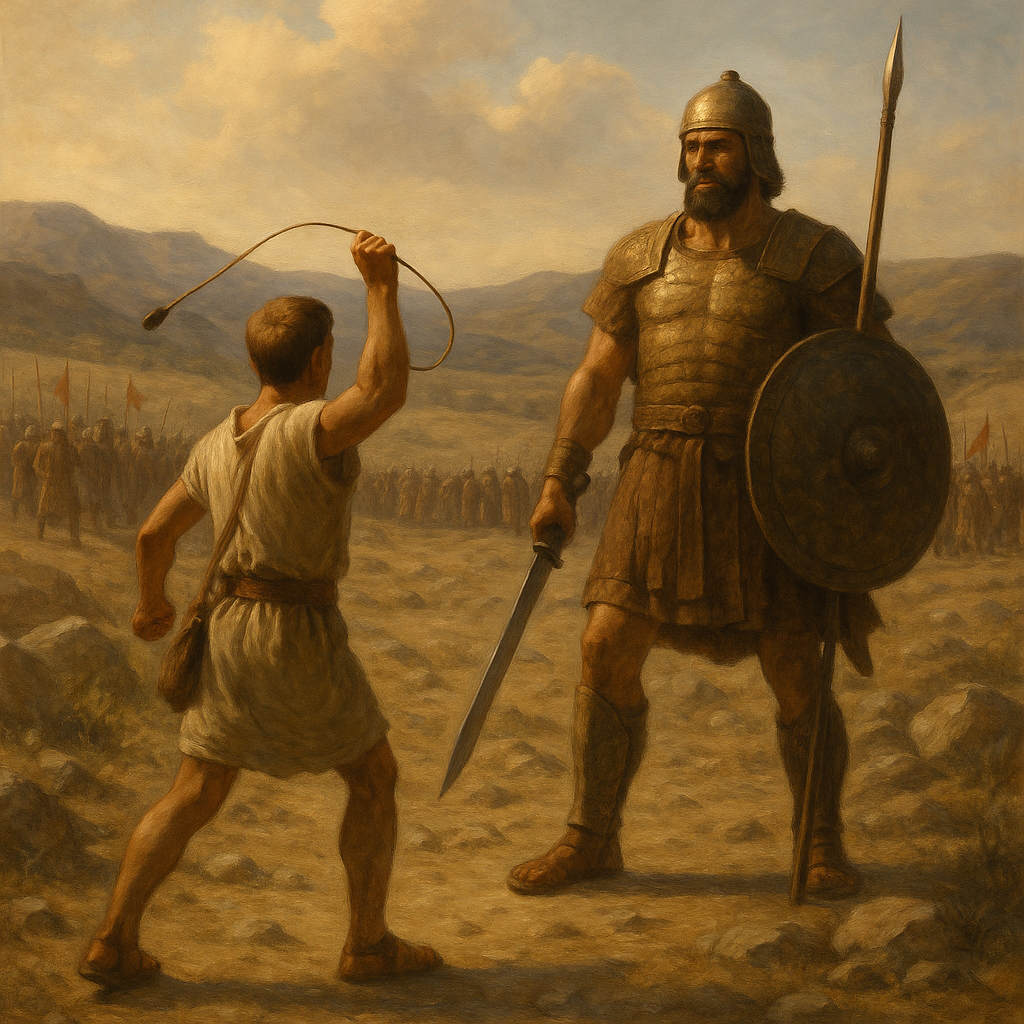
After David killed Goliath, Saul and Abner seemed to not know who David was. In the previous chapter it seems that Saul asked Jesse if David could stay with him, which he did, and calmed Saul down.
You are noticing something many readers catch:
In 1 Samuel 16, Saul knows David.
In 1 Samuel 17, Saul and Abner seem not to know David.
At first glance, it looks like a contradiction — but it’s not.
Here is the clear conservative Baptist explanation that fits the KJV text perfectly.
1. Saul Was Not Asking “Who Is David?” — He Was Asking “Whose Son Is He?”
This is the key.
In 1 Samuel 17:55, Saul asks:
“Whose son is this youth?”
He does not say:
-
Who is this young man?
-
What is his name?
-
Where have I seen him before?
He asks specifically about his father.
Why?
Because Saul had made a royal promise:
“…make his father’s house free in Israel.” (1 Sam. 17:25)
To keep this tax-exemption and reward promise, Saul needed to know:
-
David’s tribe
-
David’s lineage
-
David’s family standing
-
The legal head of the house
Saul already knew David personally as a musician,
but he had never inquired about David’s family background.
2. In Chapter 16, Saul Never Met Jesse, and David Was Just “The Harp Player” to Him
In chapter 16:
-
David was brought to Saul as a harpist.
-
Saul was comforted by David’s playing.
-
Saul loved him and made him his armorbearer.
But notice:
-
There is no record Saul asked about David’s father.
-
David was much younger, and likely insignificant in Saul’s mind.
-
David may not have been constantly in Saul’s court — he went back and forth between Saul and Jesse (16:21–23; 17:15).
To Saul, David was simply:
-
the young harp player
-
the armorbearer
-
the boy who could calm him
Saul never asked:
-
“Who is his father?”
-
“What is his family’s standing?”
-
“What is his lineage?”
Until now, it simply didn’t matter.
3. David Looked Completely Different on the Battlefield
In 1 Samuel 17:
-
David is now armed with shepherd gear.
-
He is bold, fearless, and confident.
-
He is speaking publicly in the camp.
-
He is confronting Israel’s men.
-
Saul sees him standing victorious with Goliath’s head.
He was not the quiet harp player Saul remembered.
Even Abner — the captain of the host — is unsure, because Abner never had reason to interact with David before.
So Saul asks:
“Abner, whose son is this youth?”
This fits the context perfectly.
4. Saul’s Mental State Was Declining
Because the Spirit of the LORD departed from Saul (1 Sam. 16:14), Saul’s mental clarity had begun deteriorating.
This explains:
-
inconsistency
-
forgetfulness
-
confusion
-
paranoia
This does not mean Saul forgot David entirely — rather, he had no firm grasp of David’s background.
5. David’s Status Had Changed Dramatically in One Moment
Before killing Goliath:
-
David was a servant, a nobody.
After killing Goliath:
-
David was the national hero.
-
David was the future son-in-law (17:25).
-
David was the one God prospered.
-
David was suddenly someone Saul needed to track.
Saul’s question is entirely appropriate for someone now needing to elevate David to national prominence.
6. Abner Did Not Know David’s Lineage Either
Abner was a military man.
He did not work in the music room, nor did he track family trees.
So his answer makes perfect sense:
“As thy soul liveth, O king, I cannot tell.”
CONSERVATIVE BAPTIST SUMMARY
There is no contradiction.
The passages fit together naturally.
? Saul knew David,
but did not know David’s father, which he needed to know because of the promised royal rewards.
? David looked and behaved very differently on the battlefield,
making him seem like a different man than the quiet harpist.
? Saul’s spiritual and mental decline made him inconsistent.
The loss of the Spirit (16:14) affected his perception.
? Abner never previously interacted with David in any identifying manner.
Therefore, Saul’s question in chapter 17 is not about David’s identity, but about David’s lineage, which was essential for keeping Saul’s promise.
In verse 16:19 Saul sent unto Jesse
1 Samuel 16:19, where Saul did send to Jesse and ask for David:
“Wherefore Saul sent messengers unto Jesse, and said, Send me David thy son, which is with the sheep.”
So if Saul knew Jesse—why, in chapter 17, does Saul ask Abner:
“Whose son is this youth?”
(1 Sam. 17:55)
Here is the clear, conservative explanation that resolves both chapters without contradiction.
? 1. Saul Knew Jesse’s Name, but Not David’s Lineage or Status
In 1 Samuel 16, Saul only needed David for harp playing.
His messengers told him:
-
David’s name
-
Jesse’s name
-
Where he lived
-
That David was skilled
That does not mean Saul:
-
knew Jesse personally
-
knew Jesse’s tribe
-
knew Jesse’s standing
-
knew Jesse’s family history
-
knew Jesse’s military obligations
-
knew anything legal about Jesse’s “house”
Saul only knew the basics necessary to summon a servant.
Knowing a man’s father’s name is NOT the same as knowing his father’s house.
The “house” (in ancient Israel) involved:
-
family lineage
-
inheritance
-
tribal standing
-
service obligations
-
taxation records
-
redemption rights
-
exemption privileges
-
military status
That is exactly what mattered now because Saul had promised:
“…and make his father’s house free in Israel.”
(1 Sam. 17:25)
This required formal, legal identification—not casual knowledge from a messenger.
? 2. Saul Did Not Personally Interact With Jesse in Chapter 16
Saul never met Jesse.
He sent messengers:
-
They contacted Jesse
-
They brought David
-
Saul accepted David into his service
Saul himself had no relationship with Jesse.
This makes his question in chapter 17 reasonable:
“Whose son is this youth?”
Because now he needed to know Jesse’s:
-
identity
-
lineage
-
household standing
-
legal status
? 3. David Was Not Living Permanently at Saul’s Court Yet
This is extremely important.
1 Samuel 17:15 says:
“But David went and returned from Saul to feed his father’s sheep at Bethlehem.”
Meaning:
-
David was not permanently in Saul’s service
-
He was going back and forth
-
He was a part-time servant, not a member of Saul’s court
-
Saul likely had many servants of similar age
David was not high profile.
Saul had no reason to investigate his background until the Goliath event.
? 4. David Looked Completely Different in Chapter 17
In chapter 16:
-
David is a quiet harp-player
-
Dressed as a court servant
-
Submitted and calm
-
Not a warrior
In chapter 17:
-
He arrives as a shepherd
-
Without court dress
-
Boldly asking questions
-
Challenging soldiers
-
Speaking faith with authority
-
Then standing victorious with Goliath’s head
He did not look or act like the same person Saul saw in calmer days.
? 5. Saul’s Spiritual and Mental Decline Affected His Perception
1 Samuel 16:14 is key:
“the Spirit of the LORD departed from Saul”
The very next verses show:
-
instability
-
torment
-
confusion
-
deteriorating judgment
This explains why:
-
he did not connect “harp-playing David” with “giant-slaying David”
-
he forgot or ignored things he should have remembered
-
he acted inconsistently and irrationally
Saul’s spiritual decay under divine judgment is already underway.
? 6. Saul Did Not Ask: “Who is he?” — He Asked: “Whose SON is he?”
This is the entire issue.
He is not trying to identify David the person.
He is trying to identify David’s family, because:
-
He promised freedom from taxes.
-
He promised rewards to the father.
-
He promised marriage to his daughter.
-
He needed legal verification.
Before killing Goliath, David’s father-house status meant nothing.
After killing Goliath, it meant everything.
? FINAL ANSWER (Conservative Baptist Summary)
There is no contradiction between chapters 16 and 17.
Saul knew David by name and as a harpist (chapter 16).
He did NOT know his father’s lineage, legal house, or tribal standing (chapter 17).
David was a low-level servant who traveled back and forth to Bethlehem and did not live in Saul’s court. Saul had never met Jesse personally and had no reason to investigate his family until David’s victory required legal, national recognition.
Thus Saul asks Abner:
“Whose son is this youth?”
Not:
-
“Who is he?”
-
“What is his name?”
-
“Do I know him?”
He needed Jesse’s official identity, not David’s.
Comments are closed