Luke 3-5: Repentance, Christ’s Authority, and the Call to Follow Him
 Luke 3-5 moves from John the Baptist’s preparation of the people to the public ministry of Jesus Christ. John calls for repentance and points to One mightier than himself. Jesus is baptized, faces the devil’s temptations, preaches the Word, casts out devils, heals the sick, forgives sins, and calls disciples to follow Him.
Throughout these chapters, the emphasis rests upon who Jesus is and how people respond to Him. His authority reaches beyond physical sickness to mankind’s deeper need: forgiveness of sins and reconciliation to God.
Chapter Summaries
Luke 3: John Prepares the Way, and the Father Identifies His Son
John’s ministry and message: Luke 3:1-6
Luke places John’s ministry within a named historical setting, identifying political rulers and religious leaders. Against that background, “the word of God came unto John the son of Zacharias in the wilderness” (Luke 3:2).
John comes into the country around Jordan, preaching “the baptism of repentance for the remission of sins” (Luke 3:3). Luke connects his ministry with the words of Esaias:
“Prepare ye the way of the Lord, make his paths straight.”
Luke 3:4
John’s work prepares people for the Lord’s coming. His message requires a response to God’s truth, rather than confidence in religious ancestry or outward appearance.
Repentance must bear fruit: Luke 3:7-14
John warns the multitudes about coming wrath and commands:
“Bring forth therefore fruits worthy of repentance.”
Luke 3:8
Claiming Abraham as their father cannot shield them from judgment. The image of the ax laid to the root of the trees stresses the seriousness of God’s demand for good fruit.
When the people ask what they should do, John gives specific answers:
- Those with clothing and food should share with those who lack them.
- Publicans should collect no more than the appointed amount.
- Soldiers should avoid violence and false accusation and be content with their wages.
These actions are fruits worthy of repentance, not a purchase price for salvation. John’s wording distinguishes repentance from the conduct that should accompany it. Salvation is by grace through faith, while good works belong in the life of those saved by grace (Ephesians 2:8-10).
The mightier One and coming judgment: Luke 3:15-18
When people wonder whether John might be the Christ, he directs attention away from himself:
“One mightier than I cometh, the latchet of whose shoes I am not worthy to unloose.”
Luke 3:16
John baptizes with water, but the coming One will baptize “with the Holy Ghost and with fire.” The next verse describes wheat gathered into the garner and chaff burned “with fire unquenchable” (Luke 3:17). That immediate context connects the fire with judgment; it should not be casually presented as a symbol of religious excitement.
Christ distinguishes between those represented by the wheat and those represented by the chaff. His coming brings both blessing and judgment.
Herod’s resistance to rebuke: Luke 3:19-20
John reproves Herod concerning Herodias, his brother Philip’s wife, and the other evils Herod has done. Herod adds to his wrongdoing by imprisoning John.
Luke records this imprisonment before describing Jesus’ baptism. That arrangement should not be used to claim that John was already imprisoned when Jesus was baptized. Matthew 3:13-17 explicitly identifies John as the one who baptized Jesus.
Jesus’ baptism and genealogy: Luke 3:21-38
Jesus is baptized, and while He prays, heaven opens. The Holy Ghost descends in a bodily shape like a dove, and the Father’s voice declares:
“Thou art my beloved Son; in thee I am well pleased.”
Luke 3:22
The Father speaks, the Son is present, and the Holy Ghost descends. This passage provides clear testimony to the distinction of the divine Persons.
Jesus’ baptism is not a confession of personal sin. Scripture declares that He was “without sin” (Hebrews 4:15). Matthew records His explanation that it was fitting “to fulfil all righteousness” (Matthew 3:15).
Luke states that Jesus was “about thirty years of age” and was, “as was supposed,” the son of Joseph (Luke 3:23). That qualification agrees with Luke’s earlier account of His virgin conception (Luke 1:34-35).
The genealogy reaches through David and Abraham to Adam. Luke does not explicitly call it Mary’s genealogy; that familiar explanation should not be presented as a direct statement of this passage.
Luke 4: Christ Resists Temptation and Ministers with Authority
Temptation in the wilderness: Luke 4:1-13
Jesus, full of the Holy Ghost, returns from Jordan and is led by the Spirit into the wilderness. He is tempted by the devil for forty days and eats nothing during that period.
Luke records three temptations:
- Command a stone to become bread. Jesus answers that man does not live by bread alone, but by every word of God.
- Worship the devil in exchange for the kingdoms of the world. Jesus declares that worship and service belong to God alone.
- Cast Himself down from the temple. Jesus refuses to tempt the Lord God.
In each response, Jesus appeals to Scripture (Deuteronomy 8:3; 6:13, 16). The devil also quotes Scripture, demonstrating that biblical words can be misused when separated from obedience to God.
The devil claims authority over the kingdoms in Luke 4:6. The passage records his claim; it does not require readers to accept every part of that claim as a truthful description of his rights.
Jesus withstands temptation without sin. After the temptations, the devil departs “for a season” (Luke 4:13).
The Scripture fulfilled at Nazareth: Luke 4:14-22
Jesus returns in the power of the Spirit into Galilee and teaches in the synagogues. At Nazareth, where He was brought up, He enters the synagogue on the sabbath, “as his custom was” (Luke 4:16).
He reads from Esaias concerning the Spirit-anointed ministry of preaching good news, healing, deliverance, and liberty. He then announces:
“This day is this scripture fulfilled in your ears.”
Luke 4:21
Jesus identifies Himself as the fulfillment of the passage. His ministry carries divine authorization and brings God’s provision to those in need.
Rejection at Nazareth: Luke 4:23-30
Jesus declares that no prophet is accepted in his own country. He recalls two Old Testament events: Elias was sent to a widow in Sarepta, and Naaman the Syrian was cleansed of leprosy in the days of Eliseus.
These examples show God’s dealings extending beyond Israel. They provide no basis for human demands that God grant special favors because of hometown familiarity or national identity.
Those in the synagogue become furious and attempt to cast Jesus down from the brow of the hill. He passes through their midst and goes His way. Scripture states that He escaped their attempt, but does not explain how He passed through them.
Authority over devils and disease: Luke 4:31-44
At Capernaum, the people are astonished because Jesus’ word is with power. He commands an unclean devil to come out of a man, and the man is delivered.
Jesus also heals Simon’s mother-in-law of a great fever. She immediately rises and ministers to them. Later, people bring the sick to Him, and He heals them. Devils identify Him as Christ, but He does not permit them to speak.
When people seek to keep Him from departing, Jesus states His purpose:
“I must preach the kingdom of God to other cities also: for therefore am I sent.”
Luke 4:43
His ministry includes compassionate healing, but He expressly identifies the preaching of God’s kingdom as part of His commission.
Luke 5: Christ Calls Disciples, Cleanses, and Forgives
The miraculous catch and the call to follow: Luke 5:1-11
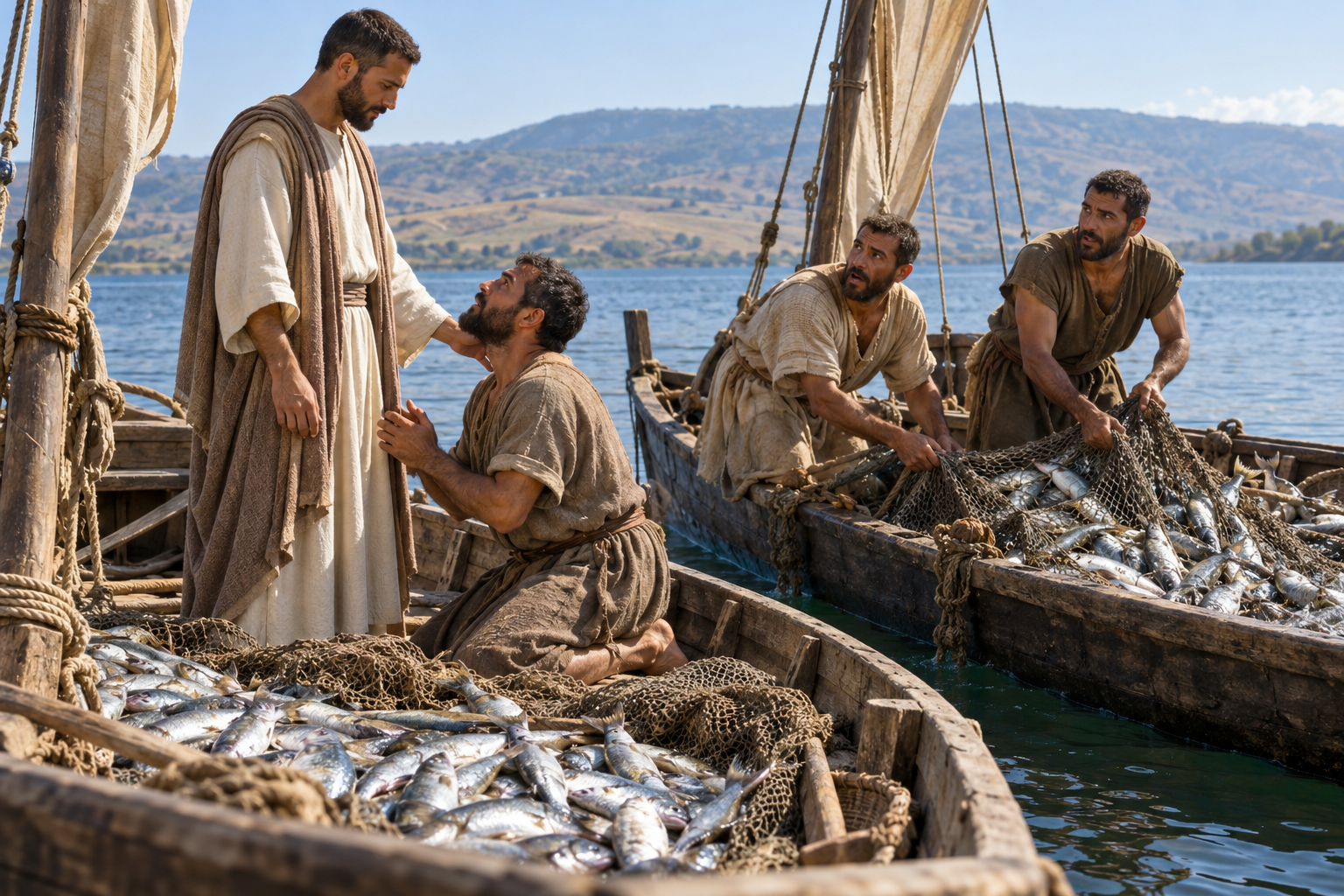
By the lake of Gennesaret, the people press upon Jesus to hear the Word of God. He teaches from Simon’s ship, then commands him to launch into the deep and let down the nets.
Simon acknowledges that they have worked all night without catching anything, but responds:
“Nevertheless at thy word I will let down the net.”
Luke 5:5
The catch is so great that the net breaks, and their partners help fill both ships. Confronted with this display of Christ’s power, Simon Peter falls at Jesus’ knees and confesses his sinfulness.
Jesus answers:
“Fear not; from henceforth thou shalt catch men.”
Luke 5:10
Simon, James, and John bring their ships to land, forsake all, and follow Him. The narrative emphasizes Christ’s authority, Peter’s recognition of his sin, and the disciples’ response to the Lord’s call.
The cleansing of a leper: Luke 5:12-16
A man “full of leprosy” falls before Jesus and says:
“Lord, if thou wilt, thou canst make me clean.”
Luke 5:12
His words affirm Christ’s ability while appealing to His willingness. Jesus touches him and answers, “I will: be thou clean.” Immediately the leprosy departs.
Jesus instructs him to show himself to the priest and make the offering Moses commanded, “for a testimony unto them” (Luke 5:14; see Leviticus 14).
As crowds gather to hear and be healed, Jesus withdraws into the wilderness and prays. Public demands do not eliminate His practice of prayer.
Forgiveness and the healing of the palsied man: Luke 5:17-26
Men bring a man with palsy to Jesus. Unable to enter because of the crowd, they lower him through the housetop.
Seeing their faith, Jesus says:
“Man, thy sins are forgiven thee.”
Luke 5:20
The scribes and Pharisees question His words, asking who can forgive sins but God alone. Jesus knows their thoughts and declares that the Son of man has power on earth to forgive sins.
He then commands the man to rise, take up his couch, and go home. The man immediately obeys, glorifying God.
Jesus explicitly connects the visible healing with His authority to forgive sins. The miracle confirms the authority He has just claimed.
Levi’s call and Christ’s mission to sinners: Luke 5:27-32
Jesus sees Levi, a publican, sitting at the receipt of custom and says, “Follow me.” Levi leaves all, rises, and follows Him.
Levi then makes a great feast in his house. Publicans and others sit with Jesus and His disciples. When the scribes and Pharisees object, Jesus answers:
“I came not to call the righteous, but sinners to repentance.”
Luke 5:32
His association with sinners serves His declared purpose of calling them to repentance. It does not express approval of their sins.
Fasting, the bridegroom, and the parables: Luke 5:33-39
Asked why His disciples eat and drink while others fast, Jesus compares His presence with that of a bridegroom among the children of the bridechamber. He also states that days will come when the bridegroom will be taken away, and then they will fast.
He follows with illustrations involving a new garment, an old garment, new wine, and old bottles. These comparisons show the damage caused by attempting to combine things that do not fit together.
In context, they explain why His disciples’ conduct cannot simply be forced into the expectations raised by His questioners. They should not be stretched into a claim that the Old Testament was mistaken or that God’s moral commands no longer matter.
Key People and Places
People
- Jesus Christ: The beloved Son of the Father, victorious over temptation and possessing authority to teach, deliver, heal, and forgive.
- John the Baptist: The son of Zacharias, sent to prepare the Lord’s way through preaching repentance.
- Herod the tetrarch: A ruler rebuked by John who adds to his sins by imprisoning him.
- Herodias: Identified as the wife of Herod’s brother Philip in John’s rebuke of Herod.
- The devil: The tempter who seeks to turn Jesus from obedience to God.
- Simon Peter: The fisherman who obeys Jesus’ command, confesses his sinfulness, and follows Him.
- James and John: Sons of Zebedee and Simon’s partners, who also forsake all and follow Jesus.
- Levi: A publican who answers Christ’s call and hosts a feast.
- The scribes and Pharisees: Religious figures who question Jesus’ authority to forgive and His association with publicans and sinners.
- Elias, Eliseus, and Naaman: Old Testament figures Jesus mentions when addressing the people at Nazareth.
Places
- Jordan: The region associated with John’s baptismal ministry.
- The wilderness: The setting of John’s reception of God’s word, Jesus’ temptation, and occasions of prayer.
- Galilee: A principal region of Jesus’ teaching and ministry in these chapters.
- Nazareth: The town where Jesus was brought up and where His synagogue message meets violent rejection.
- Capernaum: A Galilean city where Jesus teaches, casts out a devil, and heals.
- Jerusalem: The city where the devil sets Jesus on a pinnacle of the temple.
- The lake of Gennesaret: The setting of Jesus’ teaching from Simon’s ship and the miraculous catch.
- Sarepta in Sidon: The location of the widow to whom Elias was sent.
Main Doctrinal or Spiritual Themes
1. Repentance produces appropriate fruit.
John requires “fruits worthy of repentance” (Luke 3:8). Jesus calls sinners to repentance (Luke 5:32). Neither religious ancestry nor outward association substitutes for a personal response to God’s truth.
2. Jesus is the beloved Son of God.
The Father’s declaration at His baptism establishes His identity (Luke 3:22). His authority throughout these chapters agrees with that testimony.
3. The Father, Son, and Holy Ghost are distinct.
At Jesus’ baptism, the Son is baptized, the Holy Ghost descends, and the Father speaks. This distinction agrees with the biblical doctrine of the Trinity, while Scripture also declares that there is one God (Deuteronomy 6:4).
4. Scripture governs faithful obedience.
Jesus answers temptation with the written Word. The devil’s misuse of Scripture also warns that quoting a verse is insufficient when its meaning and application are distorted.
5. Christ has authority to forgive sins.
The healing of the palsied man verifies Jesus’ declared authority as the Son of man to forgive sins on earth (Luke 5:24). Forgiveness rests upon His authority, not human merit.
6. Religious privilege does not guarantee acceptance with God.
John rejects confidence in Abrahamic ancestry, and Jesus confronts the expectations of His hometown audience. Each person must respond to God’s truth.
7. Christ calls sinners and commands discipleship.
Jesus calls people to repentance and calls disciples to follow Him. Levi’s response and the fishermen’s response show obedience expressed in decisive action.
8. Judgment is real.
John’s warnings about wrath, the ax, and unquenchable fire are solemn declarations of accountability before God (Luke 3:7-9, 17).
Practical Applications or Lessons
- Examine the fruit of your professed repentance. Honesty, generosity, contentment, and just treatment of others are specific matters addressed in John’s preaching.
- Submit to Scripture in temptation. Learn the Word in context and obey it. Do not use isolated verses to justify conduct that contradicts God’s commands.
- Do not confuse familiarity with faith. Knowing religious language or having a religious background does not replace a personal response to Christ.
- Obey the Lord even when circumstances discourage you. Simon’s unsuccessful night did not prevent him from responding, “Nevertheless at thy word.”
- Approach Christ with humility. Peter acknowledged his sinfulness, and the leper appealed to the Lord’s willingness. Neither approached Him as though His help were owed.
- Make room for prayer. Jesus withdrew to pray even while crowds sought Him. Ministry activity should not consume the time needed for communion with God.
- Bring people to Christ with perseverance. The men carrying the palsied man persisted despite the crowd. Their conduct provides an example of determined care for another person’s need.
- Keep repentance central in outreach. Christ’s compassion toward sinners accompanied His call to repentance. Christian witness should reflect both truth and compassion.
- Respond to Christ’s call with action. Levi rose and followed. The fishermen forsook all and followed. Faithful discipleship requires more than admiration.
- Give God the glory. The healed man glorified God, and those who witnessed the miracle did likewise (Luke 5:25-26).
Comments are closed