And what I say unto you I say unto all, Watch
 Mark 13–14 brings the earthly ministry of Jesus Christ toward its final hours before the crucifixion. Mark 13 records Christ’s prophetic teaching concerning the destruction connected with the temple, coming deception and persecution, great tribulation, His visible return in power and glory, and the repeated command to watch. Mark 14 then records the conspiracy against Christ, His anointing at Bethany, Judas’s betrayal agreement, the Passover, the institution of the Lord’s Supper, Gethsemane, Christ’s arrest and hearing before the Jewish council, and Peter’s three denials.
These chapters place two truths side by side: Jesus Christ is the sovereign Lord who knows what is coming, and His servants are responsible to believe His Word, pray, watch, obey, and remain faithful.
Chapter Summaries
Mark 13 — Prophecy, Tribulation, the Coming of the Son of Man, and the Command to Watch
The temple and Christ’s prophecy — Mark 13:1–4
As Jesus went out of the temple, one of His disciples called attention to its impressive stones and buildings. Jesus answered:
“Seest thou these great buildings? there shall not be left one stone upon another, that shall not be thrown down.” — Mark 13:2
The KJV explicitly records a coming destruction of the buildings being admired. The passage itself does not give the calendar date when this would occur.
Later, while Christ sat upon the mount of Olives “over against the temple,” Peter, James, John, and Andrew asked Him privately when these things would happen and what sign would indicate their fulfillment.
The setting is therefore unmistakably Jewish and connected directly with Jerusalem, the temple, Judaea, and Old Testament prophecy. This is important when interpreting what follows.
Deception, conflict, upheaval, and persecution — Mark 13:5–13
Christ begins not by satisfying curiosity but with a warning:
“Take heed lest any man deceive you.” — Mark 13:5
Many would come in His name. Wars and rumors of wars would occur. Nations and kingdoms would rise against one another. Earthquakes, famines, and troubles would come.
Yet Christ says:
“these are the beginnings of sorrows.” — Mark 13:8
Believers would also face persecution. Christ speaks of councils, synagogues, rulers, and kings. The gospel was to be “published among all nations” (Mark 13:10).
When His servants were brought to trial, Christ told them not to anxiously prearrange what they would say:
“for it is not ye that speak, but the Holy Ghost.” — Mark 13:11
Family betrayal and hatred are also plainly predicted.
Verse 13 states:
“but he that shall endure unto the end, the same shall be saved.”
This verse must not be made to teach salvation by human works. The verse says that the one enduring to the end “shall be saved”; it does not say that endurance earns justification.
The immediate context concerns severe persecution and endurance through it. Scripture elsewhere explicitly teaches salvation by grace through faith rather than works (Ephesians 2:8–9; Romans 4:5). Exactly which aspect of salvation or deliverance Mark 13:13 emphasizes should therefore be interpreted within this prophetic setting without using the verse to contradict the Bible’s clear doctrine of justification by faith.
The abomination of desolation and great affliction — Mark 13:14–23
Christ then gives a particular sign:
“But when ye shall see the abomination of desolation, spoken of by Daniel the prophet, standing where it ought not, (let him that readeth understand,) then let them that be in Judaea flee to the mountains:” — Mark 13:14
Several details are explicit.
Jesus identifies the prophecy with Daniel the prophet. He speaks specifically of Judaea. He commands immediate flight. Those on housetops are not to return for possessions. Those in fields are not to turn back for garments. Special difficulty is mentioned concerning women with child and those nursing infants. They are instructed to pray that their flight not occur in winter.
Christ then says:
“For in those days shall be affliction, such as was not from the beginning of the creation which God created unto this time, neither shall be.” — Mark 13:19
The days are shortened “for the elect’s sake” (13:20).
False Christs and false prophets will attempt to deceive, using signs and wonders. Christ’s repeated safeguard is His revealed Word:
“But take ye heed: behold, I have foretold you all things.” — Mark 13:23
From a conservative dispensational Baptist interpretation, this section points ultimately to the future Tribulation connected with Daniel’s prophecy and Israel. Scripture’s distinction between Israel and the Church should not be erased.
Mark 13 itself, however, does not explicitly describe the pre-tribulation Rapture of the Church. That doctrine is established from other KJV passages such as 1 Thessalonians 4:13–18 and 1 Corinthians 15:51–52. It should not be inserted into a verse where Christ does not explicitly mention it.
Matthew Henry’s devotional treatment rightly emphasizes the practical force of the chapter: Christ’s prophetic warnings are designed to produce vigilance and faithfulness rather than mere prophetic curiosity.
The visible coming of the Son of man — Mark 13:24–27
The sequence in Mark is explicit:
“But in those days, after that tribulation…” — Mark 13:24
The sun will be darkened. The moon will not give her light. The stars of heaven will fall, and “the powers that are in heaven shall be shaken.”
Then:
“And then shall they see the Son of man coming in the clouds with great power and glory.” — Mark 13:26
This is no secret or merely inward coming. Christ describes a visible manifestation of the Son of man “with great power and glory.”
He then sends His angels:
“and shall gather together his elect from the four winds, from the uttermost part of the earth to the uttermost part of heaven.” — Mark 13:27
Within premillennial dispensational doctrine, this visible appearance after the tribulation is understood as Christ’s Second Advent in glory. It should be distinguished from the catching away of believers described in 1 Thessalonians 4.
The fig tree and the certainty of Christ’s Word — Mark 13:28–31
Christ uses the fig tree as an illustration. When its branch becomes tender and leaves appear, one knows summer is near. Likewise, when the things Christ has described are seen, His hearers are to recognize nearness.
Verse 30 states:
“Verily I say unto you, that this generation shall not pass, till all these things be done.”
The phrase “this generation” has received several interpretations. Mark 13 itself does not explicitly define whether the expression refers to Christ’s immediate generation in relation to certain events, the generation witnessing the final signs, or another proposed sense. Because the wording does not explicitly settle every question raised by interpreters, it is wiser not to claim more certainty than the text gives.
What is absolutely certain is Christ’s next statement:
“Heaven and earth shall pass away: but my words shall not pass away.” — Mark 13:31
Prophecy rests upon the unchanging authority of the words of Christ. Heaven and earth are less permanent than His words.
No revealed date — watch and pray — Mark 13:32–37
Christ declares concerning “that day and that hour”:
“knoweth no man, no, not the angels which are in heaven, neither the Son, but the Father.” — Mark 13:32
That statement should be accepted exactly as Scripture gives it. Elsewhere the KJV explicitly affirms Christ’s deity and divine knowledge. Conservative Christian theology therefore understands Mark 13:32 in harmony with the incarnation and Christ’s voluntary humiliation, rather than as a denial that Jesus Christ is God.
The practical command is unmistakable:
“Take ye heed, watch and pray: for ye know not when the time is.” — Mark 13:33
Christ compares the situation to a man taking a far journey who gives his servants their work and commands the porter to watch.
The possibility of the master arriving unexpectedly demands constant readiness.
The chapter closes:
“And what I say unto you I say unto all, Watch.” — Mark 13:37
The chief practical emphasis of biblical prophecy is therefore not date-setting but watchfulness, prayer, obedience, discernment, and faithful service.
Mark 14 — Betrayal, the Lord’s Supper, Gethsemane, Arrest, Trial, and Peter’s Denial
The conspiracy against Jesus — Mark 14:1–2
The Passover and feast of unleavened bread were two days away. The chief priests and scribes sought a way to take Jesus “by craft” and kill Him.
They said:
“Not on the feast day, lest there be an uproar of the people.” — Mark 14:2
Their conspiracy demonstrates deliberate human wickedness. Yet the chapter also shows that Christ was not surprised by what occurred.
The woman anoints Christ at Bethany — Mark 14:3–9
Jesus was in Bethany, “in the house of Simon the leper.”
Scripture does not explicitly state in this verse whether Simon was presently diseased or had previously been healed; therefore nothing more should be asserted.
A woman came carrying an alabaster box of very precious spikenard. She broke the box and poured the ointment upon Christ’s head.
Mark does not name the woman in this account, so she should not be assigned a name merely from tradition without explaining that another passage would be needed to make such an identification.
Some present complained that the ointment could have been sold for more than three hundred pence and given to the poor.
Jesus defended her:
“Let her alone; why trouble ye her? she hath wrought a good work on me.” — Mark 14:6
He also said:
“She is come aforehand to anoint my body to the burying.” — Mark 14:8
Christ Himself therefore interprets her action in relation to His burial.
Her act would also be remembered wherever the gospel was preached throughout the world.
The lesson is not disregard for the poor. Christ says, “ye have the poor with you always, and whensoever ye will ye may do them good” (14:7). The point is that this was a unique opportunity to honor Christ personally before His death.
Matthew Henry’s practical emphasis is fitting here: genuine devotion to Christ may be misunderstood by others, but Christ Himself knows the value and motive of the service rendered to Him.
Judas agrees to betray Christ — Mark 14:10–11
Judas Iscariot, “one of the twelve,” went to the chief priests to betray Jesus.
They were glad and promised him money.
Mark does not state the amount in this passage.
From that point Judas “sought how he might conveniently betray him.”
The contrast is striking. The unnamed woman gives something costly to honor Christ; Judas seeks an opportunity to hand Christ over to His enemies.
Preparation for the Passover — Mark 14:12–16
The disciples asked where Jesus desired them to prepare the Passover.
Christ sent two disciples and told them they would meet a man carrying a pitcher of water. They were to follow him and ask the goodman of the house concerning the guestchamber.
They found:
“a large upper room furnished and prepared” — Mark 14:15
Everything occurred as Christ said.
The Passover itself reaches back to God’s deliverance of Israel from Egypt in Exodus 12. That Old Testament background is explicit in Scripture and provides the biblical setting for the meal.
Christ identifies the coming betrayal — Mark 14:17–21
Jesus came with the twelve in the evening.
While they ate, He said:
“Verily I say unto you, One of you which eateth with me shall betray me.” — Mark 14:18
The disciples became sorrowful and individually asked, “Is it I?”
Jesus then said:
“The Son of man indeed goeth, as it is written of him: but woe to that man by whom the Son of man is betrayed!” — Mark 14:21
This preserves two truths simultaneously: God’s prophetic purpose is being fulfilled, yet Judas remains morally accountable for betraying Christ.
Divine foreknowledge does not make man’s sin innocent.
The Lord’s Supper — Mark 14:22–25
Jesus took bread, blessed it, broke it, and gave it to the disciples:
“Take, eat: this is my body.” — Mark 14:22
He then took the cup, gave thanks, and gave it to them:
“This is my blood of the new testament, which is shed for many.” — Mark 14:24
The Lord’s Supper directs attention to Christ’s sacrificial death and His shed blood.
Historic Baptist doctrine understands the Lord’s Supper as a memorial ordinance, not as a saving sacrament and not as a transformation of bread and wine into Christ’s literal body and blood. The clearest interpretive statement is supplied by Scripture itself in 1 Corinthians 11:24–26, where Christ says, “this do in remembrance of me,” and believers “shew the Lord’s death till he come.”
The ordinance does not impart justification. Salvation is received by faith in Jesus Christ, apart from sacramental works.
Mark 14:25 also points forward:
“I will drink no more of the fruit of the vine, until that day that I drink it new in the kingdom of God.”
The cross is approaching, but so is the kingdom.
The disciples’ coming failure foretold — Mark 14:26–31
After singing an hymn, Jesus and the disciples went to the mount of Olives.
Jesus told them:
“All ye shall be offended because of me this night” — Mark 14:27
He cited the smiting of the shepherd and scattering of the sheep.
He also explicitly foretold His resurrection:
“But after that I am risen, I will go before you into Galilee.” — Mark 14:28
Peter strongly insisted that even if everyone else were offended, he would not be.
Jesus answered:
“this day, even in this night, before the cock crow twice, thou shalt deny me thrice.” — Mark 14:30
Peter spoke even more vehemently, and the others said the same.
The chapter later demonstrates that human confidence is unreliable when it contradicts Christ’s Word.
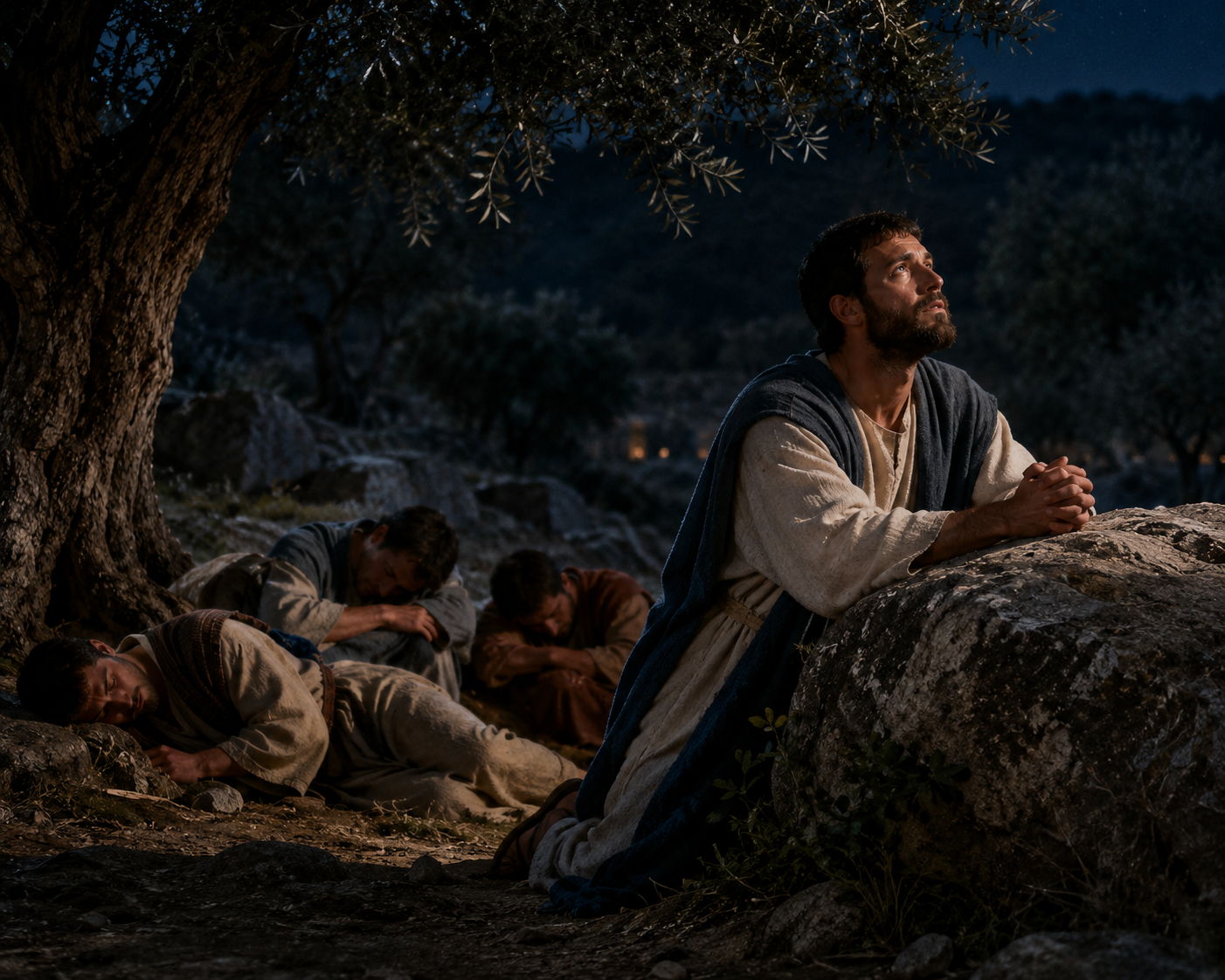
Gethsemane — Mark 14:32–42
Jesus and His disciples came to Gethsemane.
He took Peter, James, and John with Him and:
“began to be sore amazed, and to be very heavy” — Mark 14:33
He told them:
“My soul is exceeding sorrowful unto death: tarry ye here, and watch.” — Mark 14:34
Going forward, He fell on the ground and prayed that, if possible, the hour might pass from Him.
His prayer expresses both genuine anguish and perfect submission:
“Abba, Father, all things are possible unto thee; take away this cup from me: nevertheless not what I will, but what thou wilt.” — Mark 14:36
The immediate context plainly connects the “cup” with the suffering before Him. Other KJV passages make clear that His death involved bearing our sins (Isaiah 53:5–6; 1 Peter 2:24). We need not invent details beyond what Scripture reveals.
Three times Jesus found the disciples sleeping.
His warning remains spiritually important:
“Watch ye and pray, lest ye enter into temptation. The spirit truly is ready, but the flesh is weak.” — Mark 14:38
Prayer is not ornamental to Christian living. It is a biblical defense against temptation and fleshly weakness.
The betrayal and arrest — Mark 14:43–52
Judas arrived with “a great multitude with swords and staves,” sent from the chief priests, scribes, and elders.
Judas had arranged a sign:
“Whomsoever I shall kiss, that same is he; take him, and lead him away safely.” — Mark 14:44
He then kissed Christ, and Jesus was taken.
One person present drew a sword and cut off the ear of the high priest’s servant. Mark does not identify either man by name in this passage, so those names should not be supplied as though Mark itself gives them.
Jesus reminded His captors that He had openly taught in the temple:
“but the scriptures must be fulfilled.” — Mark 14:49
Then comes one of the chapter’s saddest statements:
“And they all forsook him, and fled.” — Mark 14:50
Mark also records a young man who followed Jesus wearing a linen cloth. When men laid hold of him, he left the linen cloth and fled naked.
Scripture does not identify this young man. Claims that he was Mark himself are possible historical suggestions, not explicit biblical facts, and therefore should not be stated as certainty.
Jesus before the high priest — Mark 14:53–65
Jesus was brought before the high priest. The chief priests, elders, and scribes assembled.
Peter followed “afar off.”
The council sought witness against Jesus in order to put Him to death:
“but found none.” — Mark 14:55
Many bore false witness, yet:
“their witness agreed not together.” — Mark 14:56
Even testimony concerning Christ’s words about the temple did not agree.
Finally the high priest directly asked:
“Art thou the Christ, the Son of the Blessed?” — Mark 14:61
Jesus answered:
“I am: and ye shall see the Son of man sitting on the right hand of power, and coming in the clouds of heaven.” — Mark 14:62
This is one of Mark’s strongest direct declarations concerning Christ’s identity and future glory.
The high priest charged Him with blasphemy, and the assembled leaders condemned Him as “guilty of death.”
They spit upon Him, covered His face, struck Him, mocked Him concerning prophecy, and the servants struck Him with their hands.
Christ does not cease to be King because wicked men reject Him. The One mocked in Mark 14:65 is the same Son of man who declared in Mark 13 that He will come “with great power and glory.”
Peter’s three denials — Mark 14:66–72
While Jesus was being questioned, Peter was beneath in the palace.
A maid recognized him as one who had been with Jesus of Nazareth.
Peter denied it.
He was challenged again and denied Him again.
Those standing nearby then said:
“Surely thou art one of them: for thou art a Galilaean, and thy speech agreeth thereto.” — Mark 14:70
Peter began “to curse and to swear,” insisting:
“I know not this man of whom ye speak.” — Mark 14:71
The cock then crowed the second time.
Peter remembered the exact warning Christ had spoken:
“Before the cock crow twice, thou shalt deny me thrice.”
Mark concludes:
“And when he thought thereon, he wept.” — Mark 14:72
The text explicitly records Peter’s denial, remembrance, and tears. His later ministry and service are recorded elsewhere in Scripture, but Mark 14 itself ends this scene with Peter weeping.
Key People and Places
- Jesus Christ — The central Person of both chapters: Prophet, Messiah, Son of man, Son of the Blessed, sacrificial Saviour, and coming King.
- Peter — One of the four disciples who privately questioned Christ in Mark 13; confidently promised faithfulness in Mark 14, then denied Christ three times.
- James — Present for the private prophetic teaching and later taken farther into Gethsemane.
- John — Present both on the mount of Olives and with Christ in Gethsemane.
- Andrew — Named among the four who privately questioned Christ concerning the temple prophecy.
- The unnamed woman at Bethany — Anointed Christ with costly spikenard. Mark does not give her name.
- Simon the leper — His house in Bethany was the location of the anointing. Mark does not explain his medical condition at that time.
- Judas Iscariot — One of the twelve who arranged to betray Christ and identified Him by a kiss.
- The chief priests, scribes, and elders — Religious authorities involved in the conspiracy, arrest, and condemnation of Jesus.
- The high priest — Questioned Christ directly concerning His identity.
- The high priest’s servant — Had his ear cut off during Christ’s arrest; Mark does not name him.
- The unnamed young man — Fled after leaving his linen cloth behind; Scripture does not identify him.
- The disciples / the twelve — Shared the Passover, heard Christ’s warnings, failed to watch in Gethsemane, and fled when He was taken.
- The temple — The great buildings admired at the beginning of Mark 13 and the subject of Christ’s prophecy.
- The mount of Olives — Location “over against the temple” where Christ gave the prophetic teaching of Mark 13; also visited after the supper in Mark 14.
- Judaea — Specifically named in Christ’s warning concerning the abomination of desolation.
- Bethany — Location of the anointing of Jesus.
- Gethsemane — Place where Christ prayed in deep sorrow before His arrest.
- Galilee — Christ said He would go before His disciples there after He was risen.
- The upper room — The furnished room where the Passover was prepared.
Main Doctrinal or Spiritual Themes
1. The absolute authority of Christ’s words
“Heaven and earth shall pass away: but my words shall not pass away” (Mark 13:31). Christ’s words are certain, enduring, and worthy of complete trust.
2. Biblical prophecy calls for watchfulness
Mark 13 does not encourage sensational date-setting. Christ repeatedly says, “Take heed,” “watch,” and “pray.”
Prophecy should produce holiness and faithfulness rather than speculation.
3. Israel and the prophetic program must not be confused with the Church
Mark 13 contains explicitly Jewish and geographical language: the temple, Daniel, Judaea, the sabbath in the parallel account, and the abomination of desolation.
A dispensational interpretation therefore preserves the distinction between Israel and the Church instead of making every prophetic statement directly about the Church.
4. Christ will visibly return in glory
Mark 13:26 declares that men will “see the Son of man coming in the clouds with great power and glory.”
The rejected Christ of Mark 14 will return as the glorious Son of man of Mark 13.
5. False religion and spiritual deception will increase
Christ warns of false Christs and false prophets.
Miraculous claims are not sufficient evidence of truth. God’s written Word must judge every religious claim.
6. Salvation is not earned by endurance or ordinances
Neither “endure unto the end” nor participation in the Lord’s Supper establishes salvation by works.
Justification is by grace through faith. Christian obedience follows salvation; it does not purchase it.
7. The blood of Christ is central to redemption
Jesus said:
“This is my blood of the new testament, which is shed for many.” — Mark 14:24
The coming crucifixion was not an accidental tragedy. Christ knowingly approached the shedding of His blood.
8. The Lord’s Supper is centered upon Christ’s sacrifice
Bread and the cup direct believers back to Christ’s body and shed blood. Scripture instructs believers to observe it in remembrance of Him.
9. Christ submitted perfectly to the Father’s will
Gethsemane gives one of Scripture’s clearest expressions of obedient submission:
“nevertheless not what I will, but what thou wilt.” — Mark 14:36
Obedience to God is not merely doing His will when it is easy.
10. Prayer is essential in resisting temptation
“Watch ye and pray, lest ye enter into temptation” is Christ’s direct command.
The disciples’ sleep stands in sharp contrast with Christ’s prayer.
11. Self-confidence is spiritually dangerous
Peter sincerely believed he would remain faithful even if others failed. Christ’s prophecy proved true, not Peter’s confidence.
Matthew Henry similarly draws attention to the danger of trusting our own hearts and abilities rather than depending upon divine grace.
12. Christ’s sufferings fulfilled Scripture
At His arrest Christ said:
“but the scriptures must be fulfilled.” — Mark 14:49
Human wickedness does not overthrow God’s revealed purpose.
13. Human responsibility remains real under divine foreknowledge
Christ knew Judas would betray Him, yet pronounced woe upon the betrayer. God’s knowledge of an act does not make the sinner innocent or remove moral accountability.
14. Jesus Christ openly affirmed His identity
When asked whether He was “the Christ, the Son of the Blessed,” Jesus answered:
“I am.” — Mark 14:62
He then declared His future position at the right hand of power and His coming in the clouds of heaven.
Practical Applications or Lessons
- Believe Christ’s Word above appearances. The temple buildings looked permanent, yet Christ declared their coming destruction. What God says is more certain than what men see.
- Do not let prophecy become mere curiosity. Study prophecy carefully, but obey its practical commands: “Take heed,” “watch,” and “pray.”
- Test religious claims by Scripture. False Christs and false prophets may appear convincing. Signs do not overrule God’s written Word.
- Expect opposition without abandoning faithfulness. Mark 13 prepares God’s servants for hatred, betrayal, and persecution without excusing retreat from truth.
- Keep the gospel central. Amid upheaval and persecution, Christ still speaks of the gospel being published among the nations.
- Honor Christ while opportunity is present. The woman at Bethany acted when she could. Christ Himself called what she did “a good work.”
- Do not use one Christian duty to cancel another. Concern for the poor did not justify condemning genuine devotion to Christ.
- Beware of hidden sin and betrayal. Judas was outwardly numbered among the twelve while secretly arranging Christ’s betrayal.
- Remember the cross when observing the Lord’s Supper. The ordinance directs the believer to Christ’s body given and His blood shed, not to human merit.
- Do not boast about what you will never do. Peter’s confident declaration did not keep him from denying Christ.
- Watch and pray before temptation arrives. Spiritual preparation must precede the crisis.
- Submit your will to God. Christ’s prayer in Gethsemane gives the supreme pattern: “not what I will, but what thou wilt.”
- Do not mistake temporary religious success for victory over Christ. Christ’s enemies arrested and condemned Him, but He had already declared that the Son of man will return “with great power and glory.”
- Remember that Christ knows beforehand. Nothing in Mark 14 surprised Him: the betrayal, the scattering of the disciples, Peter’s denial, His death, and His resurrection were all spoken of beforehand.
- Failure should produce humility rather than excuses. When Peter remembered Christ’s word, “he wept.” The proper response to recognized sin is not self-justification.
Overall Message
Mark 13–14 presents Jesus Christ as the rejected but sovereign Son of God who knows the future, speaks words that cannot pass away, willingly approaches His sacrificial death, submits perfectly to the Father’s will, and promises to return in power and glory.
Mark 13 says, in effect: Do not be deceived. Take heed. Watch. Pray. Believe Christ’s words.
Mark 14 says: Do not trust the flesh. Honor Christ. Remember His blood. Pray against temptation. Submit to God’s will. Believe the Scriptures.
The disciples may sleep, scatter, flee, and deny; Judas may betray; false witnesses may accuse; religious rulers may condemn—but the purposes and words of Jesus Christ stand unchanged.
“And what I say unto you I say unto all, Watch.” — Mark 13:37
Comments are closed