CHAPTER SUMMARIES
Judges 20 — Israel’s Civil War Against Benjamin
 After the horrific sin committed in Gibeah (Judges 19), all Israel gathers “from Dan even to Beersheba” (20:1) before the LORD at Mizpeh. Over 400,000 armed men appear. The Levite recounts the vile actions of the men of Gibeah (20:4–7), and the congregation unites to “put away evil from Israel” (20:13).
Israel demands that Benjamin deliver the guilty men of Gibeah, but Benjamin refuses, choosing instead to defend Gibeah (20:13–14). This reveals a tribal loyalty that overrules righteousness—Benjamin protects evildoers rather than uphold God’s law.
Israel inquires of the LORD at Bethel (20:18), and the LORD permits them to go up against Benjamin. Despite their numerical advantage, Israel loses 22,000 men the first day (20:21). They weep before the LORD and ask again, and God again sends them against Benjamin; they lose another 18,000 (20:25). These losses remind the nation that even a just cause does not guarantee success without humility and full dependence on God.
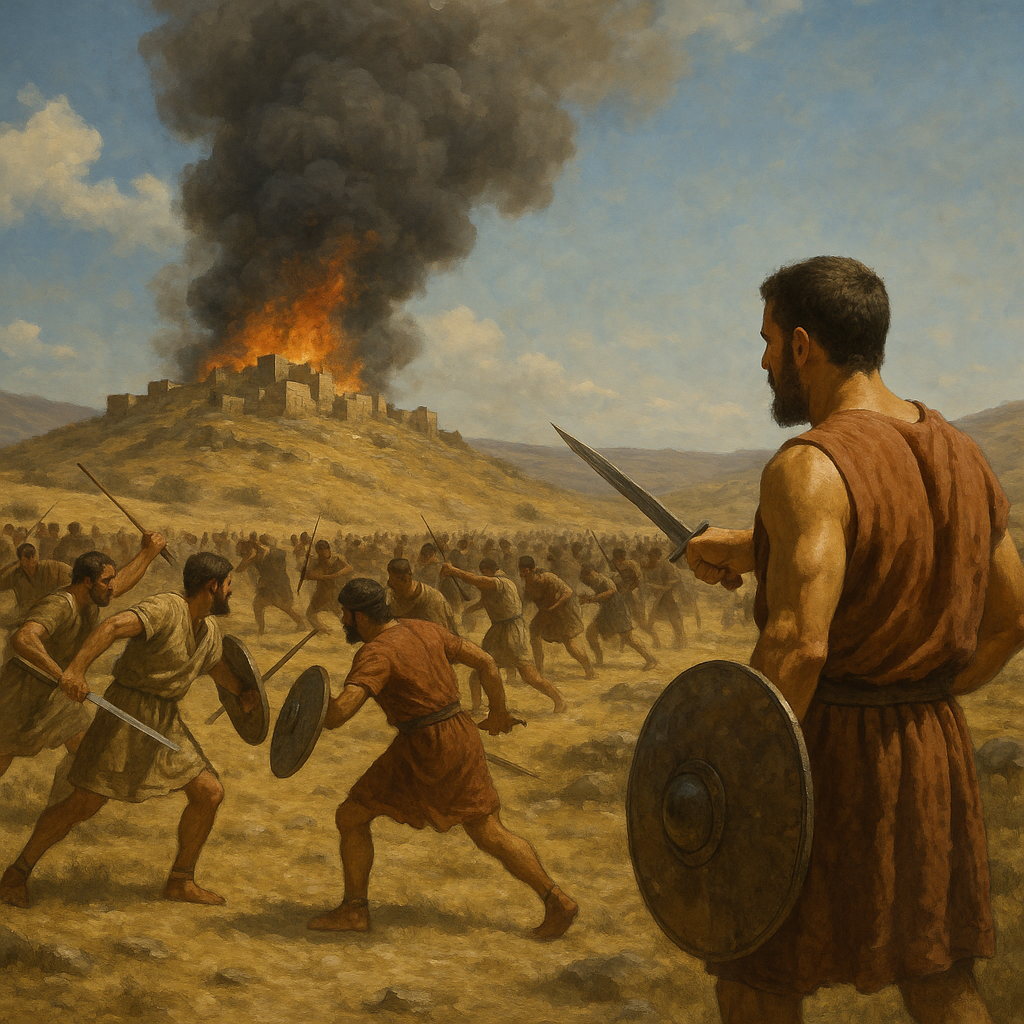
On the third inquiry—after fasting, offering burnt offerings, and peace offerings (20:26)—the LORD promises victory (20:28). Israel sets an ambush around Gibeah, and the battle turns: Benjamin initially smites about thirty Israelites, believing victory is theirs, but the ambush overwhelms the city. The smoke rising from Gibeah signals the turning point (20:40). Israel destroys most of Benjamin’s warriors—only 600 men escape to the rock Rimmon (20:47).
The chapter reveals the tragic consequences when sin is tolerated and when a tribe protects wickedness instead of purging it.
Judges 21 — Preservation of the Tribe of Benjamin
Israel gathers at Shiloh, mourning that “there is one tribe cut off from Israel this day” (21:6). They face a dilemma: they had sworn not to give their daughters to Benjamin (21:1), yet they do not want a tribe to perish.
Israel first seeks judgment upon Jabesh-gilead, a city that did not appear at Mizpeh. Twelve thousand soldiers kill its inhabitants but preserve 400 virgins for the Benjamites (21:10–12). These are given to the 600 survivors, but this does not provide enough wives.
Israel then devises another solution: the Benjamites are instructed to seize wives from the daughters of Shiloh who come out to dance at a yearly feast (21:19–21). This plan circumvents Israel’s oath while ensuring the survival of the tribe. The Benjamites take wives from the dancers, return to their inheritance, rebuild their cities, and dwell in them (21:23).
The book concludes with the well-known explanation for Israel’s moral collapse:
“In those days there was no king in Israel: every man did that which was right in his own eyes.” (21:25)
The closing emphasizes the necessity of divine authority, righteous leadership, and obedience to God’s law.
KEY PEOPLE AND PLACES
People
-
The Levite — whose concubine’s death exposes Israel’s moral decay; his testimony drives national action.
-
The men of Gibeah — sons of Belial, representing unchecked wickedness within Israel.
-
The Tribe of Benjamin — tragically defends the sinners of Gibeah; nearly exterminated.
-
Phinehas, son of Eleazar (20:28) — ministering before the ark; a reminder of God’s legitimate priesthood and guidance.
Places
-
Mizpeh — gathering point for Israel’s assembly and judgment.
-
Bethel — where Israel seeks the LORD’s direction before the ark.
-
Gibeah — the city of the crime and the central battlefield.
-
Rock Rimmon — refuge of the 600 surviving Benjamites.
-
Shiloh — location of the tabernacle; where the feast occurs.
-
Jabesh-gilead — judged for refusing to join Israel.
MAIN DOCTRINAL OR SPIRITUAL THEMES
1. The Necessity of Purging Sin
Israel’s unity around “putting away evil” reflects God’s demand that sin not be tolerated in the congregation (cf. Deut. 13:5). Holiness requires action, even when costly.
2. Human Loyalty Must Never Override Righteousness
Benjamin’s refusal to surrender wicked men shows the danger of prioritizing family or tribal allegiance above God’s law.
3. God’s People Must Seek His Guidance
Israel’s repeated inquiries at Bethel, though delayed in spiritual preparation, demonstrate the need for divine direction rather than human confidence.
4. Judgment Is Sometimes Severe Because Sin Is Severe
The near extinction of Benjamin shows that sin can destroy a people. God’s justice is real, yet so is His mercy in preserving a remnant.
5. The Deep Consequences of Doing “Right in One’s Own Eyes”
The repeated phrase highlights moral relativism—an abandonment of God’s authority leads to national collapse.
PRACTICAL APPLICATIONS OR LESSONS
1. Sin Must Be Addressed Biblically, Not Ignored
Tolerating sin for the sake of peace or loyalty leads to greater destruction.
2. Personal Offense Must Never Replace Spiritual Discernment
Israel initially acts with zeal but later weeps, realizing their imperfect motives. Believers must seek God’s wisdom before acting.
3. Leadership Matters
Without godly leadership, families, churches, and nations drift into chaos. The absence of righteous authority invites moral collapse.
4. Restoration Is Possible, Even After Deep Failure
Benjamin’s survival shows God’s mercy. Though the tribe suffered greatly, God did not allow them to be destroyed entirely.
5. Obedience to Scripture Prevents Moral Confusion
Israel’s complicated oaths and human-devised solutions stem from failing to seek God fully. God’s Word gives clarity when followed sincerely.
Comments are closed