Chapter Summaries
 Chapter 18
-
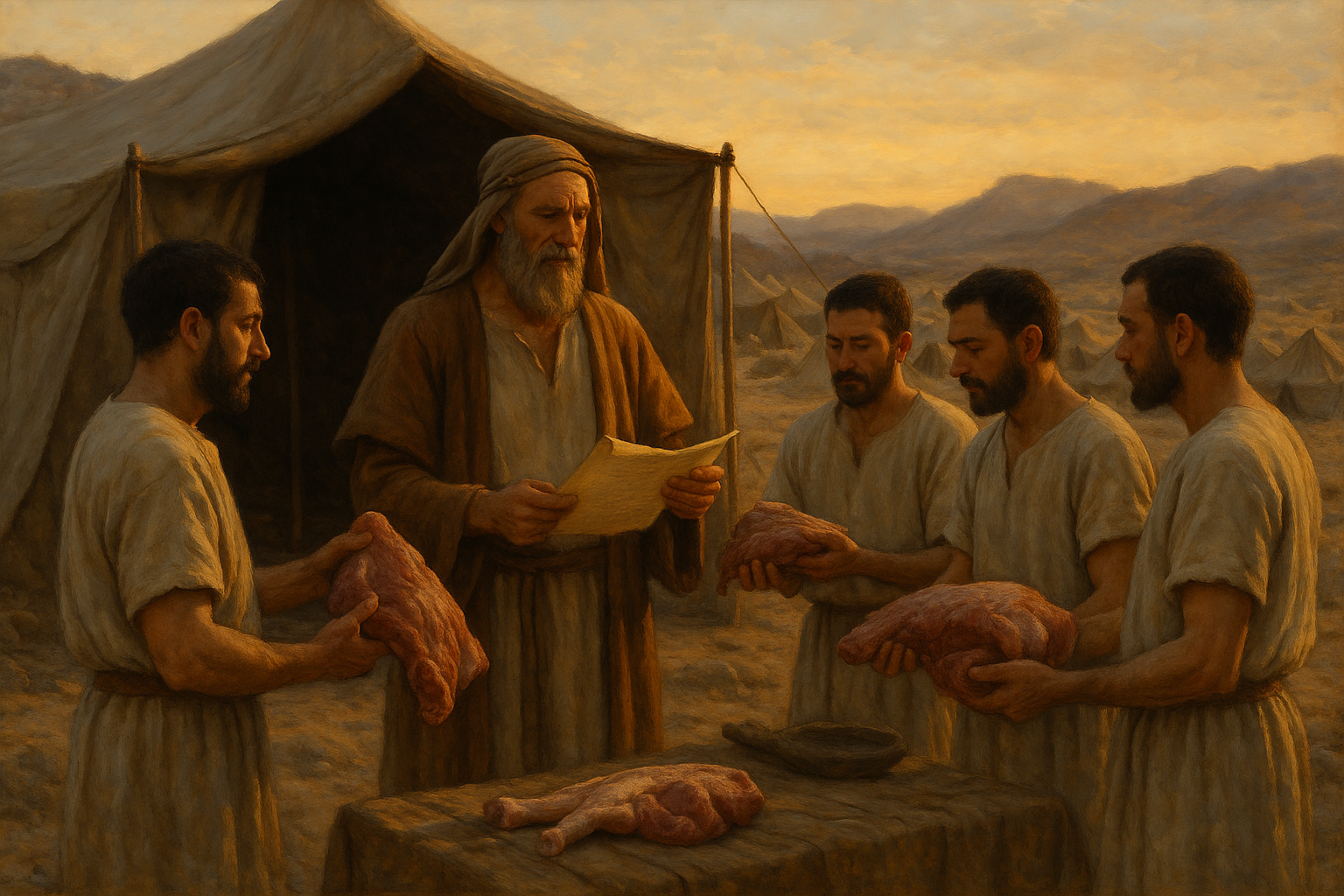
Verses 1-8: Moses reminds the people of Israel that the Levitical priests shall have “no part nor inheritance with Israel: they shall eat the offerings of the LORD made by fire, and His portion.” (KJV) He underscores that the Lord is their inheritance. The priests/Levites are to be supported by the people’s offerings rather than land allotments. Precept Austin+2Enduring Word+2
-
Verses 9-14: A stern warning against adopting the abominable practices of the nations: “There shall not be found among you anyone … who makes his son or his daughter to pass through the fire, or one who practices witchcraft… or one who calls up the dead.” (KJV) Israel is to be wholly separate, not delving into occult or pagan rituals. Enduring Word+1
-
Verses 15-22: Moses declares the promise: “The LORD thy God will raise up unto thee a Prophet from the midst of thee, of thy brethren, like unto me; unto him ye shall hearken.” (KJV) He then gives criteria for true and false prophets, warning against those who speak presumptuously in God’s name and whose prophecies fail. StudyLight.org+2Bible Hub+2
-
Doctrinal/historical note: This chapter ties the priesthood and prophecy together: the priestly/Levital system shows the way God provided for worship, teaching and mediation, and prophecy shows God continuing to speak—including pointing ahead to the Messiah. The prohibition of occult practices highlights the holiness of God and the separation demanded of His covenant people.
Chapter 19
-
Verses 1-13: The instruction to set aside three cities of refuge so that a manslayer (who killed unintentionally) might flee there and live, lest the avenger of blood overtake him. (KJV) Enduring Word+1
-
Verses 14: A command: “Thou shalt not remove thy neighbour’s landmark, which the men of old have set.” (KJV) Emphasizing respect for property boundaries and justice. Enduring Word
-
Verses 15-21: Legal instruction about witnesses: “A single witness shall not rise up against a man for any iniquity… At the mouth of two witnesses… shall the matter be established.” (KJV) Also the lex talionis principle: “life for life, eye for eye…” (KJV) emphasizing proportional justice. Precept Austin+1
-
Historical/doctrinal background: The refuge-cities reflect God’s justice and mercy (innocent manslayer protected) and underline the sanctity of human life (Genesis 9:6 referenced by some commentaries) and the importance of sound justice mechanisms in a covenant community. Enduring Word
Chapter 20
-
Verses 1-20: Regulations for warfare when Israel goes out to battle: The priest shall encourage the troops, those fearful may return home; exemptions (vineyard, house, betrothed); when approaching a city far off: offer terms of peace, if accepted live; if refused, besiege it. When the city is near Israel, the command is to put all males to the sword, but spoil, livestock, children may be taken. Trees that yield food should not be destroyed. (KJV) Orthodox Christian Theology
-
Verses 21: Commands about offering first-born animals to the Lord, and how to deal with areas of land that one will hold for some time but then abandon.
-
Doctrinal/historical note: These military laws reflect the holiness of God’s people, the seriousness of God’s judgment on idolatrous nations, and the covenant-land context. They are not easily detached from theology: they underscore God’s sovereignty, the seriousness of sin, and the responsible life of the covenant people in conquest. At the same time, they presage New Testament ethical reflection on war, violence, and divine judgment.
Chapter 21
-
Verses 1-9: If a slain person is found in the field and the murderer is unknown, the elders shall measure and the nearest city shall perform a ritual: the heifer slain by the brook, elders of that city wash their hands over it saying, “Our hands have not shed this blood…” (KJV) This is to purge the blood from among you.
-
Verses 10-14: Concerning the beautiful captive (a woman from a defeated city): If an Israelite sees among the captives a woman he desires, he shall bring her home, let her mourn a month, then marry her; if he later dislikes her, let her go free—not sell her for money. (KJV)
-
Verses 15-17: If a man has two wives, one beloved and one hated, and both bear him sons, but the hated has the firstborn, then he must acknowledge the firstborn by giving him a double portion of all he has. (KJV)
-
Verses 18-21: The law of the stubborn and rebellious son: if a son is obstinate, gluttonous, drunken, does not obey his parents, the parents bring him to the elders and the judges shall stone him to death, so that all Israel hears and fears. (KJV)
-
Verses 22-30: Miscellaneous laws: about a man hanged on a tree being cursed, taking a wife and then finding her displeasing, manslaughter, etc.
-
Doctrinal/historical note: These laws reflect the seriousness of community discipline, social structure in covenant Israel, respect for parents, protection of the innocent, and avoidance of evil influence. They highlight God’s holiness, His demand for obedience, and the consequences of rebellion. For the believer today, they must be interpreted in light of the fuller revelation in Christ, while still affirming God’s moral standards.
Key People and Places
-
Moses (Moses): The one speaking in this book, delivering God’s law to Israel from the plains of Moab.
-
The Levites / Priests: The tribe of Levi and its priestly subset; no inheritance of land, sustained by offerings. (Ch 18)
-
The manslayer / cities of refuge: Not specific person names, but concept of those who kill unintentionally and the cities designated for them (Ch 19).
-
The Israelite warrior and captive woman: In Ch 21 the law of the beautiful captive illustrates the war-context and post-battle marriage.
-
The “stubborn and rebellious son”: A hypothetical figure in Ch 21 illustrating discipline in the covenant community.
-
Place references: The land which the LORD thy God is giving thee (chapters 18-21 repeatedly refer to Israel’s entry into Canaan); the city which is far off / the city within thine own land (Ch 20); city of refuge (Ch 19).
-
Implicit locations: Plains of Moab (where Moses addresses Israel), future land of Canaan (the inheritance).
Main Doctrinal or Spiritual Themes
-
God’s holiness and separation: The prohibition of pagan practices (Ch 18:9-14) and the command to live set-apart illustrate that God’s people must not adopt other gods’ ways.
-
Priestly and prophetic ministry: In 18 we see both the priest/Levite and prophet offices emphasised: the Lord provides for His ministers; the Lord speaks through a prophet like Moses. The promise points ahead to Christ (cf. commentary on Deut 18:15-19). GotQuestions.org+1
-
Justice, mercy and the sanctity of life: In 19 the cities of refuge protect the innocent; rules for witnesses and property boundaries uphold fairness. • Life-for-life emphasises the value of human life.
-
Faithful warfare and divine sovereignty: In 20 the wars are not typical wars of conquest but carried out under God’s command, showing that the Lord fights for His people and the land is His.
-
Community discipline and covenant living: In 21 the laws of the rebellious son, the firstborn inheritance, the captive woman—all point to the fact that Israel is a covenant community under God, not just a loose collection of individuals; obedience and reverence for God’s order matter deeply.
-
Typology pointing to Christ: Especially in 18 the prophet like Moses, the priesthood, the Levites’ inheritance in God — all serve as shadows of Christ’s work and ministry, aligning with conservative Baptist doctrine of typology and Christ’s fulfilment.
-
Work of obedience: Throughout these chapters the emphasis is on hearing, doing, obeying God’s statutes—not just knowing them, but living them. This reflects the covenantal aspect of the Law for Israel and for New Testament believers (while not under the Mosaic civil code, understanding God’s moral character, justice, and worship are revealed).
-
Covenantal land and community: The giving of the land, inheritance issues, cities of refuge, war laws, communal discipline all emphasise the communal dimension of the covenant: God’s people share the land, worship, blessings and responsibilities together.
Practical Applications or Lessons
-
Support for ministry: Just as the Levites had no land inheritance and were supported by God’s people (Deut 18 1-8), modern believers should honour and support those in gospel ministry, recognising that God is their portion.
-
Avoiding occult and pagan practices: The prohibition in 18 9-14 remains relevant: believers must not dabble in practices that claim supernatural power apart from God. Discernment is required, and complete separation from the occult is commanded.
-
Listening to God’s Word and God’s messengers: With the promise of a prophet in 18 15-19, believers are urged to hear Christ and heed the Word of God. False prophets (and false teachers) must be tested by Scripture (18 21-22).
-
Justice in the community: The cities of refuge (19) teach that we must protect the innocent and uphold justice. Churches and believers must ensure causes are heard, rights respected, and guilty are not shielded by favoritism.
-
Respecting others’ property and boundaries: Verses like 19 14 show that even seemingly small injustices (moving a boundary stone) are unacceptable. Believers should live transparently and justly in their dealings.
-
Trusting God in conflict: Chapter 20 teaches that when believers face spiritual battles, they are to go forth with faith in God, not fear, and recognise that the battle belongs to the Lord.
-
Order in family and church life: The laws in 21 regarding firstborn, rebellious son, marriage of the captive woman—all underline respect for family structure, parental authority, proper marriage, and church discipline. While the civil codes differ for today, the principle of submitting to God-appointed authority and preserving holiness in family and church remains.
-
Understanding God’s judgments and mercy: The war laws and the law of the manslayer reflect a balance of mercy and judgment. Believers should appreciate God’s mercy in Christ and also acknowledge that God is just, and that moral rebellion has consequences.
-
Living as a covenant community: These chapters show that Christian life is not purely individualistic: we are part of God’s people, with mutual responsibilities to one another (support, discipline, justice) and to God.
-
Christ-centred typology: By seeing how the priest, the prophet, the refuge for the manslayer all foreshadow Christ, believers are encouraged to centre faith and hope in Him—the ultimate Prophet, Priest, and Refuge.
Comments are closed