Chapter Summaries
Chapter 3
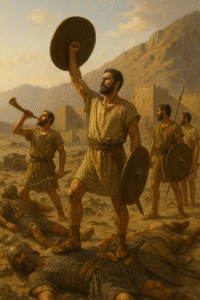 Moses reviews Israel’s victorious conquest of the land east of the Jordan under God’s power. “Then we turned, and went up the way to Bashan: and Og the king of Bashan came out against us, he and all his people, to battle at Edrei.” (Deut 3:1, KJV)
God assures Moses, “Fear him not: for I will deliver him, and all his people, and his land, into thy hand; and thou shalt do unto him as thou didst unto Sihon king of the Amorites” (v.2).
The LORD delivers King Og of Bashan and his people into Israel’s hand, they defeat them until none remain, and take sixty cities in the region of Argob (vv.3-4).
All these cities were well-fortified (v.5). Israel utterly destroys the men, women and children of every city, though takes the spoil and cattle for themselves (vv.6-7).
The territory taken is described: “from the river of Arnon unto mount Hermon” (v.8) including Gilead and Bashan (v.10).
Then Moses records how he allocated the land: to the two and a half tribes (Reuben, Gad, and half the tribe of Manasseh) (vv.12-17) and urged their full participation in the war until the land west of Jordan was taken (vv.18-20). He gives Joshua encouragement: “Be strong and of a good courage … for thou shalt go over this Jordan” (v.21).
Finally Moses records that he asked initially to go over and behold the good land, but the LORD denied his request: “But the LORD was wroth with me for your sakes, and would not hear me: … And the LORD said unto me, Let it suffice thee; speak no more unto me of this matter.” (v.26)
Historical/Doctrinal background:
-
The land east of Jordan (Bashan, Gilead) is part of the Promised Land given to Israel under the conquest narrative.
-
The complete defeat of Og underscores the sovereignty and faithfulness of God in fulfilling His promise to Israel, and serves as a reassurance for the coming battles west of Jordan.
-
Moses’ own circumstance (forbidden to enter the land) is a sober reminder that even great servants of God are under divine discipline if there is disobedience or failure (cf. Num 20).
-
The allocation of land to Reuben, Gad, and half-Manasseh shows both God’s provision and Israel’s responsibility: those tribes must still help in the conquest although they receive land.
Chapter 4
In this chapter Moses changes tone: from recounting past conquest to giving solemn exhortation and instruction. He begins: “Now therefore hearken, O Israel, unto the statutes and unto the judgments, which I teach you, to do them, that ye may live, and go in and possess the land which the LORD God of your fathers giveth you.” (v.1)
He warns that they must not add to or diminish the word which he commands them (v.2).
He reminds them of their history: their eyes have seen what the LORD did because of Baal-Peor; those who cleaved unto the LORD were alive (vv.3-4).
He teaches that keeping God’s commands is their wisdom and understanding “in the sight of the people” (v.6) and that no other nation has God so near as Israel (v.7), or statutes and judgments so righteous as this law (v.8).
Then he gives a plea: “Only take heed to thyself, and keep thy soul diligently, lest thou forget the things which thine eyes have seen” (v.9), and instruct their children and grandchildren in them.
Moses reminds them that at Horeb the LORD spoke out of the fire; they heard the voice but saw no form (v.12-13).
He exhorts them to remember that the LORD alone is God: “Therefore know this day, and consider it in thine heart, that the LORD he is God in heaven above, and upon the earth beneath: there is none else.” (v.39)
He warns of idolatry, turning aside to worship other gods, and predicts exile if they forget the covenant (vv.23-28). He contrasts finally the blessedness of returning to the LORD and the vindication of His covenant faithfulness (vv.29-31).
Historical/Doctrinal background:
-
The chapter is delivered on the plains of Moab, east of the Jordan, just before Israel enters into Canaan under Joshua.
-
This setting implies an urgency: the people have seen the wilderness journey, the manna, the fire and cloud, the victories — now they must live in obedience in the land.
-
The strong emphasis on hearing, obeying, and not altering God’s Word reflects conservative Baptist doctrine of the authority, sufficiency and finality of Scripture (and by implication of God’s revealed law).
-
The repeated use of “this day” underscores the immediacy of the covenant commitment.
-
The warning about idolatry and the certainty of judgment is consistent with classic covenant theology: blessing for obedience, curse for disobedience.
Key People and Places
-
Moses – The leader of Israel, porter of the law, narrator of these events and spokesperson for God’s covenant.
-
Joshua – Moses’ successor, mentioned as one who is to lead the people west of the Jordan (3:21–22).
-
**Og, king of Bashan – The foe defeated by Israel east of the Jordan (3:1-3).
-
**Sihon, king of the Amorites – Earlier defeated foe, whose fate is pointed to as precedent (3:2).
-
Bashan – Region east of the Jordan, the kingdom of Og, taken by Israel (3:1, 8-10).
-
Gilead – Region east of Jordan, given to tribes (3:13, 16).
-
Mount Hermon – Reference point in the territorial description (3:8).
-
**Horeb (also called Sinai) – The mountain where Israel heard God’s voice but saw no form, referenced by Moses (4:12-14).
-
**Reubenites & Gadites & half-tribe of Manasseh – Recipients of the land east of the Jordan and participants in the conquest (3:12-17).
Main Doctrinal or Spiritual Themes
-
God’s Sovereignty & Faithful Deliverance – In chapter 3 the LORD promises and accomplishes the defeat of Og (3:2-3). The victory is not Israel’s strength, but the LORD’s faithfulness.
-
Divine Judgment and the Seriousness of War/Conquest – The text records the utter destruction of the enemy (3:6). While difficult, this is consistent with the biblical theme of divine judgment against persistent evil.
-
Responsibility and Obedience of God’s People – In chapter 4 the repeated “hearken”, “keep”, “do” emphasizes that while God acts, the people must respond in obedience (4:1–2,9;13).
-
The Authority, Sufficiency and Stability of God’s Word – “Ye shall not add unto the word which I command you, neither shall ye diminish from it” (4:2). This aligns with conservative Baptist emphasis on Scripture’s unchanging character.
-
God’s Unique Covenant Relationship – “The LORD he is God in heaven above, and upon the earth beneath: there is none else” (4:39). Israel’s distinctiveness as God’s people is emphasized.
-
Memorial and Passing On to the Next Generation – Moses stresses remembering what they have seen and teaching it to children and grandchildren (4:9,10). Christian believers similarly must disciple the next generation.
-
Blessing and Curse, Reward for Obedience, Punishment for Disobedience – The covenant framework: obedience leads to life and possession; disobedience leads to exile and destruction (4:25-31).
-
Holiness and Separation – Although not always spelled out in this section, the theme that God’s people must not imitate the nations (4:16-19) underlines separation from idolatry and compromise.
Practical Applications or Lessons
-
Trust God in the Battles You Face. Just as Israel was assured “Fear him not … I will deliver him …” (3:2), believers today can trust the Lord for victories He has promised.
-
Obedience Matters. The principle “hear and do” (4:1) remains: knowledge without obedience fails to produce life.
-
Avoid Tampering with God’s Word. The command not to add or take away (4:2) warns believers against altering Scripture or treating it as optional.
-
Remember God’s Work and Teach It. Moses urges remembering the events and passing them to children (4:9-10). In Christian life, remembering God’s past faithfulness encourages current faith and equips discipleship.
-
Live Distinctively as God’s People. Because God is unique (4:39) and His statutes righteous (4:8), believers must reflect His holiness in a world that does not.
-
Be Aware of the Consequences of Idolatry. Just as Israel was warned about worshipping other gods (4:15-20), believers must guard against modern idols and turn wholly to the LORD.
-
Hope in Restoration. Although Moses warns of exile in disobedience, he also points to return to the LORD (4:29-31). Believers have hope in God’s mercy when we repent.
-
Entrust the Next Generation. The instruction to teach sons and grandsons (4:9) underscores the responsibility to pass faith, not merely live it.
-
Recognize the Wrath of God Even Toward His Leader. Moses’ own appeal is refused (3:26); even the greatest servant must submit to divine holiness. This reminds us of the seriousness of ministry and the weight of responsibility.
Comments are closed