
1 Samuel 8-10: Israel Demands a King and Saul Is Chosen
 First Samuel 8-10 records Israel’s demand for a king, Saul’s meeting with Samuel, and Saul’s public identification as the man the LORD had chosen. These chapters distinguish between God’s faithful rule and Israel’s desire to resemble the surrounding nations. They also show God’s care for His people even while He exposes the sin in their request.
The central issue was more than a change in government. The LORD told Samuel, “they have not rejected thee, but they have rejected me, that I should not reign over them” (1 Samuel 8:7). Israel wanted a king to judge them and fight their battles, but their demand expressed rejection of the LORD’s kingship.
Chapter Summaries
1 Samuel 8: Israel Rejects the LORD’s Rule
Samuel’s sons pervert judgment. When Samuel was old, he made his sons judges over Israel. Joel and Abiah served in Beersheba, but they did not follow their father’s ways. They “turned aside after lucre, and took bribes, and perverted judgment” (1 Samuel 8:1-3).
Their misconduct was real, and the elders correctly identified it. However, the passage does not explain how Samuel had raised them or establish that their corruption resulted from a particular failure in his parenting. The stated facts are that Samuel appointed them and that they acted wickedly.
The elders demand a king. The elders came to Samuel at Ramah and said, “make us a king to judge us like all the nations” (1 Samuel 8:5). Samuel was displeased and prayed to the LORD (1 Samuel 8:6).
God directed Samuel to listen to the people while explaining the spiritual meaning of their demand. Their rejection of God’s rule continued the pattern of forsaking Him and serving other gods that had marked their history since the departure from Egypt (1 Samuel 8:7-8).
The existence of a king was not, by itself, outside the provisions of God’s law. Deuteronomy 17:14-20 gave instructions for a king, including the requirement that he be the man the LORD chose and remain subject to God’s written law. Nevertheless, God explicitly condemned the rejection of His rule expressed in this particular demand (1 Samuel 8:7; 10:19).
Samuel warns them about royal demands. At God’s direction, Samuel solemnly described “the manner of the king that shall reign over you” (1 Samuel 8:9-11). The king would take sons for military and agricultural service, daughters for work as confectionaries, cooks, and bakers, and property and produce to support his servants and officers. The warning ended with the declaration, “and ye shall be his servants” (1 Samuel 8:11-17).
Samuel also warned that they would cry out because of the king they had chosen, but “the LORD will not hear you in that day” (1 Samuel 8:18). In context, this concerns their cry for relief from the consequences of their chosen kingship. It should not be expanded into a claim that God would never again hear any prayer from Israel.
The people refuse the warning. Israel answered, “Nay; but we will have a king over us” (1 Samuel 8:19). They wanted to be like the nations, with a king to judge them, go before them, and fight their battles (1 Samuel 8:20).
Their response is especially striking beside the preceding chapter, where the LORD thundered against the Philistines and gave Israel deliverance (1 Samuel 7:10-13). In chapter 8, they nevertheless insisted on having a king to fight their battles. Samuel reported their words to the LORD, and God instructed him to make them a king (1 Samuel 8:21-22).
1 Samuel 9: God Directs Saul to Samuel
Saul is introduced. Saul was the son of Kish, a Benjamite described as “a mighty man of power” (1 Samuel 9:1). Saul was “a choice young man, and a goodly,” and he stood taller than the people from his shoulders upward (1 Samuel 9:2). These statements describe his appearance and stature; they do not establish his spiritual qualifications.
When Kish’s asses were lost, he sent Saul and a servant to find them. Their search took them through several regions before they reached the land of Zuph (1 Samuel 9:3-5). Saul then proposed returning because his father might stop worrying about the animals and become concerned about them.
The servant proposes consulting the man of God. Saul’s servant knew of a man of God in a nearby city and said, “all that he saith cometh surely to pass” (1 Samuel 9:6). The servant proposed asking him about their way and had a fourth part of a shekel of silver available as a gift (1 Samuel 9:6-8).
The passage records their proposed gift, but it does not say that Samuel required payment for divine guidance.
An explanatory note states that the person called a prophet was formerly called a seer (1 Samuel 9:9). As Saul and his servant approached the city, young women drawing water told them that the seer had arrived and that a sacrifice was taking place at the high place that day (1 Samuel 9:11-13).
The LORD has prepared Samuel for Saul’s arrival. The day before Saul came, the LORD had told Samuel that He would send a man from Benjamin. Samuel was to anoint him “to be captain over my people Israel,” and he would save them from the Philistines (1 Samuel 9:15-16).
God explained, “for I have looked upon my people, because their cry is come unto me” (1 Samuel 9:16). Israel’s sinful demand did not erase God’s concern for their affliction.
When Samuel saw Saul, the LORD identified him as the man previously described (1 Samuel 9:17). This is more than an uncertain inference about providence: God explicitly said He would send the man, and He explicitly identified Saul when he arrived.
Samuel receives Saul and assures him about the animals. Samuel told Saul that the asses had been found and spoke to him about the desire of Israel. Saul replied by emphasizing the smallness of his tribe and the low standing of his family within Benjamin (1 Samuel 9:19-21).
His reply expresses lowliness concerning his family position. It does not, by itself, prove a complete or lasting condition of spiritual humility.
Samuel gave Saul and his servant a prominent place among approximately thirty invited guests. Saul received a portion of food that had been set aside for him (1 Samuel 9:22-24). Afterward, Samuel conversed with Saul upon the housetop.
The next morning, as Samuel accompanied Saul toward the edge of the city, he instructed Saul to send the servant ahead and remain: “stand thou still a while, that I may shew thee the word of God” (1 Samuel 9:25-27).
1 Samuel 10: Saul Is Anointed and Publicly Chosen
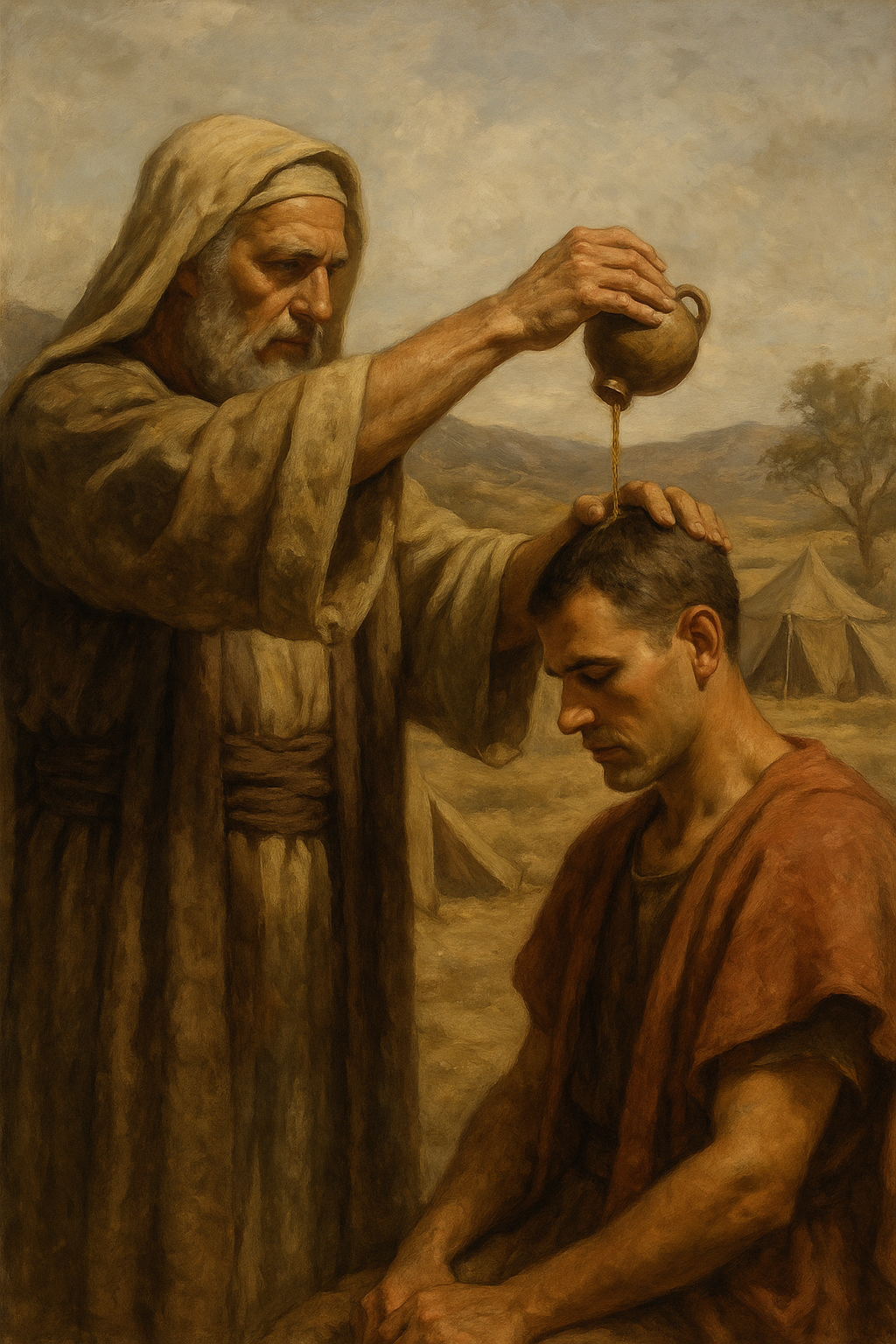
Samuel privately anoints Saul. Samuel poured oil upon Saul’s head, kissed him, and said, “Is it not because the LORD hath anointed thee to be captain over his inheritance?” (1 Samuel 10:1).
The wording identifies Israel as God’s inheritance. Saul’s appointment did not make the people his personal possession or place him above the LORD’s authority.
Samuel gives confirming signs. Samuel foretold a series of encounters:
- Near Rachel’s sepulchre, two men would report that the asses had been found and that Saul’s father was concerned about him.
- At the plain of Tabor, three men going up to God to Bethel would meet him and give him two loaves of bread.
- At the hill of God, where the Philistine garrisons were, Saul would meet a company of prophets with musical instruments before them. The Spirit of the LORD would come upon Saul, and he would prophesy with them (1 Samuel 10:2-6).
Samuel told Saul that he would “be turned into another man” and that God would be with him (1 Samuel 10:6-7). He also instructed Saul to go before him to Gilgal and wait seven days for Samuel to come, offer sacrifices, and show him what to do (1 Samuel 10:8). This chapter records the instruction; it does not narrate its completion.
The signs come to pass. As Saul turned to leave Samuel, “God gave him another heart: and all those signs came to pass that day” (1 Samuel 10:9). At the hill, the Spirit of God came upon him, and he prophesied among the prophets (1 Samuel 10:10).
Those who had previously known Saul were astonished, and the question “Is Saul also among the prophets?” became a proverb (1 Samuel 10:11-12).
The text explicitly records God’s action upon Saul’s heart and the Spirit’s enabling of his prophesying. It does not explicitly describe this event as Saul’s conversion or provide a complete explanation of his eternal standing. The passage should therefore be allowed to state what happened without making “another heart” settle questions it does not directly answer.
When Saul’s uncle asked about the journey, Saul told him that Samuel had assured them the asses were found. He did not tell his uncle what Samuel had said about the kingdom (1 Samuel 10:14-16). Scripture does not explicitly say why he withheld that information.
Samuel gathers Israel at Mizpeh. Before the public selection, Samuel reminded Israel that the LORD had brought them out of Egypt and delivered them from oppression. He then declared, “ye have this day rejected your God,” connecting that rejection with their demand for a king (1 Samuel 10:17-19).
As the tribes and families were brought forward, Benjamin was taken, then the family of Matri, and then Saul. However, Saul could not be found. When the people inquired of the LORD, He answered, “Behold, he hath hid himself among the stuff” (1 Samuel 10:20-22).
The passage states where Saul was hiding but does not identify his motive. Fear, modesty, or reluctance should not be presented as established facts.
Saul is presented to the people. When Saul was brought forward, Samuel said, “See ye him whom the LORD hath chosen, that there is none like him among all the people?” The people shouted, “God save the king” (1 Samuel 10:23-24).
Samuel explained “the manner of the kingdom,” wrote it in a book, and laid it up before the LORD (1 Samuel 10:25). The chapter does not reproduce the contents of that document.
Saul returned to Gibeah, accompanied by “a band of men, whose hearts God had touched” (1 Samuel 10:26). Others, described as “the children of Belial,” despised him, questioned his ability to save them, and brought him no presents. Saul “held his peace” (1 Samuel 10:27).
Key People and Places
People
- Samuel: The prophet who prayed over Israel’s request, delivered God’s warning, anointed Saul, and presided over his public selection.
- Joel and Abiah: Samuel’s sons, who judged in Beersheba and corrupted justice through greed and bribery (1 Samuel 8:1-3).
- The elders of Israel: Representatives who asked Samuel for a king like those of the surrounding nations (1 Samuel 8:4-5).
- Kish: Saul’s father, whose lost asses occasioned Saul’s journey (1 Samuel 9:1-3).
- Saul: The Benjamite whom the LORD chose and Samuel anointed to be captain over Israel.
- Saul’s servant: The unnamed companion who proposed consulting the man of God (1 Samuel 9:6-10).
- The company of prophets: The group Saul encountered when the Spirit of God came upon him and he prophesied (1 Samuel 10:5-13).
- The men whose hearts God touched: Those who accompanied Saul home after his public selection (1 Samuel 10:26).
- The children of Belial: Those who despised Saul and questioned his ability to deliver them (1 Samuel 10:27).
Places
- Beersheba: Where Samuel’s sons served as judges (1 Samuel 8:2).
- Ramah: Where the elders presented their demand to Samuel (1 Samuel 8:4-5).
- Mount Ephraim, Shalisha, Shalim, Benjamin, and Zuph: Areas named during Saul’s search for the lost asses (1 Samuel 9:4-5).
- The city where Saul met Samuel: The city of the meeting is not explicitly named in the account in 1 Samuel 9.
- Rachel’s sepulchre and Zelzah: Landmarks associated with the first promised encounter (1 Samuel 10:2).
- The plain of Tabor: The location of the encounter with three men going to Bethel (1 Samuel 10:3-4).
- Bethel: The destination of those three men, described as “going up to God” (1 Samuel 10:3).
- The hill of God: The place associated with Philistine garrisons and Saul’s meeting with the prophets (1 Samuel 10:5-10).
- Gilgal: Where Saul was instructed to wait for Samuel (1 Samuel 10:8).
- Mizpeh: Where Samuel assembled Israel for the public selection of the king (1 Samuel 10:17).
- Gibeah: Saul’s home, to which he returned after the assembly (1 Samuel 10:26).
Main Doctrinal or Spiritual Themes
God’s Authority Over His People
Israel’s demand revealed rejection of the LORD’s reign (1 Samuel 8:7). Human government could not replace Israel’s obligation to obey God. Even the king was required to read God’s law, fear the LORD, and keep His commandments (Deuteronomy 17:18-20).
The king’s authority was therefore subject to God’s authority. Position did not grant permission to disregard Scripture.
The Danger of Seeking Conformity to the Nations
Israel twice expressed the desire to resemble other nations (1 Samuel 8:5, 20). In this setting, that desire accompanied rejection of God’s rule.
The application is not that every similarity to surrounding society is sinful. The danger is allowing the world’s example to determine what God’s people want when that desire conflicts with His revealed will. Believers are commanded, “be not conformed to this world” (Romans 12:2).
Corrupt Leadership Does Not Justify Disobedience
Samuel’s sons perverted judgment, but their wickedness did not make Israel’s rejection of God right (1 Samuel 8:3-7). Both matters must be acknowledged.
Scripture condemns taking gifts that corrupt judgment (Deuteronomy 16:19). It also exposes the people’s sinful demand. The failures of human leaders do not cancel God’s authority.
God’s Permission Does Not Establish His Approval
God instructed Samuel to grant the people’s request while explicitly identifying their rejection of Him (1 Samuel 8:7-9, 22). In this account, receiving what they demanded did not prove their demand was righteous.
This passage does not teach that every granted request is a judgment. It does demonstrate that obtaining a desired result is not sufficient evidence of God’s moral approval.
Divine Direction and Human Responsibility
God told Samuel beforehand that Saul would come, identified Saul upon his arrival, and fulfilled the signs Samuel announced (1 Samuel 9:15-17; 10:9).
At the same time, Israel remained responsible for rejecting God’s rule (1 Samuel 10:19). God’s direction of events does not remove the responsibility Scripture assigns to human choices.
God’s Compassion Amid His People’s Failure
The LORD heard His people’s cry and appointed Saul to deliver them from the Philistines (1 Samuel 9:16). His compassion did not make their rejection innocent, but their sin did not prevent Him from expressing concern for their oppression.
The passage presents both God’s truthful judgment of sin and His merciful care for His people.
Spiritual Enabling and Submission to God’s Word
The Spirit of God came upon Saul, and he prophesied as Samuel had foretold (1 Samuel 10:6-10). Samuel also gave him specific instructions to follow (1 Samuel 10:8).
Divine enabling did not remove the need for obedience. The account concerns God’s particular work in Saul and should not be made into a promise that every believer will receive the same prophetic manifestation.
Practical Applications or Lessons
- Take troubling decisions to God in prayer. Samuel prayed when the elders’ demand displeased him (1 Samuel 8:6). His example encourages believers to seek the LORD when confronted with difficult requests.
- Reject greed and favoritism in positions of trust. Joel and Abiah allowed financial gain to corrupt their judgment (1 Samuel 8:3). Those entrusted with responsibility must deal honestly with the people they serve.
- Examine both the problem and the proposed solution. Israel correctly identified corrupt judges, but their demand also rejected God’s rule (1 Samuel 8:3-7). A genuine problem does not make every proposed remedy right.
- Listen when God’s Word challenges what you want. The people heard Samuel’s warning and refused to yield (1 Samuel 8:19-20). A sound devotional application is to examine whether we are willing to obey Scripture when it contradicts our preferences.
- Do not mistake favorable circumstances for moral approval. Israel received permission to have a king, yet God still described their demand as rejection of Him (1 Samuel 8:7, 22). Evaluate choices by Scripture rather than by whether circumstances allow them.
- Do not measure spiritual fitness by appearance. Saul’s stature and appearance were impressive (1 Samuel 9:2; 10:23-24). These outward features do not establish the condition of the heart. Scripture explicitly distinguishes outward appearance from God’s knowledge of the heart (1 Samuel 16:7).
- Make room to hear God’s Word. Samuel told Saul to stand still so that he could show him the word of God (1 Samuel 9:27). As a devotional application, believers should give Scripture deliberate attention instead of allowing constant activity to crowd it out.
- Exercise restraint when despised. Saul held his peace when men scorned him (1 Samuel 10:27). His conduct provides an example of leaving an insult unanswered. It does not establish that every accusation or wrongdoing must always be met with silence.
- Keep confidence in the LORD above confidence in human leaders. Israel wanted a king to go before them and fight their battles (1 Samuel 8:20). Believers should heed the biblical principle, “It is better to trust in the LORD than to put confidence in princes” (Psalm 118:9).
- Respect the limits of what Scripture reveals. These chapters do not explain Saul’s motive for hiding or explicitly identify the giving of “another heart” as his conversion. Faithful Bible teaching states what God has written and leaves unspoken what He has not disclosed.
Website Tags
Yoast SEO
Focus keyphrase: 1 Samuel 8-10 KJV
SEO title: 1 Samuel 8-10 KJV: Israel Demands a King
Slug: 1-samuel-8-10-kjv
Meta description: Study 1 Samuel 8-10 KJV: Israel demands a king, Samuel anoints Saul, and God reveals lessons about His authority, obedience, and leadership.
Comments are closed