1 Samuel 4-7: God’s Holiness, Israel’s Repentance, and Divine Deliverance
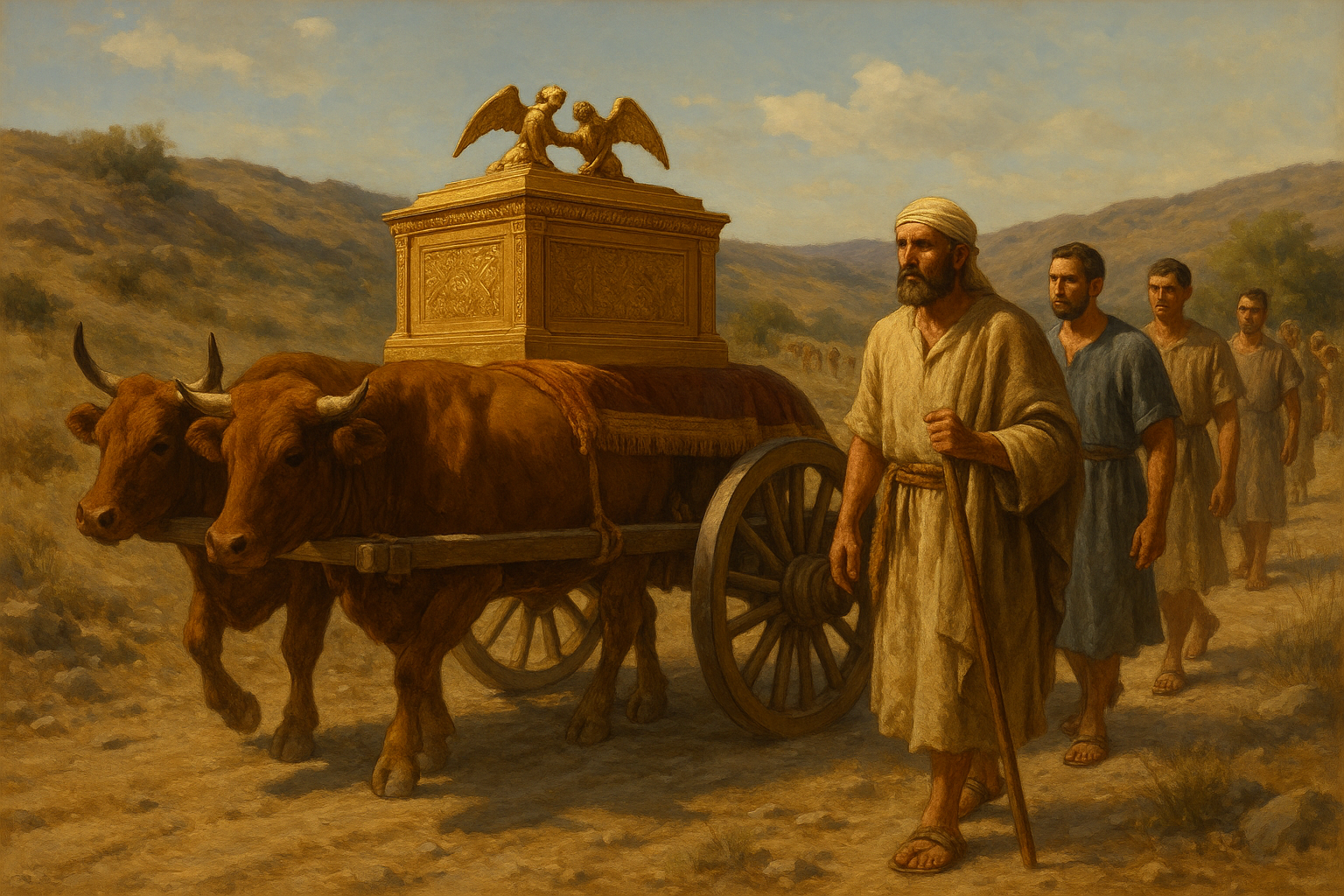
 First Samuel 4-7 records Israel’s defeat, the capture and return of the ark of God, and the nation’s return to the LORD under Samuel’s leadership. These chapters emphasize God’s holiness, the helplessness of idols, the necessity of repentance, and the power of prayer.
The contrast between chapters 4 and 7 is especially significant. In chapter 4, Israel brings the ark into the camp, saying, “it may save us out of the hand of our enemies” (1 Samuel 4:3). In chapter 7, the people put away their idols and ask Samuel to cry unto the LORD for their deliverance (1 Samuel 7:4-8). Religious possessions cannot substitute for a right relationship with the God whom they represent.
Chapter Summaries
1 Samuel 4: Israel’s Defeat and the Capture of the Ark
Defeat leads to a decision about the ark. Israel camps beside Ebenezer, while the Philistines camp at Aphek. In the first battle, about four thousand Israelites are killed. The elders ask, “Wherefore hath the LORD smitten us to day before the Philistines?” They then decide to bring the ark of the covenant from Shiloh, expecting its arrival to bring deliverance (1 Samuel 4:1-3).
The chapter records their decision, but it does not record a command from God directing them to bring the ark into this battle. Their statement places confidence in the ark’s arrival. This may indicate that they were treating possession of the ark as a guarantee of victory.
The ark was associated with the LORD’s covenant presence. First Samuel 4:4 identifies Him as “the LORD of hosts, which dwelleth between the cherubims.” Nevertheless, bringing the ark into the camp did not place God under Israel’s control.
A great shout is followed by a greater defeat. Hophni and Phinehas, Eli’s sons, accompany the ark. Israel shouts so loudly that “the earth rang again.” The Philistines become afraid, but they encourage one another to fight. Israel suffers another defeat, thirty thousand footmen fall, the ark is captured, and Hophni and Phinehas are killed (1 Samuel 4:4-11).
Their deaths fulfill the previously announced sign that both sons would die in one day (1 Samuel 2:34). The noise and excitement surrounding the ark’s arrival do not prevent God’s declared judgment.
Eli dies when he hears that the ark has been taken. A man of Benjamin brings the news to Shiloh. Eli is ninety-eight years old, unable to see, and deeply concerned about the ark. The messenger reports Israel’s defeat, the deaths of Eli’s sons, and the capture of the ark. When the ark is mentioned, Eli falls backward from his seat, breaks his neck, and dies. He had judged Israel forty years (1 Samuel 4:12-18).
Ichabod’s birth accompanies the household’s grief. Phinehas’ wife goes into labor upon hearing the news. As she dies, she names her son Ichabod and says, “The glory is departed from Israel.” The passage connects her words with the capture of the ark and the deaths of her father-in-law and husband (1 Samuel 4:19-22).
Her words express the terrible loss associated with these events. They should not be expanded into a claim that God had ceased to act or had permanently abandoned Israel. The following chapters record His power among the Philistines and His deliverance of His people.
1 Samuel 5: The LORD’s Power in Philistine Territory
Dagon falls before the ark. The Philistines bring the captured ark to Ashdod and place it in the house of Dagon. The next morning, Dagon is lying face down before the ark. They put the idol back in its place, but the following morning it has fallen again. Its head and the palms of its hands are cut off upon the threshold (1 Samuel 5:1-5).
The text describes the idol’s physical collapse, not a conscious act of worship by Dagon. The scene exposes the helplessness of the object the Philistines worshiped: its worshipers must lift it back into position.
God’s judgment follows the ark from city to city. The LORD’s hand is heavy upon Ashdod and its surrounding territory. The people suffer destruction and are smitten with “emerods.” The men of Ashdod recognize that God’s hand is against both them and Dagon (1 Samuel 5:6-7).
The ark is moved to Gath, where severe judgment follows. It is then sent to Ekron, whose inhabitants protest that it has been brought there to kill them. The chapter closes with deadly destruction and the city’s cry going up to heaven (1 Samuel 5:8-12).
The KJV identifies the affliction as “emerods.” It does not provide a modern medical diagnosis, so identifying a particular disease would go beyond its explicit wording.
Israel’s military defeat has not made the LORD powerless. While the ark is in Philistine territory, God continues to exercise judgment. His authority is not confined to Israel’s land or dependent upon Israel’s military strength.
1 Samuel 6: The Ark Returns, and God’s Holiness Remains
The Philistines seek instructions for returning the ark. After seven months, the Philistines consult their priests and diviners. These advisers recommend returning the ark with a trespass offering of golden emerods and golden mice. They also warn against hardening their hearts as Pharaoh and the Egyptians had done (1 Samuel 6:1-6).
These instructions come from Philistine religious advisers. The account records their counsel without making their practices a pattern for biblical worship.
The cart travels directly toward Bethshemesh. The advisers propose a new cart drawn by two milk cows that have never borne a yoke. Their calves are to be kept at home. The proposed test is whether the cows will take the ark toward Bethshemesh. The Philistines say that this outcome will identify the LORD as the source of their affliction (1 Samuel 6:7-9).
The cows take the straight road to Bethshemesh, lowing as they go and turning aside neither to the right nor to the left. The five Philistine lords follow them to the border (1 Samuel 6:10-12). This outcome matches the test the advisers proposed; chapter 5 has already explicitly identified the LORD’s hand as the cause of the judgment.
Joy at the ark’s return is followed by judgment. The people of Bethshemesh are reaping wheat when they see the ark and rejoice. The cart stops in the field of Joshua, a Bethshemite. The Levites take down the ark and the accompanying coffer, and offerings are made unto the LORD (1 Samuel 6:13-18).
Then the LORD smites the men of Bethshemesh because they have looked into the ark. The KJV gives the number as “fifty thousand and threescore and ten men” (1 Samuel 6:19). The stated reason is their looking into the ark; the passage does not explain their individual motives.
The people ask:
“Who is able to stand before this holy LORD God?”
1 Samuel 6:20
They send messengers to Kirjathjearim, asking its inhabitants to take the ark (1 Samuel 6:21).
The chapter establishes that God’s holiness must be regarded among Israelites as well as Philistines. Rejoicing over the ark’s return does not make irreverent conduct acceptable.
1 Samuel 7: Repentance, Prayer, and Ebenezer
The ark is placed in Abinadab’s house. The men of Kirjathjearim bring the ark into the house of Abinadab in the hill. They sanctify his son Eleazar to keep it. The text then mentions a period of twenty years and says that “all the house of Israel lamented after the LORD” (1 Samuel 7:1-2).
The passage identifies Eleazar’s responsibility but does not explicitly identify Abinadab’s family as Levites. It also does not say that the ark was removed at the end of the twenty years.
Samuel calls Israel to wholehearted repentance. Samuel tells the people:
“If ye do return unto the LORD with all your hearts, then put away the strange gods and Ashtaroth from among you, and prepare your hearts unto the LORD, and serve him only.”
1 Samuel 7:3
Israel responds by putting away Baalim and Ashtaroth and serving the LORD only (1 Samuel 7:4). Their return includes a definite rejection of idolatry.
Samuel gathers the people at Mizpeh and promises to pray for them. They draw water and pour it out before the LORD, fast, and confess, “We have sinned against the LORD” (1 Samuel 7:5-6). Scripture records the pouring out of water but does not explicitly explain its symbolic meaning.
The LORD answers Samuel’s prayer. When the Philistines approach, Israel is afraid and asks Samuel to continue crying unto the LORD for them. Samuel offers a sucking lamb as a burnt offering and prays. The text states plainly, “the LORD heard him” (1 Samuel 7:7-9).
As the Philistines draw near, the LORD thunders with a great thunder and throws them into confusion. Israel pursues them from Mizpeh to below Bethcar (1 Samuel 7:10-11). The passage attributes the decisive intervention to the LORD.
Samuel sets up a memorial to God’s help. Samuel places a stone between Mizpeh and Shen, names it Ebenezer, and declares:
“Hitherto hath the LORD helped us.”
1 Samuel 7:12
The Philistines are subdued, cities and territory are recovered, and there is peace between Israel and the Amorites. The chapter states that the LORD’s hand was against the Philistines all the days of Samuel (1 Samuel 7:13-14).
Samuel continues judging Israel throughout his life. His yearly circuit includes Bethel, Gilgal, and Mizpeh. He returns to Ramah, where his house is located, where he also judges Israel, and where he builds an altar unto the LORD (1 Samuel 7:15-17).
Key People and Places
People and Groups
- Samuel: God’s servant who calls Israel to repentance, prays for the people, and judges the nation (1 Samuel 7:3-17).
- Eli: The aged judge whose heart trembles for the ark and who dies upon hearing of its capture (1 Samuel 4:13-18).
- Hophni and Phinehas: Eli’s sons, killed on the day the ark is captured (1 Samuel 4:4, 11).
- Phinehas’ wife: The unnamed woman who gives birth to Ichabod and speaks of Israel’s departed glory as she dies (1 Samuel 4:19-22).
- Ichabod: The son named in connection with the capture of the ark and the losses in Eli’s household (1 Samuel 4:21-22).
- The Philistines: Israel’s enemies, who capture the ark and then experience God’s judgment (1 Samuel 4:10-11; 5:1-12).
- The Philistine priests and diviners: Advisers who propose how the ark should be returned (1 Samuel 6:2-9).
- Joshua the Bethshemite: The man whose field receives the returning cart and ark (1 Samuel 6:14, 18).
- Abinadab and Eleazar: The ark is placed in Abinadab’s house, and Eleazar is sanctified to keep it (1 Samuel 7:1).
- The Levites: Those who take the ark and coffer down from the cart at Bethshemesh (1 Samuel 6:15).
Places
- Shiloh: The location from which the ark is brought and to which the messenger brings news of Israel’s defeat (1 Samuel 4:3-4, 12).
- Ebenezer and Aphek: The locations associated with the opposing camps in chapter 4 (1 Samuel 4:1).
- Ashdod, Gath, and Ekron: Philistine cities to which the captured ark is taken (1 Samuel 5:1-12).
- Gaza and Askelon: Additional Philistine cities named in connection with the golden offerings (1 Samuel 6:17).
- Bethshemesh: The place where the people see the returning ark during wheat harvest (1 Samuel 6:12-13).
- Kirjathjearim: The town whose inhabitants bring the ark into Abinadab’s house (1 Samuel 7:1).
- Mizpeh: The gathering place for Israel’s confession, fasting, and Samuel’s intercession (1 Samuel 7:5-9).
- Bethcar: The location associated with the end of Israel’s pursuit of the Philistines (1 Samuel 7:11).
- Shen: A landmark near the memorial stone Samuel names Ebenezer (1 Samuel 7:12).
- Bethel, Gilgal, and Ramah: Places connected with Samuel’s continuing ministry as judge (1 Samuel 7:16-17).
Main Doctrinal or Spiritual Themes
1. God’s Holiness Requires Reverence
The Philistines experience God’s judgment, and the men of Bethshemesh are also judged. Belonging to Israel does not exempt anyone from accountability before the holy LORD God (1 Samuel 5:6-12; 6:19-20).
Reverence involves more than a religious feeling. God’s people must honor Him in their conduct.
2. Religious Possessions Cannot Guarantee God’s Blessing
Israel possesses the ark in chapter 4 but suffers defeat. In chapter 7, the people turn from idols, confess their sin, and seek the LORD’s help (1 Samuel 4:3-11; 7:3-10).
For believers today, church membership, baptism, ministry responsibilities, and possession of a Bible must never become substitutes for personal faith and obedience. This is a practical application of the contrast, not a claim that these Christian practices are themselves discussed in the passage.
3. The LORD Has Authority Over Idols and Nations
Dagon falls, and Philistine cities experience the LORD’s heavy hand. Capturing the ark does not give the Philistines power over the God of Israel (1 Samuel 5:1-12).
God remains sovereign when His people suffer defeat. Human failure does not diminish His authority.
4. Repentance Includes Turning from Known Sin
Samuel calls for a return with the whole heart, the removal of strange gods, and exclusive service to the LORD. Israel responds by putting away Baalim and Ashtaroth (1 Samuel 7:3-4).
The passage concerns Israel’s return to the LORD and deliverance from the Philistines. It should not be used to teach that sinners earn eternal salvation by reforming their conduct. Salvation is by grace through faith, “not of works” (Ephesians 2:8-9).
5. Prayer Expresses Dependence upon God
Israel asks Samuel to pray, Samuel cries unto the LORD, and the LORD hears him (1 Samuel 7:8-9).
Samuel’s effectiveness is not presented as an independent power belonging to him. He petitions God, and God grants the deliverance. Faithful spiritual leadership directs people toward the LORD.
6. God’s Help Deserves Grateful Remembrance
Samuel’s memorial gives the credit to God: “Hitherto hath the LORD helped us” (1 Samuel 7:12).
The stone marks remembered help. The text does not present it as an object possessing power or as a guarantee that Israel could disregard God in the future.
Practical Applications or Lessons
- Examine what you are trusting. Israel’s confidence in the ark’s arrival did not secure victory. Ask whether your confidence rests in the LORD or merely in your religious associations and habits (1 Samuel 4:3-11).
- Do not confuse excitement with spiritual faithfulness. Israel’s great shout was followed by defeat. Enthusiasm should accompany truth and obedience, not replace them (1 Samuel 4:5-10).
- Take God’s warnings seriously. The deaths of Hophni and Phinehas fulfilled the announced sign. God’s Word should govern conduct before consequences make its seriousness undeniable (1 Samuel 2:34; 4:11).
- Confess sin plainly. At Mizpeh, Israel said, “We have sinned against the LORD.” Their confession provides an example of acknowledging guilt without shifting responsibility to others (1 Samuel 7:6).
- Put away what competes with loyalty to God. Israel’s response included removing its idols. As a present-day application, examine any pursuit or attachment that draws you into disobedience or claims the devotion owed to God (1 Samuel 7:3-4).
- Pray when fear rises. The people were afraid of the approaching Philistines, but they sought the LORD’s help through prayer. Fear should move believers toward dependence upon God (1 Samuel 7:7-9).
- Remember God’s help with humility. Samuel credited the LORD for the victory. Remembering answered prayer should encourage gratitude rather than self-congratulation (1 Samuel 7:12).
- Continue serving after the crisis passes. The chapter closes with Samuel’s ongoing work of judging Israel. Faithfulness includes regular responsibilities as well as extraordinary moments of need (1 Samuel 7:15-17).
Comments are closed