CHAPTER SUMMARIES
1 Samuel 18 — The Rise of David and the Jealousy of Saul
After David’s victory over Goliath, Scripture records that “the soul of Jonathan was knit with the soul of David” (18:1). Jonathan forms a covenant with David, demonstrating spiritual unity, humility, and loyalty, even though Jonathan is the natural heir to Saul’s throne. His gesture of giving David his robe, sword, bow, and girdle (18:4) symbolizes honor and recognition of God’s evident calling upon David.
David prospers in battle, and “the LORD was with him” (18:12, 14). The women of Israel sing, “Saul hath slain his thousands, and David his ten thousands” (18:7). This inflames Saul’s pride and insecurity. Saul becomes jealous, resentful, and fearful of David, three times described in this chapter as being afraid of him (18:12, 15, 29).
Under demonic influence (18:10), Saul attempts to kill David with a javelin. He then schemes to have David killed by the Philistines, offering Michal as a snare (18:21). David humbly declines honor but accepts the king’s challenge and brings the required dowry. David succeeds because God is with him (18:28), and Saul’s hatred deepens.
1 Samuel 19 — Saul’s Open Hostility and God’s Protection
Jonathan warns David of Saul’s murderous intentions (19:1–3). Jonathan speaks good on David’s behalf, reminding Saul of David’s faithfulness and his role in Israel’s deliverance (19:4–5). Saul temporarily swears an oath that David will not be slain (19:6).
But soon the evil spirit troubles Saul again, and he casts another javelin at David (19:9–10). David flees. Michal helps David escape through a window (19:11–12) and uses deception to delay Saul’s messengers.
David flees to Samuel in Ramah (19:18). Saul sends messengers to capture David, but each group ends up prophesying under the power of God’s Spirit (19:20–21). Finally, Saul himself goes, and he too is overcome, falling down, unable to carry out his wicked plan (19:23–24). God visibly intervenes to preserve His chosen servant.
1 Samuel 20 — Jonathan and David’s Covenant Tested
 David returns secretly to Jonathan, convinced that Saul seeks his life (20:1–3). Jonathan, struggling to believe his father capable of such sin, nevertheless agrees to test Saul’s intentions.
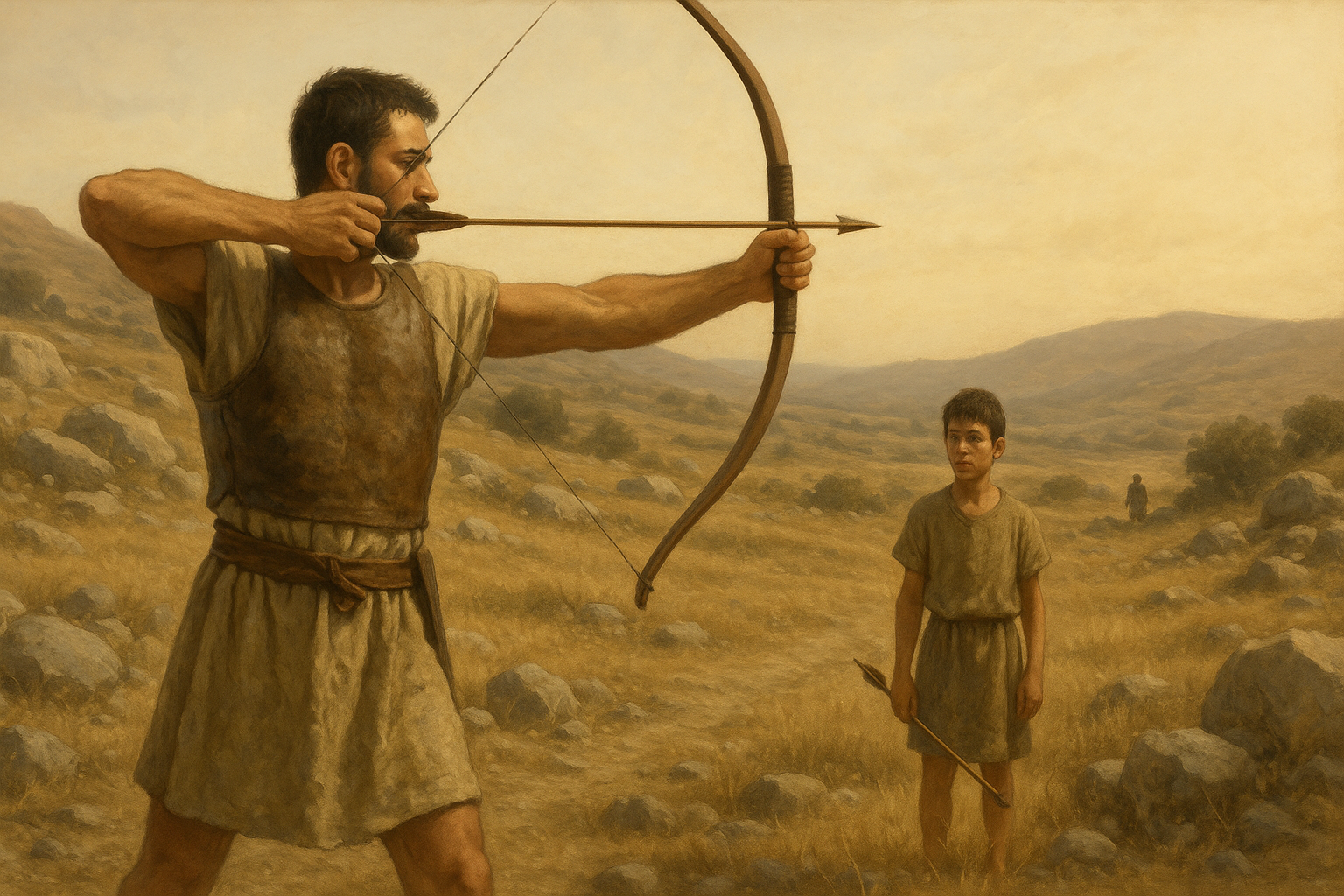
David will hide at the appointed time of Saul’s feast. Jonathan is to observe Saul’s reaction and then communicate the truth through a pre-arranged signal involving arrows shot into the field (20:18–22).
At the feast, Saul’s anger erupts when he realizes David is absent. He rages at Jonathan, calling him “the son of the perverse rebellious woman” (20:30). Saul then attempts to kill Jonathan with a javelin, proving beyond all doubt the king’s murderous heart (20:33).
Jonathan goes out the next morning and gives the signal of danger. The two men meet briefly, weep, reaffirm their covenant, and part (20:41–42). Jonathan returns to his doomed father; David departs to continue fleeing until the day God exalts him.
KEY PEOPLE AND PLACES
David
God’s chosen king, walking in faith, humility, and obedience while enduring persecution.
Jonathan
Saul’s son; a godly, loyal friend to David. His covenant loyalty reflects selflessness and righteousness.
Saul
The rejected king whose jealousy, pride, and spiritual rebellion grow into murderous rage.
Michal
Saul’s daughter and David’s wife, who helps David escape, though her character later reveals mixed motives.
Samuel (Ramah/Naioth)
The prophet of God; a place of spiritual refuge for David, protected by God’s presence.
Gibeah
Saul’s home city and the location of the royal court.
Naioth
A prophetic settlement near Ramah where God supernaturally restrains Saul.
MAIN DOCTRINAL OR SPIRITUAL THEMES
1. God Exalts the Humble and Resists the Proud
David’s rise and Saul’s fall demonstrate Proverbs 3:34 and James 4:6 in action. Pride destroys; humility is blessed.
2. The Reality of Spiritual Warfare
Saul is influenced by an evil spirit because of a hardened, rebellious heart (18:10; 19:9). This reminds believers that spiritual decline follows disobedience.
3. Covenant Loyalty and Godly Friendship
Jonathan’s covenant points to biblical faithfulness, sacrificial love, and righteousness.
4. God’s Sovereign Protection of His Anointed
Every attempt to kill David fails—not by chance—but by direct divine intervention.
5. The High Cost of Jealousy and Sin
Saul’s envy becomes rage and violence. Sin always grows if unchecked.
PRACTICAL APPLICATIONS OR LESSONS
1. Guard Against Jealousy and Pride
Saul’s downfall warns that envy blinds, corrupts, and destroys relationships.
2. Seek Friendships That Strengthen Godliness
Jonathan and David model loyalty, accountability, and spiritual support—friendship rooted in truth, not convenience.
3. God Protects Those Who Walk Uprightly
David faced danger repeatedly yet was preserved. Believers can trust God’s watchcare even in trials.
4. Obedience Brings Fellowship; Disobedience Brings Darkness
Saul drifted far from God because he refused to obey earlier commands. Small compromises lead to great ruin.
5. Do Right Even When It Costs You
Jonathan risks his status, inheritance, and even life to stand for righteousness. God honors those who choose principle over personal gain.
Comments are closed