CHAPTER SUMMARIES
Ruth 1 — The Famine, the Loss, and Ruth’s Loyal Commitment
 The book begins in the days when the judges ruled—an era marked by spiritual inconsistency. A famine strikes Bethlehem (“the house of bread”), driving Elimelech, Naomi, and their sons Mahlon and Chilion into Moab, a nation often hostile toward Israel (Deut. 23:3). While in Moab, Elimelech dies, and the two sons marry Moabite women—Orpah and Ruth—yet after about ten years, the sons also die (Ruth 1:3–5).
Naomi, “left of her husband and her two sons,” decides to return to Bethlehem upon hearing “the LORD had visited his people in giving them bread” (1:6). She urges her daughters-in-law to remain in Moab. Orpah eventually returns, but Ruth refuses, declaring her famous pledge:
“Whither thou goest, I will go… thy people shall be my people, and thy God my God.” (1:16)
This is not merely emotional devotion; it is a confession of faith—Ruth chooses the God of Israel. Naomi returns to Bethlehem in deep sorrow, saying, “Call me not Naomi… call me Mara” (1:20), acknowledging the LORD’s hand in her affliction, yet still recognizing His sovereignty.
The chapter ends with hope: they arrive “in the beginning of barley harvest” (1:22).
Ruth 2 — Ruth’s Gleaning and God’s Providential Kindness Through Boaz
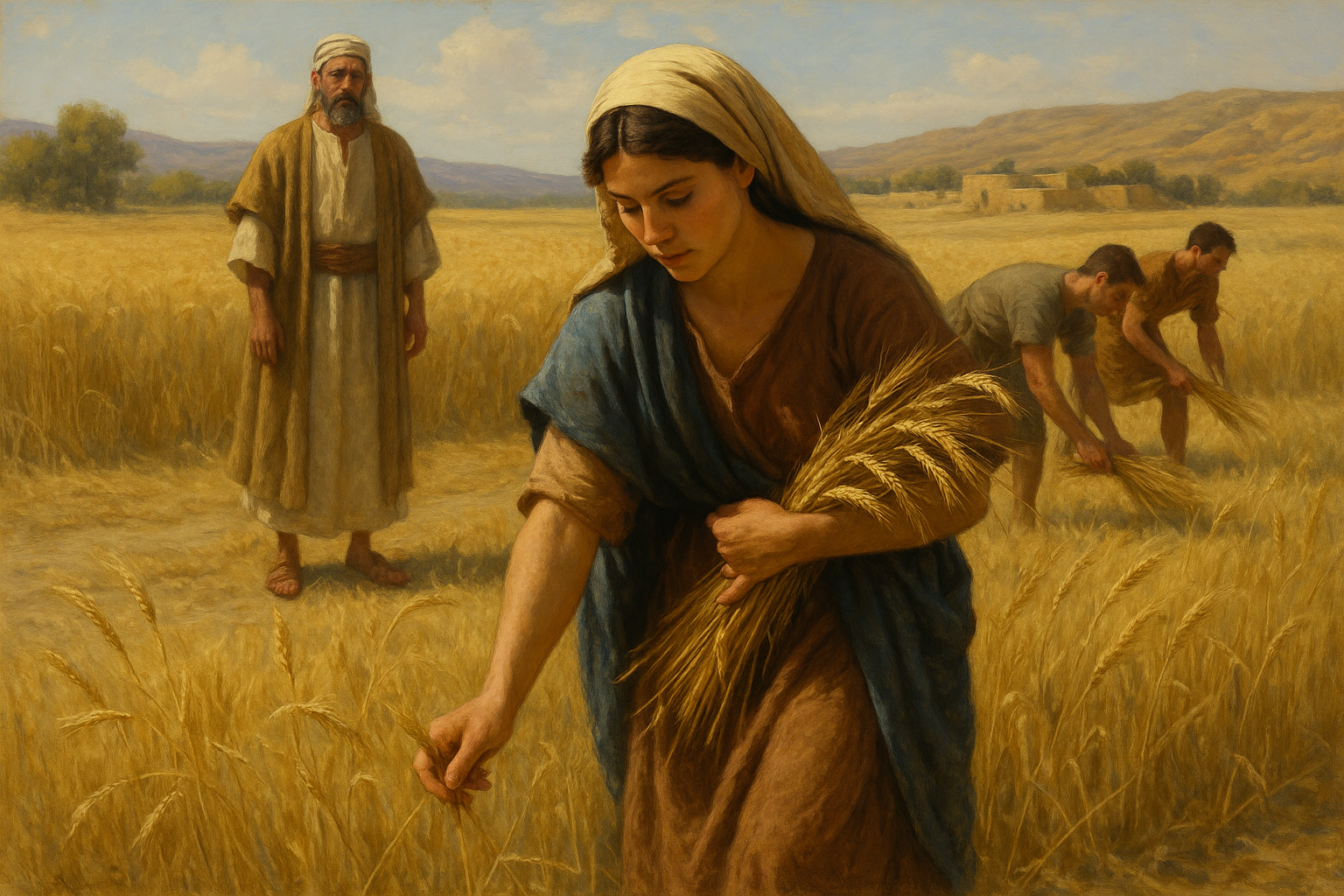
Ruth seeks permission to glean in the fields as the law allowed for the poor (Lev. 19:9–10). She “happened” to come into the field of Boaz (2:3)—a phrase showing divine providence more than mere chance. Boaz is introduced as “a mighty man of wealth” and a near kinsman to Elimelech.
Boaz notices Ruth’s humility and diligence. He had heard of her kindness to Naomi and her commitment to Israel’s God. He blesses her:
“The LORD recompense thy work… under whose wings thou art come to trust.” (2:12)
Boaz ensures her safety, instructs his men to leave handfuls of grain for her, and treats her with generosity and respect. Ruth returns home with abundant barley, and Naomi recognizes the hand of God: “Blessed be he of the LORD” (2:20). She reveals that Boaz is a “kinsman.”
Ruth 3 — Ruth’s Appeal at the Threshing Floor
Following Naomi’s counsel, Ruth approaches Boaz at the threshing floor after the harvest celebration. She uncovers his feet and lies down—not an immoral act, but a symbolic request for redemption, invoking the kinsman-redeemer law (Deut. 25:5–10).
Boaz calls her “a virtuous woman” (3:11) and praises her modesty and kindness. Yet a nearer kinsman exists. Boaz vows to resolve the matter honorably the next morning.
He sends Ruth home with barley as a pledge of his good intention. Naomi expresses confidence: “The man will not be in rest, until he have finished the thing this day” (3:18).
Ruth 4 — The Legal Redemption, the Marriage, and the Line of David
Boaz goes to the elders at the gate and presents the matter to the nearer kinsman, who declines the responsibility of redemption lest he “mar mine own inheritance” (4:6). Boaz then publicly redeems the land and takes Ruth as his wife.
The people and elders bless the union, comparing Ruth to Rachel and Leah. God grants conception, and Ruth bears Obed, who becomes the father of Jesse, the father of David (4:17).
The book ends with a genealogy showing God’s providential plan leading directly to King David—and ultimately to the Messiah (Matt. 1:5–6).
KEY PEOPLE AND PLACES
People
-
Naomi — A bereaved widow who trusts the LORD in hardship.
-
Ruth — A Moabite convert marked by loyalty, humility, and genuine faith.
-
Boaz — A wealthy, godly kinsman-redeemer, picture of honor and Christlike kindness.
-
Elimelech — Naomi’s husband, whose move to Moab sets the narrative in motion.
-
Orpah — Returns to Moab; a contrast to Ruth’s faith.
-
Obed — Son of Ruth and Boaz; grandfather of David.
Places
-
Bethlehem — “House of bread,” site of famine turned to blessing.
-
Moab — Foreign land outside Israel’s covenant community.
-
Field of Boaz — Place of providence and provision.
-
The Gate of Bethlehem — Public center of legal transactions.
MAIN DOCTRINAL OR SPIRITUAL THEMES
1. God’s Providence
Nothing in Ruth happens by accident—the famine, the gleaning, the meeting with Boaz—all fulfill God’s sovereign plan.
2. Redemption
Boaz pictures the biblical doctrine of redemption:
– A near kinsman
– Able to redeem
– Willing to redeem
– Acting at personal cost
This foreshadows Christ, our Redeemer.
3. Faith and Conversion
Ruth turning from Moab’s gods to the God of Israel is a clear example of repentance and faith.
4. The Value of Virtue and Godly Character
Both Ruth and Boaz are marked by purity, integrity, and obedience.
5. God’s Grace Toward the Outsider
A Gentile woman becomes part of the Messiah’s lineage—showing His mercy extends beyond national Israel.
PRACTICAL APPLICATIONS
1. God Works Through Ordinary Faithfulness
Simple acts—gleaning, caring for family, honoring God’s law—become instruments of divine blessing.
2. Your Past Does Not Prevent God from Using You
Ruth’s Moabite background did not hinder God’s plan for her life.
3. Integrity Matters
Boaz models honorable manhood; Ruth models godly womanhood.
4. God Honors Commitment and Loyalty
Ruth’s loyalty to Naomi and to the LORD is profoundly rewarded.
5. God Provides in His Time
Even when Naomi felt “Mara,” God was already guiding the path toward restoration.
Comments are closed