Chapter Summaries
Joshua 5 – After the crossing of the Jordan, the chapter opens: “And it came to pass when all the kings of the Amorites, which were on the other side of Jordan, and all the kings of the Canaanites, which were by the sea, heard how the LORD dried up the waters of Jordan from before the children of Israel, until we were passed over, then their heart melted, and there was no spirit in them any more, because of the children of Israel.” (5:1)
– God commands Joshua: “Make thee sharp knives, and circumcise again the children of Israel the second time.” (5:2) Because those born in the wilderness had not been circumcised. Joshua performs the circumcision at Gilgal, and the reproach of Egypt is rolled away from Israel. (5:7–9)
– Then Israel keeps the Passover “at Gilgal” on the plains of Jericho, and afterward the manna ceases and the children of Israel eat of the fruit of the land of Canaan. (5:10–12)
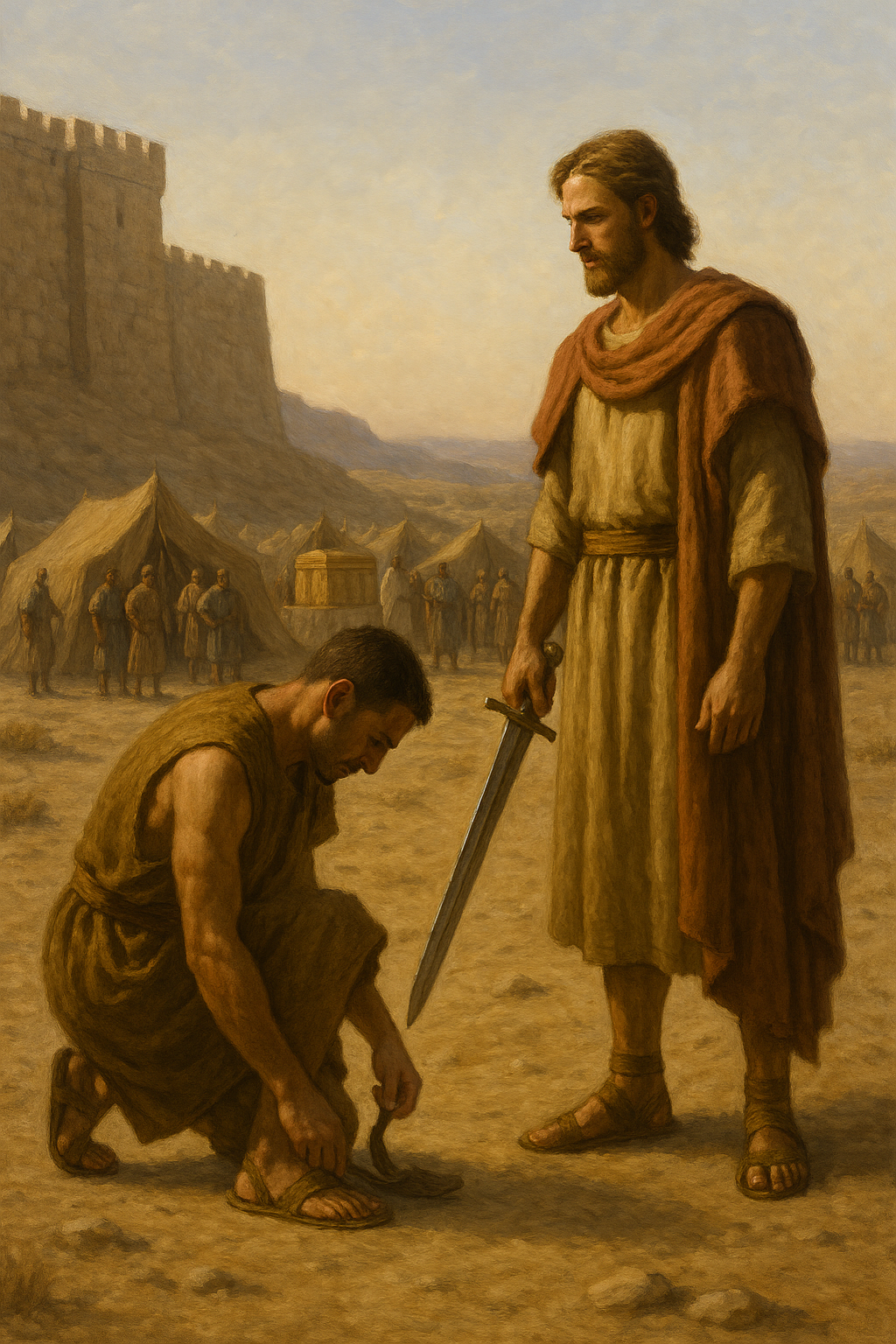
– Finally, as Joshua stands by Jericho, he sees “a Man” with drawn sword: “And he said unto him, Art thou for us, or for our adversaries? And he said, Nay; but as Captain of the host of the LORD am I now come.” (5:13–14) Joshua responds by worship, and the place is sanctified by the command to remove his shoes because he stands on holy ground. (5:15)
– Historical/doctrinal note: This chapter shows that before Israel may engage in conquest, there must be renewed covenant relationship (circumcision, Passover), recognition of God’s presence, and readiness to obey.
Joshua 6
– The chapter opens: “Now the city of Jericho was straitly shut up because of the children of Israel: none went out, and none came in.” (6:1)
– The LORD says to Joshua: “See, I have given into thine hand Jericho, and the king thereof, and the mighty men of valour.” (6:2) God gives the city before the attack begins.
– The plan is unusual: Israel is commanded to march around the city once for six days, with seven priests bearing seven trumpets of rams’ horns before the ark; on the seventh day, march around seven times, and at the blast of the trumpet and a shout, the wall will fall flat. (6:3-5)
– Joshua instructs the people accordingly (6:6–10); they obey. On the seventh day they march, priests blow the trumpets, the people shout: “And the wall fell down flat, so that the people went up into the city, every man straight before him, and they took the city.” (6:20)
– They devote the city to the LORD: “And they utterly destroyed all that was in the city, both man and woman, young and old, and ox, and sheep, and ass, with the edge of the sword.” (6:21) Except Rahab and her house are spared because she hid the spies (6:17, 22-23). The silver, gold, brass, and iron are consecrated to the LORD’s treasury (6:19). The city is burned. (6:24)
– Doctrinal note: This chapter emphasises faith-obedience to God’s command, the supremacy of God’s power rather than human strategy, and the holy war principle of devotion and separation.
Joshua 7
– The triumph of Jericho is followed by failure: “But the children of Israel committed a trespass in the accursed thing: for Achan… took of the accursed thing: and the anger of the LORD was kindled against the children of Israel.” (7:1)
– Israel attempts to attack the small city of Ai. About three thousand men go up, but they are defeated: “they fled before the men of Ai” and Israel’s hearts melt like water. (7:4-5)
– Joshua mourns: he tears his clothes, falls before the ark, and asks: “O Lord, what shall I say, when Israel turneth their back before their enemies? For the Canaanites and all the inhabitants of the land will hear it, and shall surround us…” (7:6-9)
– The LORD tells Joshua the reason: Israel has sinned, they have transgressed My covenant, have taken of the accursed thing, stolen, and also deceived. (7:11) The LORD will not be with Israel unless the accursed thing is taken away. (7:12)
– The guilty one is identified by lot: Achan, son of Carmi of the tribe of Judah, his family and belongings are taken, confession is given (7:19-22), then Achan and his possessions are destroyed by fire, stones are piled over him. “And the LORD turned from the fierceness of his anger.” (7:26)
– Doctrinal note: This chapter teaches the seriousness of corporate responsibility, the holiness of God in war and consecration, the effect of one person’s disobedience on the whole community, and the necessity of confession and separation from sin.
Key People and Places
-
Joshua (Joshua 1:1; ch.5–7): The leader of Israel after Moses, responsible for enforcing the covenant and obedience.
-
Achan (Joshua 7:1-26): A man of the tribe of Judah who took of the accursed thing, bringing defeat upon Israel.
-
Rahab (Joshua 2,6): A Canaanite woman in Jericho who hid Israel’s spies and was spared in the destruction of Jericho (6:17,22-23).
-
Gilgal (Joshua 5:9–10): The camp and memorial site just inside the land of Canaan where Israel circumcised the males, celebrated Passover, and where the reproach of Egypt was rolled away.
-
Jericho (Joshua 6): The first fortified city taken by Israel in Canaan, with walls that fell by God’s power.
-
Ai (Joshua 7): The small city whose defeat of Israel illustrates the effect of disobedience, despite God’s promise.
-
Ark of the Covenant: Throughout these chapters the ark symbolizes God’s presence and leads the people in holy war (5:15; 6:6–9).
-
The “Captain of the host of the LORD” (Joshua 5:13–15): The heavenly commander who appears to Joshua, marking the divine leadership of the campaign.
Main Doctrinal or Spiritual Themes
-
Covenant Renewal and Obedience – Before Israel could mount conquest, they needed to renew their covenant relationship with God (circumcision, Passover). (5:2-10)
-
God’s Presence and Sovereignty in Battle – The plan to take Jericho was not human strategy but divine command; the “Captain of the host of the LORD” assures Joshua that God is leading. (5:13–15; 6:2)
-
Faith and Obedience Bring Victory – Israel’s success at Jericho came by faith-obedience, not by human might. (6:16-20)
-
Holiness, Devotion, and the Ban (herem) – The taking of Jericho involved the ban: devoted things must be destroyed, not appropriated by the conquerors. (6:17-19) When this was violated, defeat followed. (7:1-12)
-
Corporate Responsibility and Consequences of Sin – One man’s disobedience (Achan) brought disaster on the nation. Fellowship with sin affects all. (7:1-5, 11-12)
-
The Presence of God Linked to Obedience – The LORD declares He will not be with Israel unless the accursed thing is removed. (7:12)
-
The Necessity of Judgment, Confession, and Restoration – Sin must be dealt with decisively; confession and removal restore fellowship with God and allow the campaign to continue. (7:16-26)
-
Typology for the Christian Life – Though Israel’s covenantal context differs from New Testament believers, the principles of obedience, the seriousness of sin, and dependence on God still apply.
Practical Applications or Lessons
-
Spiritual preparation must precede spiritual victory – Just as Israel needed renewal before conquest, believers need daily consecration and obedience before exercising spiritual ministry or warfare.
-
Trusting God’s methods, even when they seem foolish – The march around Jericho made no sense militarily, yet God’s plan worked. Likewise, Christians must obey God even when His methods appear illogical.
-
Beware of small compromises – Achan’s single act of coveting and disobedience brought national disgrace. In our lives, small sins unchecked can ruin testimony and hinder ministry.
-
Sin affects the community – In a church body, one person’s unconfessed sin can hinder the whole congregation’s effectiveness. Self-examination and accountability are vital.
-
God honours confession and repentance – After Israel confessed the sin and dealt with it, God’s anger relented and the campaign could move forward. Believers should not delay in confessing sin.
-
Obedience results in divine deliverance – When Israel obeyed, walls fell. When they disobeyed, defeat came. In our Christian walk, victories come through obedience to God’s Word.
-
The presence of God is our greatest strength – Joshua recognized his dependence on the LORD’s presence (“What shall I say… what will you do for Your great name?” 7:7). For believers, success depends on God’s presence, not merely human plans.
-
Holiness matters in warfare – Christian ministry is warfare (spiritual), and while Christ has won the ultimate victory, we must engage in holiness, devotion, and separation from sin for effective service.
-
Call to live under God’s covenant loyalty – Just as Israel had to walk in covenant obedience, believers are called to live by the terms of the new covenant: faithful to Christ, His Word, holiness, and mission.
Comments are closed