Chapter Summaries
Chapter 16
 This chapter records the allotment of land to the children of Joseph (namely the tribes of Ephraim and the half-tribe of Manasseh on the west of Jordan). “The lot for the children of Joseph began at Jordan by Jericho … and so it went out from Bethel … to the sea.” (cf. Joshua 16:1–4). Then the boundaries of Ephraim in particular are described (vv. 5–10). Notably: “But they did not utterly drive out the Canaanites that dwelt in Gezer: but the Canaanites dwell among the Ephraimites unto this day, and became tributaries.” (Joshua 16:10 KJV)
This signals both God’s faithfulness in giving the land and Israel’s incomplete obedience in driving out the enemy.
Chapter 17
Here the allotment for Manasseh is recorded (vv. 1–13) including the portion on the east side of Jordan (Gilead and Bashan) and the portion on the west. (Joshua 17:1–6 KJV) Also the daughters of Zelophehad receive an inheritance (v. 3–6), which underscores justice in God’s dealings even in difficult family circumstances. Then the children of Joseph (Ephraim and Manasseh) approach Joshua complaining that their portion is too little because they are a “great people” (v. 14–15). Joshua’s answer: “If thou be a great people, then get thee up to the wood country, and cut down for thyself there in the land of the Perizzites and of the giants; if mount Ephraim be too narrow for thee.” (v. 15 KJV) And yet the chapter closes with the reality that Israel did not fully drive out the Canaanites: “But the Canaanites would dwell in the land.” (v. 12 KJV)
This shows God’s promise fulfilled, human ambition voiced, and still the lingering of opposition because of incomplete obedience.
Chapter 18
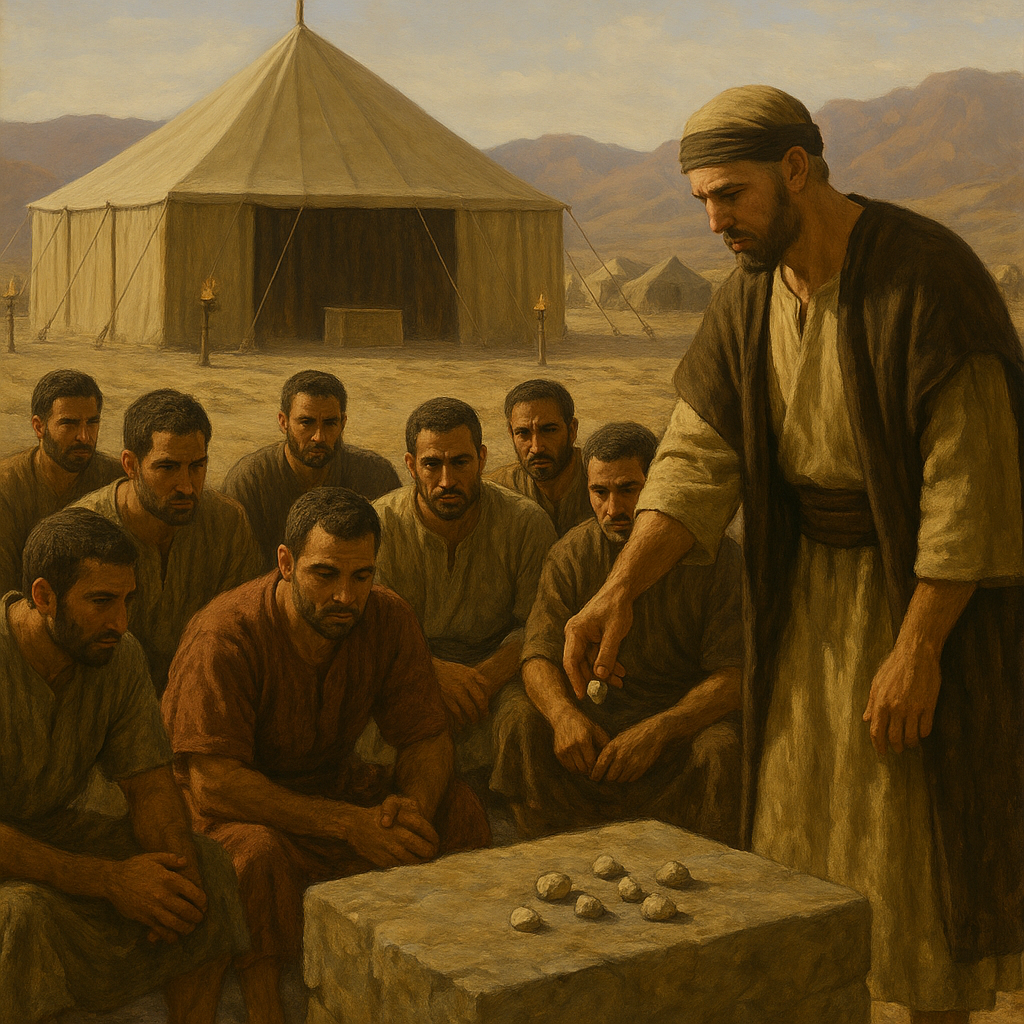
The congregation of Israel gathers at Shiloh and the tabernacle of the congregation is set up there. “And the land was subdued before them.” (Joshua 18:1 KJV) Yet seven tribes had not yet received their inheritance (v. 2). Joshua asks pointedly: “How long are ye slack to go to possess the land, which the LORD God of your fathers hath given you?” (v. 3 KJV) He then sends three men from each tribe to survey the land (vv. 4–8) and the land is divided by lots before the LORD at Shiloh (v. 10 KJV).
This chapter emphasizes God’s provision (the land is given), human delay and negligence (slackness in possessing), and the orderly divine-process of allotment by lot through Joshua.
Chapter 19
This chapter continues the allotment for the remaining tribes: the tribe of Simeon (vv. 1–9), Zebulun (vv. 10–16), Issachar (vv. 17–23), Asher (vv. 24–31), Naphtali (vv. 32–39) and Dan (vv. 40–48) (all KJV). For Dan: “And the coast of the children of Dan went out too little for them: therefore the children of Dan went up to fight against Leshem … and dwelt therein, and called Leshem, Dan, after the name of Dan their father.” (v. 47 KJV). Then, in vv. 49–50, Joshua receives his personal inheritance: “Thus the children of Israel gave an inheritance to Joshua … according to the word of the LORD. And he built the city, and dwelt therein.” (KJV) Finally verse 51 ends: “So they made an end of dividing the country.” (KJV)
Thus the allotment of the land is completed. The people of Israel have now received the promised land as their inheritance, and each tribe has its place.
Key People and Places
-
Joshua – Moses’ successor, the one who oversaw the allotment of the land to Israel (cf. Joshua 18:1).
-
Zelophehad’s daughters (Mahlah, Noah, Hoglah, Milcah, Tirzah) – Women who inherited land among their father’s family because he had no sons, recorded in Joshua 17:3-6.
-
Ephraim & Manasseh – Sons of Joseph; their tribes share a large allotment west of Jordan, chapter 16 and 17.
-
Shiloh – The place where the tabernacle is set up and where Joshua casts lots before the LORD (chapter 18:1, 18:10).
-
Benjamin, Simeon, Zebulun, Issachar, Asher, Naphtali, Dan – The tribes receiving their inheritances in chapter 19.
-
Gezer – A city the Ephraimites did not drive out, cited in Joshua 16:10.
-
Leshem (later called Dan) – The city the tribe of Dan conquered because their allotted territory was too little (Joshua 19:47).
Main Doctrinal or Spiritual Themes
-
God’s faithfulness to His promise – The allotment of the land fulfils the promise made to Abraham, Isaac and Jacob: God gives the land.
-
Inherited blessing and responsibility – The land is given as an inheritance (e.g., “the lot for the children of Joseph began …” Joshua 16:1 KJV); along with it comes the requirement of obedience (driving out enemies).
-
Incomplete obedience brings long-term issues – The failure of Israel to fully drive out the Canaanites (Joshua 16:10; 17:12) demonstrates that blessing does not remove responsibility; disobedience carries consequences.
-
Divine order in the church/kingdom life – The land is divided by lot before the LORD (Joshua 18:10), reflecting the principle that God directs.
-
Human diligence and faithfulness – Joshua’s challenge, “How long are ye slack to go to possess the land …?” (Josh 18:3 KJV) shows that believers must be active in taking up their inheritance in Christ.
-
Unity and diversity in the people of God – Each tribe has its distinct portion, yet the whole allotment is under Joshua and Eleazar’s supervision (Joshua 19:51). A picture of the body of Christ: many parts, one body.
-
Reward and service – Joshua receives his inheritance after faithfully leading (Joshua 19:49–50). Likewise, faithful service in the kingdom is rewarded by the Lord.
Practical Applications or Lessons
-
Accept your inheritance in Christ and possess it. Believers have been given an inheritance (Ephesians 1; 1 Peter 1) just as Israel was given land. But like Israel, we must actively “go in” — claim by faith and obedience what God has provided.
-
Do not be complacent or slack. Israel’s delay in chapter 18 warns us against spiritual procrastination. If God gives us blessing, we must not sit idle but live in it, serve in it, and expand it.
-
Be diligent to remove lingering “Canaanites.” In spiritual life, there may be areas where we have not fully obeyed, where unbelief, sin, or worldliness still dwell. Just as Israel did not fully expel the Canaanites, the church must pursue holiness and separation.
-
Recognize the Lord’s order in the church. The allotment by lot before the LORD reminds us that God directs leadership and ministry. Humble submission to that ordering guards against chaos.
-
Value the place of service and reward in the kingdom. Joshua’s inheritance is a tangible reward for his faithful service. As ministers or members, faithful labouring in God’s work brings reward, though we serve because Christ saved us, not merely to earn.
-
Understand your place and purpose in the body of Christ. Just as each tribe had a distinct portion and role, each believer has a unique gifting and place in the church. Yet all are under the headship of Christ (as Joshua under God).
-
Keep Scripture as your foundation. The careful listing of inheritances reminds us that God chronicles His work, remembers His people, and distributes according to His promise. We should likewise hold fast to the Word as the foundation of our ministry and life.
Comments are closed