Chapter Summaries
Joshua 23 – Joshua’s Farewell Exhortation
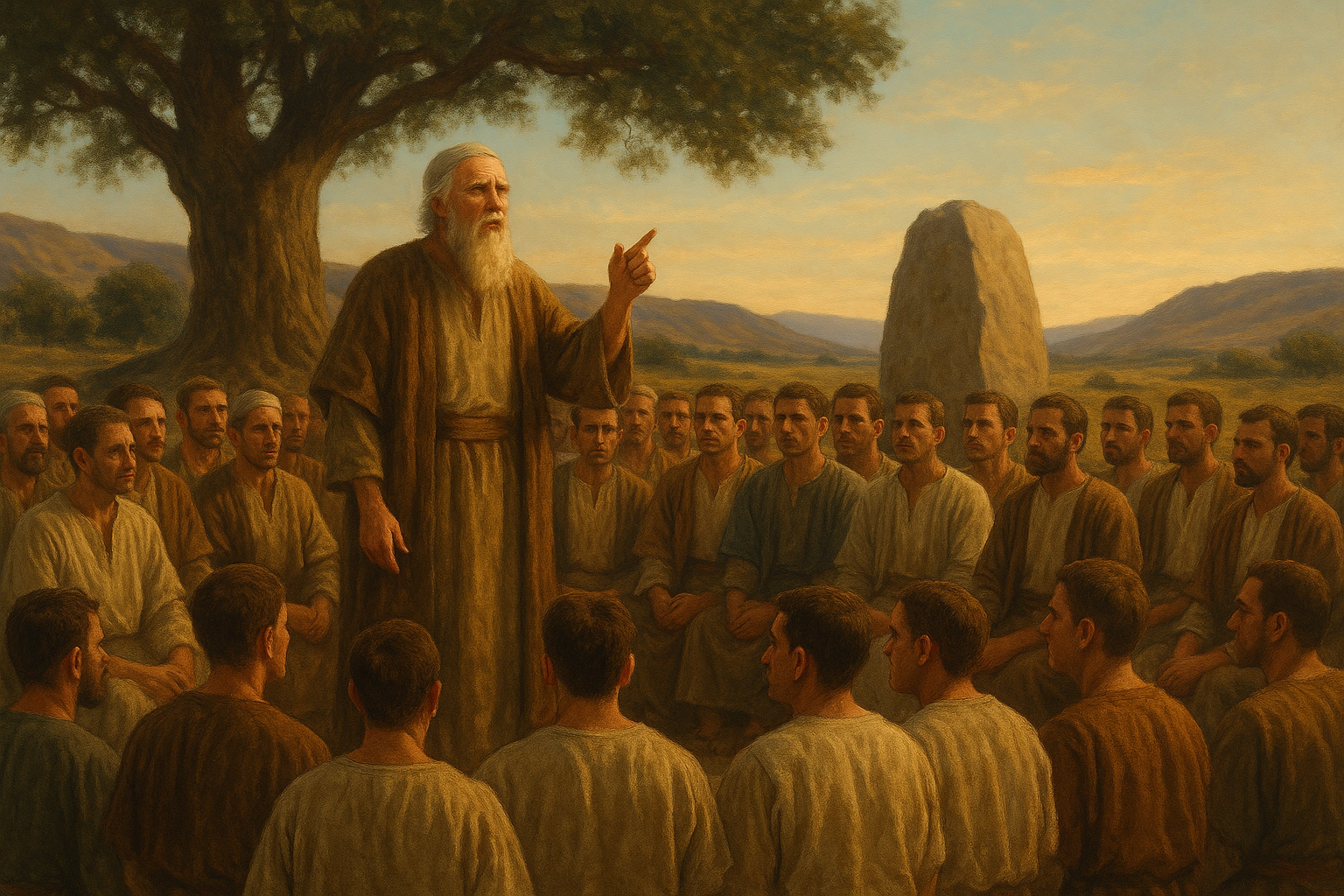
 In this chapter, Joshua, now “old and stricken in age” (v. 1), gathers all Israel—their elders, heads, judges, and officers—to deliver a solemn address of warning and encouragement before his death. The land had rest from war, and Joshua reminded the people that the Lord had fought for them (v. 3). He reviews God’s faithfulness in driving out the nations and reaffirms that the Lord “shall expel them from before you” if Israel continues to obey (v. 5).
Joshua exhorts them to “be ye therefore very courageous to keep and to do all that is written in the book of the law of Moses” (v. 6). They are warned not to associate, marry, or make alliances with the remaining Canaanites, “else if ye do in any wise go back” (v. 12), God will no longer drive out those nations. Disobedience would bring sure judgment—these nations would become “snares and traps” (v. 13).
He reminds them that every word of God’s promise has been fulfilled—“not one thing hath failed” (v. 14)—but warns that God’s curses are just as certain as His blessings if they turn to idolatry (vv. 15–16). The chapter stands as a covenantal charge: God’s blessings depend on Israel’s faithfulness to His Word.
Joshua 24 – Covenant Renewal at Shechem
Joshua assembles all the tribes of Israel at Shechem, a site rich with covenant history (Abraham first built an altar there, Genesis 12:6–7). He recounts God’s mighty acts from the calling of Abraham, the deliverance from Egypt, and victories in Canaan (vv. 2–13). The Lord is the true Deliverer: “I gave you a land for which ye did not labour, and cities which ye built not” (v. 13).
Then Joshua challenges the people with one of the most famous declarations in Scripture:
“Choose you this day whom ye will serve; … but as for me and my house, we will serve the LORD.” (v. 15)
The people affirm their loyalty, saying, “The LORD our God will we serve, and his voice will we obey” (v. 24). Joshua makes a covenant with them, writes these words “in the book of the law of God,” and sets up a great stone under an oak by the sanctuary of the LORD as a witness (v. 26–27).
The book concludes with the death of Joshua at 110 years old (v. 29), the burial of Joseph’s bones at Shechem (v. 32), and the death of Eleazar the priest (v. 33). The generation that served with Joshua remained faithful, a testament to his godly leadership and steadfast example.
Key People and Places
-
Joshua – Faithful leader who delivered his final charge and renewed the covenant before his death. A type of steadfast obedience and spiritual leadership.
-
The Elders and Tribes of Israel – Representatives of the nation charged to remain faithful to the covenant.
-
The LORD (Jehovah) – The covenant-keeping God who fulfilled every promise to Israel.
-
Shechem – Central site of covenant renewal; associated with Abraham’s altar and Jacob’s well.
-
Eleazar the Priest – Son of Aaron; his death marks the close of an era.
-
Joseph – His bones, carried from Egypt, are finally buried in the promised land, fulfilling ancient promises (Genesis 50:25).
Main Doctrinal or Spiritual Themes
-
The Faithfulness of God
Every word of promise was fulfilled (23:14). God’s faithfulness is absolute, both in blessing and in judgment. -
Separation from the World
Israel was warned not to intermarry or make alliances with idolaters (23:7, 12). This underlines the Baptist doctrine of biblical separation—God’s people must remain distinct from worldly and pagan influences. -
Covenant Obedience and Accountability
God’s covenant blessings depend upon faithful obedience. The stone at Shechem symbolized witness and accountability before God (24:27). -
The Freedom to Choose
Joshua’s challenge, “Choose you this day,” reveals man’s responsibility to serve God willingly—not out of compulsion but devotion. -
Generational Faithfulness
Israel served the Lord during Joshua’s lifetime and those elders who knew him (24:31). A faithful generation often stems from godly leadership and teaching.
Practical Applications or Lessons
-
Leadership Ends, but God’s Word Endures
Joshua’s death reminds believers that faithful men pass, but God’s truth abides forever. Ministries must be grounded in Scripture, not personalities. -
Serve God Wholeheartedly
Like Joshua, every believer should resolve, “As for me and my house, we will serve the LORD.” True service begins at home and flows from personal conviction. -
Avoid Spiritual Compromise
Just as Israel was warned against alliances with idolaters, Christians must resist entanglement with the world’s moral and spiritual corruption. (2 Corinthians 6:14–17) -
Remember God’s Faithfulness
Reflecting on past victories strengthens faith for present obedience. Gratitude is a guard against backsliding. -
Public Commitment Strengthens Private Obedience
The covenant renewal at Shechem illustrates the value of public testimony—standing with God’s people to declare allegiance to the Lord.
Summary Thought
Joshua’s final words form a fitting close to his life and the book: God is faithful, but His people must continually choose obedience. The same challenge faces every generation—will we serve the Lord faithfully, or compromise with the world?
Comments are closed