Chapter Summaries
Joshua 13 — The Land Yet to Be Possessed
 The chapter opens with the Lord speaking to Joshua in his old age: “Thou art old and stricken in years, and there remaineth yet very much land to be possessed” (v. 1). Though most of the battles had been won, much territory remained unconquered — especially in the north and along the Philistine coast. The Lord lists these regions, including the lands of the Geshurites, the Philistines, and parts of Lebanon.
God commands Joshua to “divide this land for an inheritance” among the nine and a half tribes, even though some of it was not yet subdued. This demonstrated that the conquest, though incomplete, was certain — for God had already promised it.
The chapter also recounts the inheritance already given east of Jordan to the two and a half tribes: Reuben, Gad, and the half tribe of Manasseh. Moses had allotted these lands before his death (Numbers 32). The record includes mention of Balaam’s death (v. 22), reminding Israel of God’s judgment upon false prophets. Levi received no territory, for “the sacrifices of the LORD God of Israel made by fire are their inheritance” (v. 14). This established their unique spiritual role.
Joshua 14 — Caleb’s Faithful Inheritance
 At Gilgal, the tribe of Judah approaches Joshua, led by Caleb the son of Jephunneh. Caleb reminds Joshua of the promise made forty-five years earlier when he and Joshua alone had believed the Lord after spying out the land (Numbers 13–14). He declares, “As yet I am as strong this day as I was in the day that Moses sent me” (v. 11). Caleb requests Mount Hebron, where the Anakim (giants) dwelled — a place feared by many.
Joshua blesses Caleb and grants him Hebron as an inheritance because “he wholly followed the LORD God of Israel” (v. 14). This record stands as one of Scripture’s clearest testimonies to faith’s endurance. Hebron later became a Levitical city and one of the cities of refuge, but here it first marks the victory of faith over fear.
Joshua 15 — The Inheritance of Judah
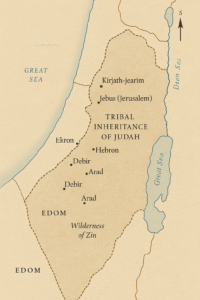
Judah’s inheritance is described in detail, beginning with its southern boundary by the wilderness of Zin and the border of Edom. Its coastal, mountain, and valley regions are carefully outlined, showing God’s precision in the division of the land.
A notable event occurs when Caleb, now settled in Hebron, drives out the three sons of Anak — Sheshai, Ahiman, and Talmai (v. 14). He then offers his daughter Achsah in marriage to whoever conquers nearby Kirjath-sepher. Othniel, Caleb’s nephew, does so and receives Achsah as his wife. Her request for “springs of water” (v. 19) illustrates faith’s desire for God’s continual blessing, not merely possession of land. The chapter concludes by listing Judah’s numerous cities and villages.
Key People and Places
-
Joshua — The aged leader still faithful to God’s command, ensuring every tribe receives its portion.
-
Caleb — A model of enduring faith, courage, and obedience; his spirit contrasts Israel’s earlier unbelief.
-
Othniel — Caleb’s nephew and future judge of Israel (Judges 3:9), exemplifying valor and faith.
-
Hebron — Formerly Kirjath-arba, city of giants, later a city of refuge; symbol of victory by faith.
-
Achsah — Her request for water springs shows spiritual desire and dependence upon blessing.
-
Tribes East of Jordan — Reuben, Gad, and half Manasseh, settled in Gilead and Bashan.
-
Philistine Cities — Gaza, Ashdod, Ashkelon, Gath, and Ekron — regions yet unconquered.
-
Levi — The priestly tribe whose inheritance was the service of the Lord, not land.
Main Doctrinal or Spiritual Themes
-
Faith in God’s Promise Despite Incompletion
The land was not fully subdued, yet God told Joshua to divide it — faith accepts God’s promise as present reality (Hebrews 11:1). -
Reward for Wholehearted Obedience
Caleb’s inheritance of Hebron teaches that spiritual courage and steadfast faith bring lasting reward. -
Separation and Holiness of the Priesthood
The Levites’ unique inheritance emphasizes that service to God is of greater worth than earthly possessions. -
The Certainty of God’s Covenant
Even when circumstances seem incomplete, God’s promises never fail. Every boundary line was marked by divine decree. -
The Power of Faith Over Fear
Caleb’s victory over the Anakim shows that trust in God conquers what seems humanly impossible.
Practical Applications or Lessons
-
Age Does Not Limit Service — Joshua and Caleb serve faithfully in old age. God values faith, not youth or strength.
-
Obedience Precedes Reward — Caleb’s blessing came after decades of patient endurance. Believers today must walk faithfully even when the promise tarries.
-
Be Content with God’s Portion — Each tribe received its assigned inheritance; believers must learn contentment within God’s providence.
-
Desire Living Water — Like Achsah, Christians should seek the continual refreshment of the Spirit, not just material gain.
-
Faith Conquers Giants — Spiritual victory requires confidence in God’s power, not human might.
Summary Thought
Joshua 13–15 marks the transition from conquest to possession. God’s faithfulness is displayed in the careful allotment of the land and in the personal victories of those like Caleb who trusted wholly in Him. Though not all territory was yet subdued, God’s promise was sure — a picture of the believer’s life, where full victory awaits but the inheritance is already secured in Christ.
Comments are closed