Chapter Summaries
Chapter 5
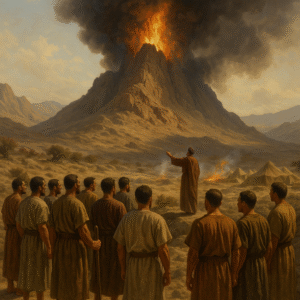 Moses summons all Israel and declares the statutes and judgments which God commanded “that ye may learn them, and keep, and do them.” (5:1)
He reminds them that the LORD made a covenant with them at Horeb (5:2–3) and that they personally stood alive for it.
He recounts how God spoke to them face to face out of the fire on the mount (5:4) and Moses stood between God and the people because they were afraid of the fire and did not go up the mount (5:5)
Moses then reiterates the Ten Commandments (verses 6–21) – the law given at Sinai, including “Honour thy father and thy mother… that thy days may be prolonged” (5:16)
He reminds them of the Sabbath commandment (5:12–15) and warns that if they do not obey all God’s commandments, they will perish like their fathers (5:33).
Historical/doctrinal background:
Israel is about to enter the Promised Land. Moses gives the law again — a restatement of the Sinai covenant for a new generation. The covenant at Horeb/Sinai is central: God’s holiness demands obedience, and the redeemed people are required to live in covenant faithfulness. The face-to?face theophany underscores God’s direct revelation and the solemnness of their calling.
Chapter 6
Moses begins: “Now these are the commandments, the statutes, and the judgments, which the LORD your God commanded to teach you, that ye might do them in the land whither ye go to possess it” (6:1)
He exhorts them to “fear the LORD thy God, to keep all his statutes and his commandments… all the days of thy life” (6:2)
He declares the greatest confession: “Hear, O Israel: The LORD our God is one LORD: And thou shalt love the LORD thy God with all thine heart, and with all thy soul, and with all thy might.” (6:4-5)
He emphasizes that these words shall be in the heart, and that parents must teach them diligently to their children, talk of them in daily life, bind them as a sign and let them be as frontlets between their eyes (6:6-9)
Moses warns them: do not forget the LORD, do not go after strange gods when you are well fed in the land (6:10-12). He commands them to do what is right and good in God’s sight (6:18) and reminds them that the LORD is a jealous God (6:15)
Background/doctrinal comment:
This chapter shifts focus from law-recital to heartfelt obedience, loving God, and passing the faith to subsequent generations. It underlines monotheism (“the LORD our God is one LORD”), the primacy of love for God, and practical spirituality: internalization of the word, family discipleship, and daily walk. For conservative Baptists this underscores that true obedience flows from a heart changed by God, not mere external compliance.
Chapter 7
Moses now addresses Israel’s entrance into the land and the nations to be dispossessed: “When the LORD thy God shall bring thee into the land … and hath cast out many nations before thee … seven nations greater and mightier than thou” (7:1)
He commands that Israel utterly destroy them, make no covenant, show no mercy, intermarry not with them (7:2-3)
Then Israel is told: “For thou art an holy people unto the LORD thy God: the LORD thy God hath chosen thee to be a special people unto himself, above all people that are upon the face of the earth.” (7:6)
The LORD did not set his love on Israel because they were more numerous, but because He loved them and kept the oath He swore to their fathers (7:7-8).
There follow warnings against idolatry, destroying the altars, not desiring the silver/gold of the idols, lest they be snared (7:25)
Background/doctrinal context:
The chapter shows the holiness of God, the chosenness of Israel, and the need for covenant separation. The command to destroy the nations highlights God’s judgment on idolatry and moral corruption; Israel is to be distinct. Conservative Baptists would see this as an era-specific command (to Israel entering Canaan) but illustrating timeless truths of God’s holiness, divine election, and spiritual separation from sin.
Key People and Places
-
Moses – the mediator, speaking to Israel on behalf of God.
-
Aaron (implicitly) and the generation of Israel, including fathers (“our fathers”) and the new generation addressed.
-
Horeb – the mountain where God made the covenant with Israel.
-
Mount Sinai (synonymous in tradition with Horeb) where God spoke face to face.
-
The land “whither ye go to possess it” – the Promised Land, Canaan. (Ch. 6 & 7)
-
The seven nations: the Hittites, Girgashites, Amorites, Canaanites, Perizzites, Hivites, and Jebusites.
Main Doctrinal or Spiritual Themes
-
The holiness of God and covenant relationship – God made a covenant with Israel, spoke face to face, and demands obedience (Ch. 5). Israel is a chosen people (7:6) and must live accordingly.
-
Law and heart obedience – While the law (the statutes, judgments, commandments) is affirmed, the emphasis in chapter 6 is on internalizing the commands (“these words … shall be in thine heart,” 6:6) and loving God with all heart, soul, might (6:5).
-
Passing the faith generation to generation – Parents are commanded to teach the Word diligently to their children (6:7), showing the importance of family discipleship and continuity of faith.
-
Separation from sin and worldliness – Israel is commanded to not yield to idolatry, not to intermarry with pagan nations, not to covet their idols (7:2-3, 25). This teaches the principle of holiness and separation.
-
Divine election and grace – God did not choose Israel because they were great in number, but because of His love and covenant (7:7-8). This points to God’s sovereign grace.
-
The land and promise as blessing tied to obedience – The promise of possessing the land is conditional upon obedience (6:2; 5:33), signifying that blessing in the Christian life is linked to faithful obedience to God’s Word.
Practical Applications or Lessons
-
Hear, learn, do: Just as Moses urged Israel (5:1), believers today must not only listen to God’s Word but learn it and put it into action.
-
Love God wholeheartedly: The command “thou shalt love the LORD thy God with all thine heart…” (6:5) applies: our devotion must be comprehensive—affective, volitional, and volitional direction (“might”).
-
Family discipleship: The verse “and thou shalt teach them diligently unto thy children” (6:7) reminds parents and church leaders that the gospel must be lived and taught in the home.
-
Guard against spiritual forgetfulness: Chapter 6 warns Israelites not to forget God when they prosper; similarly Christians must remain humble, thankful, and faithful when blessed.
-
Holiness in separation: The commands in chapter 7 to avoid alliances with pagan nations and to destroy idolatry reflect the ongoing requirement for believers to avoid compromising with worldliness, to purge sin, and live as a holy people.
-
Recognize your identity in Christ: As Israel was a “holy people unto the LORD” (7:6), so believers are called “a chosen generation, a royal priesthood” (1 Pet 2:9). This identity brings responsibility for holy living.
-
Obedience brings blessing: The link between obedience and entering the land (6:18; 5:33) shows that while salvation is by grace, the Christian life still includes a call to obedience which corresponds with God’s blessing.
-
Sovereign grace humbles us: Knowing God chose Israel not for their number but because of His love (7:7-8) humbles us—our salvation is by grace, not merit—and motivates thankful service.
Comments are closed