 Chapter Summaries
Judges 6 — The Call of Gideon
After forty years of peace under Deborah and Barak, “the children of Israel did evil in the sight of the LORD,” and the LORD delivered them into the hand of Midian for seven years (Judg. 6:1). The Midianites, allied with the Amalekites and “children of the east,” plundered Israel’s crops and herds, leaving them impoverished (vv. 2–6). In distress, Israel cried unto the LORD, and God sent a prophet to remind them of His past deliverance from Egypt and their disobedience in turning to false gods (vv. 7–10).
The Angel of the LORD appeared to Gideon, the son of Joash the Abiezrite, as he threshed wheat in secret to hide it from the Midianites. The angel greeted him, “The LORD is with thee, thou mighty man of valour” (v. 12). Gideon questioned the seeming absence of divine help, but God called him to be the instrument of deliverance. Gideon, feeling unworthy and weak, asked for a sign. Fire consumed his offering on the rock, confirming the divine commission (vv. 19–21).
That same night, Gideon obeyed the LORD’s command to destroy his father’s altar of Baal and cut down the grove beside it, building instead an altar unto the LORD (vv. 25–27). When the men of the city sought to kill him, Joash defended his son, saying, “Will ye plead for Baal?” (v. 31). Gideon earned the new name Jerubbaal, meaning “Let Baal plead against him.”
When the Midianite host gathered in the valley of Jezreel, “the Spirit of the LORD came upon Gideon” (v. 34), empowering him to call forth men from Manasseh, Asher, Zebulun, and Naphtali. Still seeking assurance, Gideon asked God for a confirming sign with a fleece of wool—first requesting dew on the fleece alone, and then the reverse the next night. God graciously granted both signs (vv. 36–40).
Judges 7 — Gideon’s 300 and the Defeat of Midian
God tested Gideon’s army to demonstrate that victory would come by divine power, not human strength. From 32,000 men, the LORD reduced the number to 300—first sending home the fearful, then selecting those who lapped water with their hands (vv. 2–7).
That night, God strengthened Gideon’s faith again, sending him with his servant Phurah to overhear a Midianite’s dream, in which a barley cake tumbled into the Midianite camp and overturned a tent—a sign interpreted as Israel’s victory through Gideon (vv. 13–15).
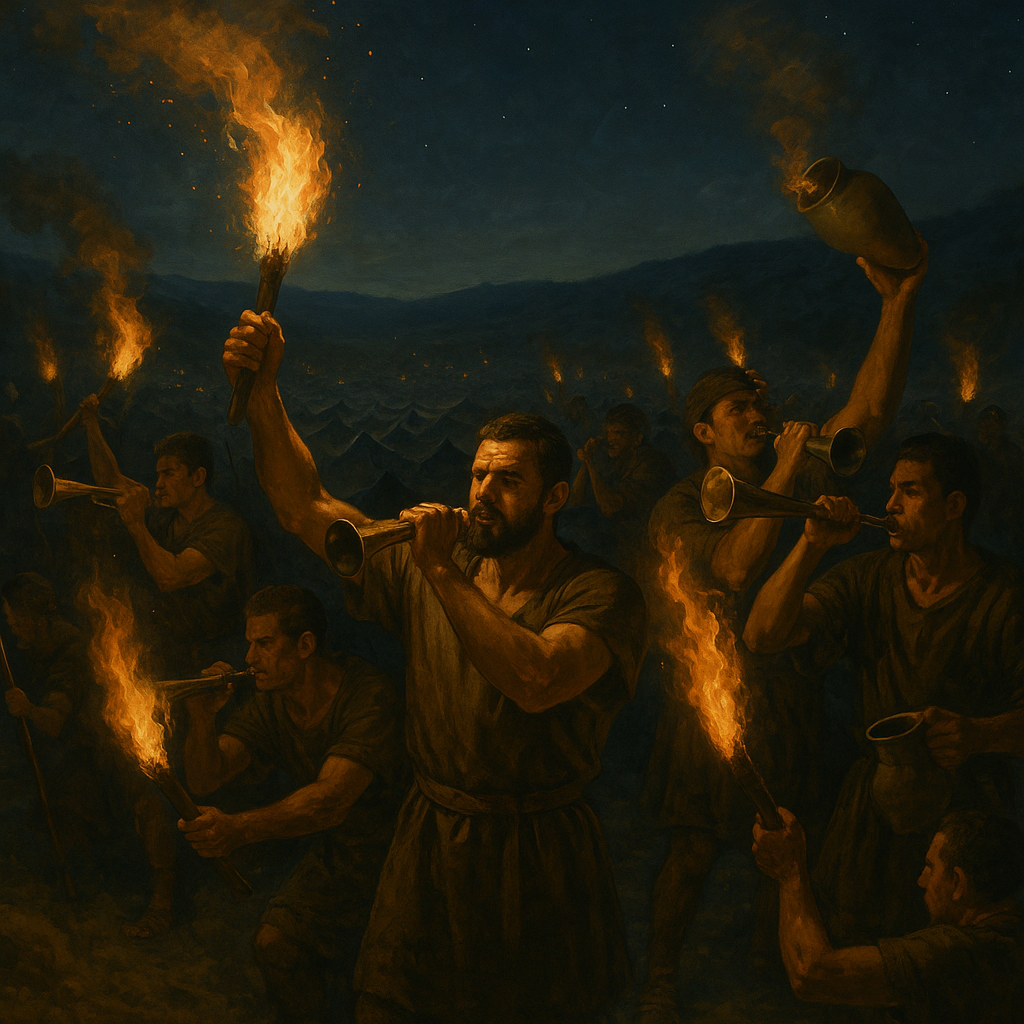
Gideon divided his 300 men into three companies, giving each a trumpet, a pitcher, and a torch hidden inside. At midnight, surrounding the Midianite camp, they broke the pitchers, held up the lights, and cried, “The sword of the LORD, and of Gideon!” (v. 20). In divine confusion, the Midianites turned their swords against one another and fled toward the Jordan. Gideon called for reinforcements from Ephraim to pursue and capture the enemy leaders Oreb and Zeeb, who were slain at the rock and winepress that bore their names (vv. 24–25).
Key People and Places
-
Gideon (Jerubbaal): A humble judge called by God to deliver Israel; noted for his initial fear, growing faith, and obedience.
-
Joash: Gideon’s father, who defended his son’s destruction of Baal’s altar.
-
Midianites and Amalekites: Nomadic raiders who oppressed Israel through plunder and fear.
-
Valley of Jezreel: The battlefield where Gideon’s small force confronted the vast Midianite host.
-
Oreb and Zeeb: Midianite princes slain during Israel’s pursuit.
-
Ophrah: Gideon’s hometown and the site of his first altar to the LORD.
Main Doctrinal or Spiritual Themes
-
God’s Sovereignty and Deliverance:
God allows oppression to bring His people to repentance, then raises up deliverers for His glory. His purposes are never thwarted by human weakness. -
Faith Tested and Strengthened:
Gideon’s repeated signs show God’s patience in growing faith. True faith does not ignore fear but overcomes it through obedience. -
The Spirit’s Empowering:
Gideon’s success came when “the Spirit of the LORD came upon him.” Spiritual battles cannot be won by carnal means but by divine enabling. -
Purity and Separation:
Gideon first had to destroy the idols at home before conquering the enemy. Victory begins with personal holiness and cleansing from false worship. -
God’s Glory, Not Man’s:
The reduction to 300 men shows that God will not share His glory with another. Salvation and victory are of the LORD alone (cf. Ps. 44:6–7).
Practical Applications or Lessons
-
Repentance Brings Renewal: God’s chastisement is redemptive, intended to restore His people to dependence and obedience.
-
Obedience Must Begin at Home: Before Gideon could confront the Midianites, he had to confront sin in his own family.
-
Faith Is Strengthened Through Trials: God often reduces our resources so we learn to trust Him rather than ourselves.
-
Spiritual Warfare Requires Preparation and Purity: Victory comes through prayer, obedience, and courage under the Spirit’s power—not through numbers or human strategy.
-
Give God the Glory: Every triumph in life and ministry belongs to the LORD; self-exaltation undermines His purpose.
Comments are closed