1. Chapter Summaries
Chapter 10
-
 The chapter opens: “Now it came to pass, when Joshua had taken Ai, and had utterly destroyed it … and how the inhabitants of Gibeon had made peace with Israel and were among them.” (10:1)
 -
Because Gibeon had made peace with Israel, five Amorite kings (led by Adoni?zedek, king of Jerusalem) assembled to attack Gibeon. (10:2-5)
-
The Gibeonites called to Joshua at Gilgal: “Slack not thy hand from thy servants; come up to us quickly … for all the kings of the Amorites … are gathered together against us.” (10:6)
-
Joshua mobilizes with his “mighty men of valour” and the LORD says to him, “Fear them not: for I have delivered them into thine hand; there shall not a man of them stand before thee.” (10:8)
-
A sudden attack follows: the LORD discomfits the armies (10:10). At one point the text records the remarkable miracle: “And the sun stood still, and the moon stayed, until the people had avenged themselves upon their enemies.” (10:13)
-
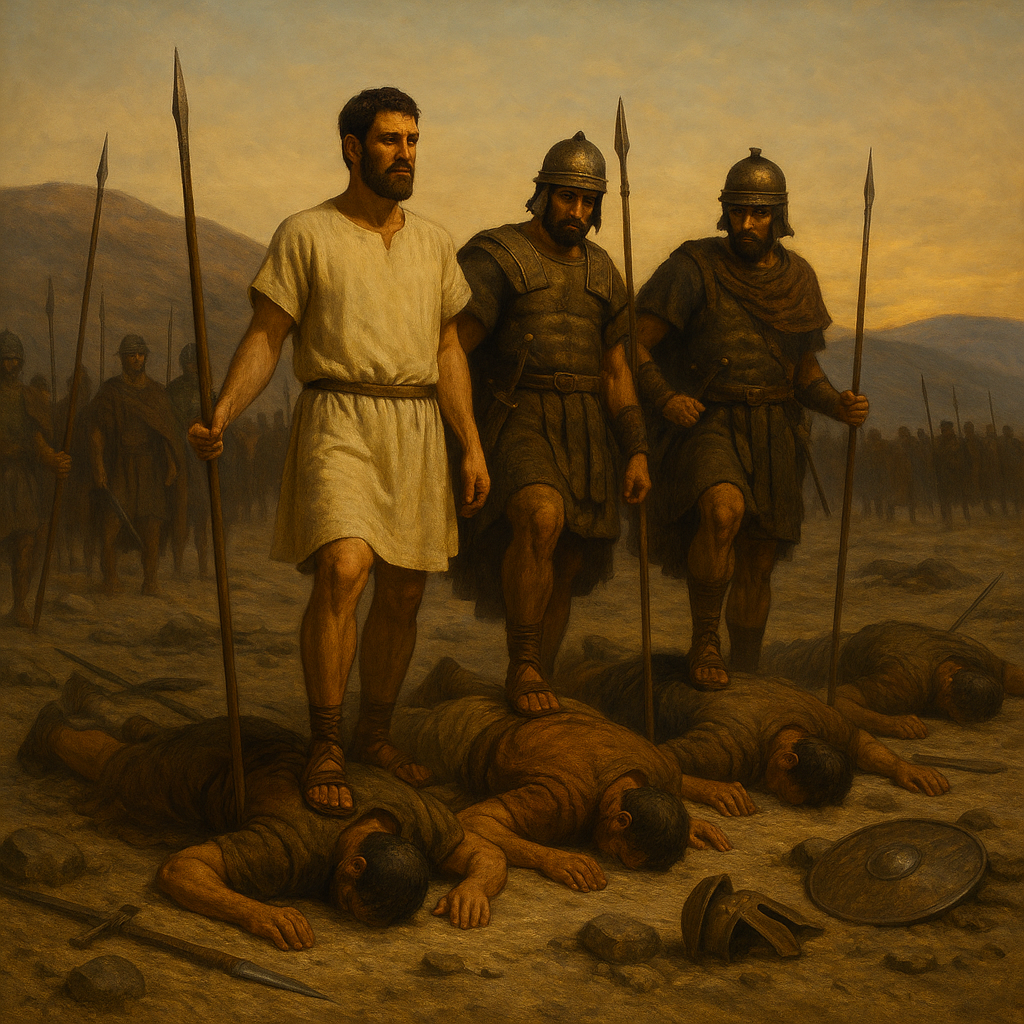
The campaign continues through the southern region; Joshua defeats and captures the kings, and orders the putting of their feet upon their necks. (10:24-25)
-
The chapter closes with the complete defeat of the southern kings. (10:40-43)
Chapter 11
-
In chapter 11 the scene shifts to the northern part of Canaan. The text: “And it came to pass, when Jabin king of Hazor heard these things … that he sent to Jobab king of Madon … and all the kings … and they went out … and all their armies with them, as many people as the sand that is on the sea-shore in multitude, with very many horses and chariots.” (11:1-4)
-
The LORD again assures Joshua and the people that He will deliver the foe. Joshua attacks and utterly destroys the northern kings. He effects the command given earlier by Moses: “so Joshua did unto them, as the LORD commanded Moses his servant: he turned not aside from any of the words of the LORD …” (11:15)
-
A notable point: Joshua takes the city of Hazor (the head of these kingdoms), strikes its king with the sword, and burns the city, whereas for other cities on hills he did not burn them. (11:10-11)
-
The chapter ends: “So Joshua took the whole land, according to all that the LORD said unto Moses; and Joshua gave it for an inheritance unto Israel according to their divisions by their tribes.” (11:23)
Chapter 12
-
Chapter 12 provides a summary list of defeated kings and territories. It begins: “These are the kings of the land whom the children of Israel smote, and possessed their land … on the other side Jordan toward the sun-rising …” (12:1)
-
Then it enumerates the kings of the two and a half tribes east of Jordan (12:1-6), and thereafter the kings of the land west of Jordan, the Canaanite kings defeated by Joshua (12:7-24). (See 12:10-24)
-
The chapter underscores the completeness of the conquest in terms of judicial defeat of the kings, even though later occupancy and full possession may still await.
2. Key People and Places
-
Joshua – the servant of God, successor to Moses, leader of Israel’s conquest under divine command.
-
Adoni-zedek – king of Jerusalem, instigator of the southern coalition against Gibeon and Israel.
-
Jabin – king of Hazor, representative of the powerful northern confederacy defeated in chapter 11.
-
Gibeon – a significant city that made a covenant with Israel, prompting the southern campaign.
-
Hazor – major city in the north, head of the northern kingdoms; Joshua destroyed its king and burned the city.
-
Gilgal – Israel’s forward camp and base of operations at this stage of the conquest (e.g., Joshua moves from Gilgal to Gibeon).
-
Beth-horon, Azekah, Makkedah – towns/locations in the southern campaign where pursuing Israel defeated the Amorites. (10:10)
-
Jordan River – implicit though earlier; the land “west of Jordan” which Israel is conquering and possessing.
3. Main Doctrinal or Spiritual Themes
-
Divine sovereignty over war and nations – The LORD repeatedly intervenes, “I have delivered them into thine hand” (10:8), showing that victory is attributable to God, not merely human might.
-
Obedience and faith of God’s people required – Joshua responds with prompt action, mobilizing at night, and following the LORD’s commands exactly (chapters 10–11). Israel’s success rests on obedience, not independent human strategy.
-
Judgment and holiness – The conquest is more than mere land capture; it involves the execution of divine judgment upon nations inhabiting the land. Israel acts as God’s instrument.
-
God’s faithfulness to His promise – Earlier in the Pentateuch God promised to give this land to Israel; chapters 10–12 show the historical fulfilment of that promise.
-
Separation from the world – The Canaanite nations are to be driven out and not mixed with Israel. This echoes the call for God’s people to be separate and pure.
-
Spiritual warfare analogy – Though this is an Old Testament conquest, the principle holds for believers: our conflict is not just physical, but spiritual (Ephesians 6 applies), and we need God’s power.
-
Rest in victory and inheritance – The conquered land becomes Israel’s inheritance; spiritually the believer likewise enters into the inheritance promised in Christ.
4. Practical Applications or Lessons
-
Trust God for your battles. When facing overwhelm (like Israel confronted by many kings), remember that the LORD is able to deliver. Don’t rely on your own strength alone.
-
Be prompt and obedient. Joshua did not hesitate; he rose up and acted night and day when called. Believers should respond quickly to God’s commands and opportunities.
-
Recognize that the fight is real. Just as Israel had to engage enemy forces, Christians must recognize spiritual hostility and put on the whole armour of God.
-
Pursue holiness and separation. Israel was commanded to fully execute the judgment upon the Canaanites rather than compromise. For believers that means fleeing worldliness, error, and compromise, and pursuing purity.
-
Celebrate God’s deliverance and live in rest. Israel received the inheritance; likewise, Christians should rest in what Christ has done, live in victory, and steward their inheritance responsibly.
-
Use victory for God’s glory, not your own. The triumph in chapters 10–12 is repeatedly attributed to the LORD. In your life, give God the honour for each step of deliverance.
-
Remember the corporate dimension of the mission. Israel fought together under Joshua, anointed leader. The church, likewise, is a body; believers don’t serve in isolation.
-
Reflect on prophetic meaning. While not allegorising, we see that the conquest foreshadows the greater deliverance in Christ. Just as Israel entered the land, we enter spiritual rest. (Hebrews 4:3-8)
Comments are closed