 Deuteronomy 25–27 continues Moses’ instruction to Israel concerning righteous judgment, family and social responsibilities, honest dealings, worship, remembrance of God’s deliverance, and covenant obedience. Deuteronomy 1:5 explicitly places Moses’ declaration of the law “on this side Jordan, in the land of Moab.” These chapters therefore concern Israel as God prepared the nation to possess the land promised to their fathers.
The commands in these chapters were given directly to Israel under the Mosaic covenant. They should not be transferred indiscriminately to the New Testament church as though the Church were Israel. Nevertheless, many of them plainly reveal abiding truths concerning God’s holiness, justice, compassion, honesty, worship, and hatred of sin.
Chapter Summaries
Deuteronomy 25 — Justice, Responsibility, Honest Dealings, and Amalek
The chapter begins with the administration of civil justice. When a controversy came before the judges, they were commanded to “justify the righteous, and condemn the wicked” (Deuteronomy 25:1).
If the guilty man was worthy to be beaten, the punishment was to be administered under judicial supervision and according to his fault. God placed a definite limitation upon the punishment:
“Forty stripes he may give him, and not exceed…” — Deuteronomy 25:3
The reason given was that excessive punishment could cause the brother to “seem vile unto thee.” The text therefore combines justice with restraint. Sin was to be punished, but punishment was not to become uncontrolled cruelty.
Verse 4 gives the brief command:
“Thou shalt not muzzle the ox when he treadeth out the corn.”
In its immediate setting this concerns the working animal. The New Testament explicitly applies the principle to those who labor in spiritual ministry. Paul quotes this command in 1 Corinthians 9:9 and again in 1 Timothy 5:18. Therefore, Scripture itself establishes the broader principle that a laborer may rightly receive support from his labor.
Verses 5–10 regulate the responsibility of a surviving brother when brothers dwelt together and one died without a child. The surviving brother was to perform “the duty of an husband’s brother” so that the deceased brother’s name would not be put out of Israel. If he refused, the matter was taken before the elders, and a public procedure followed.
This was part of Israel’s national and family law. Scripture does not present it as an ordinance for the New Testament church.
Verses 11–12 address a particular physical intervention during a fight between men and prescribe a severe judicial penalty. The passage should be allowed to stand as written without trying to soften or enlarge the circumstance beyond what the KJV states.
Verses 13–16 forbid dishonest weights and measures:
“Thou shalt have a perfect and just weight, a perfect and just measure shalt thou have…” — Deuteronomy 25:15
Dishonesty in commerce was not merely bad business practice. Verse 16 says that those who do such things “are an abomination unto the LORD thy God.”
The chapter concludes with Israel being commanded to remember Amalek. Deuteronomy 25:17–18 explicitly says Amalek attacked Israel “by the way,” smote “the hindmost,” attacked those who were “feeble,” and “feared not God.”
When the LORD had given Israel rest in the land, Israel was commanded:
“Thou shalt blot out the remembrance of Amalek from under heaven; thou shalt not forget it.” — Deuteronomy 25:19
The passage plainly presents God as remembering wickedness and commanding judgment upon persistent enemies according to His own righteous determination.
Deuteronomy 26 — Firstfruits, Thanksgiving, Tithes, and Covenant Commitment
When Israel entered and possessed the land, the people were to bring the first of the fruit of the land to the place which the LORD would choose “to place his name there” (Deuteronomy 26:2).
The worshiper was to confess that God had fulfilled His promise by bringing Israel into the land.
The prescribed confession included:
“A Syrian ready to perish was my father…” — Deuteronomy 26:5
The confession then recounts the descent into Egypt, multiplication of the people, Egyptian oppression, Israel’s cry to the LORD, divine deliverance, and entrance into “a land that floweth with milk and honey.”
The verse itself does not name the individual meant by “my father,” so it is best not to make the name part of the explicit wording of the passage.
The central emphasis is unmistakable: Israel was never to enjoy God’s blessings while forgetting the God who gave them.
The worshiper was to say:
“And now, behold, I have brought the firstfruits of the land, which thou, O LORD, hast given me.” — Deuteronomy 26:10
This was followed by worship and rejoicing:
“And thou shalt rejoice in every good thing which the LORD thy God hath given unto thee…” — Deuteronomy 26:11
Verses 12–15 concern “the third year, which is the year of tithing.” Provision was to be made for “the Levite, the stranger, the fatherless, and the widow.”
The Israelite was then to make a solemn declaration before God that he had obeyed the commandment concerning these things and to pray:
“Look down from thy holy habitation, from heaven, and bless thy people Israel…” — Deuteronomy 26:15
Notice the national identification is explicit: “thy people Israel.”
The chapter closes with a solemn statement concerning Israel and the LORD.
Israel had “avouched the LORD this day to be thy God” (v. 17), while:
“The LORD hath avouched thee this day to be his peculiar people…” — Deuteronomy 26:18
Israel was commanded to keep His commandments, and God declared His purpose to make Israel:
“high above all nations which he hath made, in praise, and in name, and in honour; and that thou mayest be an holy people unto the LORD thy God…” — Deuteronomy 26:19
This concerns Israel specifically. The wording should not be used to erase the biblical distinction between Israel and the New Testament church.
Deuteronomy 27 — The Written Law, Mount Ebal, Mount Gerizim, and the Curses
Moses, together with “the elders of Israel,” commanded the people to keep the commandments.
After crossing Jordan, Israel was to set up great stones, plaster them with plaster, and:
“thou shalt write upon them all the words of this law…” — Deuteronomy 27:3
Verse 8 emphasizes:
“And thou shalt write upon the stones all the words of this law very plainly.”
The written Word was to occupy a public and prominent place in Israel’s entrance into the land.
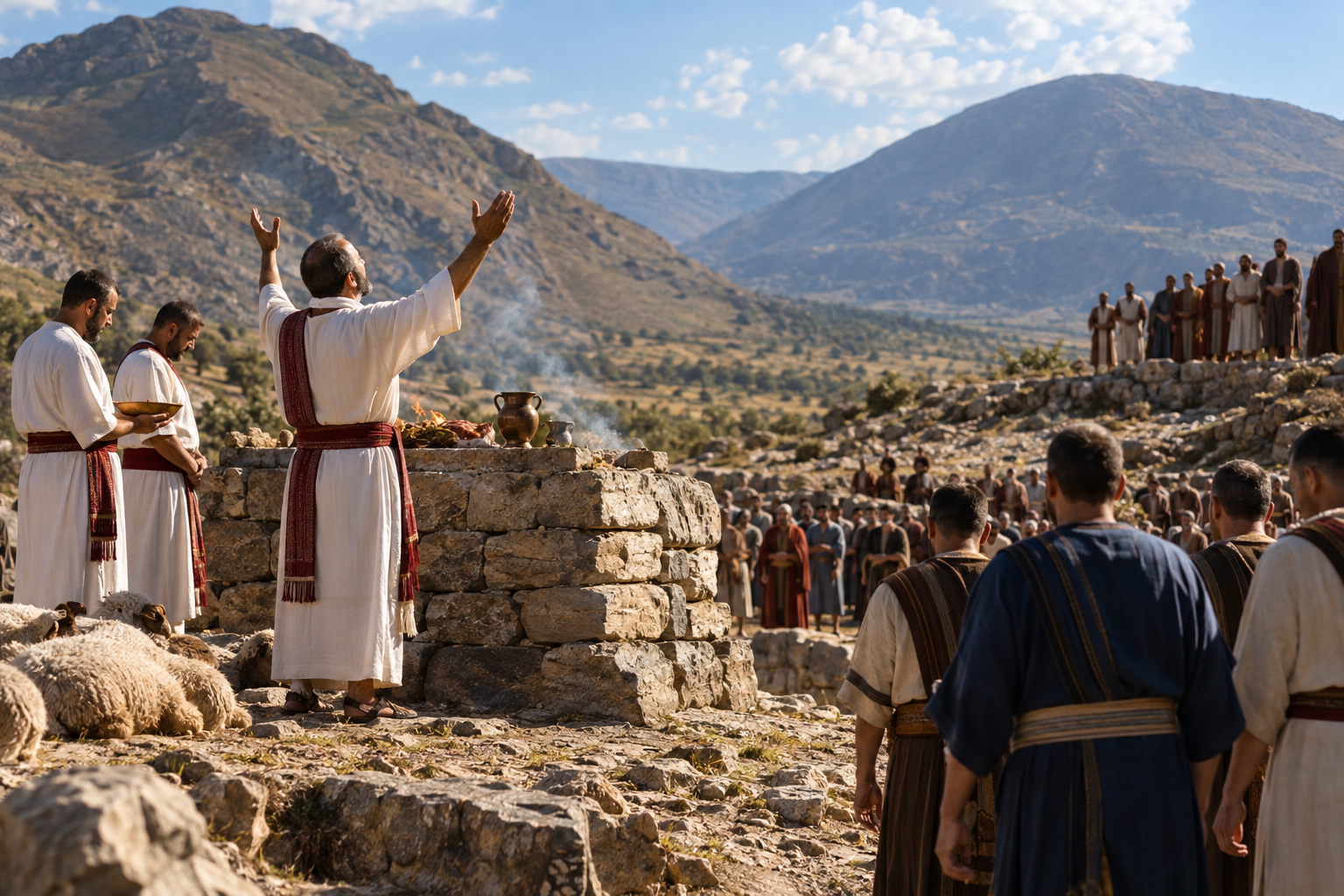
The stones were to be set up in Mount Ebal.
An altar was also to be built there:
“an altar of stones: thou shalt not lift up any iron tool upon them.” — Deuteronomy 27:5
The altar was to consist of “whole stones.” Israel was to offer burnt offerings and peace offerings, eat there, and “rejoice before the LORD thy God” (vv. 6–7).
Moses and “the priests the Levites” then addressed Israel:
“Take heed, and hearken, O Israel; this day thou art become the people of the LORD thy God.” — Deuteronomy 27:9
Whatever theological questions may be raised concerning the wording “this day,” the text itself connects the statement directly with Israel’s obligation to:
“obey the voice of the LORD thy God, and do his commandments and his statutes…” — Deuteronomy 27:10
Six tribes were appointed to stand upon Mount Gerizim to bless the people:
Simeon, Levi, Judah, Issachar, Joseph, and Benjamin.
Six were appointed upon Mount Ebal for the curse:
Reuben, Gad, Asher, Zebulun, Dan, and Naphtali.
The Levites were then to speak “with a loud voice unto all the men of Israel.”
The pronounced curses concerned secret idolatry, dishonoring parents, removing a neighbor’s landmark, misleading the blind, perverting justice for the stranger, fatherless, and widow, specified forms of sexual sin, secretly attacking a neighbor, accepting payment to kill an innocent person, and failure to uphold the law.
After each pronouncement:
“all the people shall answer and say, Amen.”
The final declaration is comprehensive:
“Cursed be he that confirmeth not all the words of this law to do them. And all the people shall say, Amen.” — Deuteronomy 27:26
This verse is especially significant doctrinally. The law demanded obedience rather than selective submission.
The New Testament quotes this principle in Galatians 3:10 and then gives the believer’s hope:
“Christ hath redeemed us from the curse of the law, being made a curse for us…” — Galatians 3:13
Salvation therefore is not obtained by a sinner successfully keeping the Mosaic law. Salvation is by the grace of God through faith in Christ, apart from works. The law exposes guilt; Christ alone provides redemption.
Key People and Places
- Moses — God’s servant through whom these commandments were delivered to Israel.
- The elders of Israel — Joined Moses in commanding the people in Deuteronomy 27:1.
- The judges — Responsible for righteous civil judgment in Deuteronomy 25:1–3.
- The priests the Levites — Joined Moses in addressing Israel in Deuteronomy 27:9 and were assigned a public role in declaring the covenant curses.
- The Levite, stranger, fatherless, and widow — Specifically named as recipients of provision in Deuteronomy 26:12–13.
- Israel — The nation directly addressed throughout these chapters.
- Amalek — The people whom Israel was commanded to remember for their attack upon the weak and feeble and because they “feared not God.”
- Egypt — The place of Israel’s affliction recalled in the firstfruits confession.
- Jordan — The river Israel was commanded to cross before establishing the memorial stones.
- Mount Ebal — Location designated for the plastered stones, altar, and the tribes appointed for the curse.
- Mount Gerizim — Location where six tribes were appointed to stand for the blessing.
- The land flowing with milk and honey — The land God promised and gave to Israel.
Main Doctrinal or Spiritual Themes
1. God Requires Righteous Judgment
Deuteronomy 25 begins with the simple judicial standard of justifying the righteous and condemning the wicked. Biblical justice does not reverse guilt and innocence.
God condemns the moral inversion later described in Isaiah 5:20:
“Woe unto them that call evil good, and good evil…”
Truth must govern judgment rather than sentiment, influence, wealth, or convenience.
2. Justice Must Remain Under God’s Restraint
Even lawful punishment had boundaries. Deuteronomy 25:3 prohibited going beyond forty stripes.
The text therefore demonstrates that biblical justice is neither permissiveness toward evil nor uncontrolled vengeance.
3. God Cares About Integrity in Ordinary Business
The command concerning weights and measures shows that holiness reaches the marketplace.
“A perfect and just weight…”
A man cannot honor God in worship while deliberately cheating others in business and suppose that God is unconcerned.
4. God Expects His People to Remember
Israel was commanded concerning Amalek:
“thou shalt not forget it.”
Deuteronomy repeatedly connects obedience with remembering what God has done and what He has said.
Spiritual forgetfulness often prepares the way for disobedience.
5. Blessings Should Produce Thanksgiving Rather Than Pride
The firstfruits ceremony forced Israel to confess that the land and its produce came from God:
“which thou, O LORD, hast given me.”
Biblical thanksgiving recognizes God as the giver.
The lesson is consistent with James 1:17:
“Every good gift and every perfect gift is from above…”
6. God Is Concerned for the Vulnerable
The Levite, stranger, fatherless, widow, blind, and innocent person all appear within these chapters.
God’s law did not permit strength, position, or prosperity to become excuses for mistreating the defenseless.
7. Worship and Obedience Belong Together
Deuteronomy 26 includes offering, confession, rejoicing, prayer, and obedience.
Deuteronomy 27 places an altar beside the public declaration of the written law.
The text does not present genuine devotion as merely emotional or ceremonial. Israel was repeatedly commanded to “do” what God had commanded.
8. God’s Word Was to Be Made Plain
One of the most striking expressions in these chapters is:
“thou shalt write upon the stones all the words of this law very plainly.”
God intended His revealed commandments to be known and obeyed.
The believer should therefore approach Scripture as authoritative revelation to be understood, believed, preached, and practiced—not as material to be corrected by changing human philosophies.
9. God Is Holy and Sin Brings a Curse
The repeated “Cursed be…” declarations reveal the seriousness of violating God’s commandments.
The final curse of Deuteronomy 27:26 reaches beyond isolated outward acts to the obligation to uphold “all the words of this law.”
This helps explain why fallen man cannot establish righteousness before God by law-keeping.
10. Christ Is the Believer’s Deliverance From the Curse
The New Testament does not teach salvation through successful obedience to Moses.
Galatians 3:13 declares:
“Christ hath redeemed us from the curse of the law, being made a curse for us…”
The Mosaic law reveals God’s holiness and exposes man’s guilt, but justification is received through faith in Christ rather than earned through works.
11. Israel and the Church Must Remain Distinct
Deuteronomy repeatedly names Israel and concerns Israel’s inheritance, national judges, tribal arrangements, land laws, tithing system, and covenant responsibilities.
The New Testament church should learn from these Scriptures, because:
“All scripture is given by inspiration of God, and is profitable…” — 2 Timothy 3:16
But learning spiritual and moral truth from Israel’s law does not make the Church national Israel or place believers under Israel’s Mosaic covenant.
Practical Applications or Lessons
Practice honesty even when deception would be profitable. God called false weights and measures an abomination. A Christian’s business conduct should agree with his profession of faith.
Do not confuse mercy with refusal to judge wrongdoing. Deuteronomy 25 required the guilty to be condemned while simultaneously placing limits upon punishment. Biblical compassion does not require calling evil good.
Honor legitimate labor. The command, “Thou shalt not muzzle the ox when he treadeth out the corn,” is explicitly applied by Paul to rewarding those who labor.
Remember what God has done. Israel was repeatedly instructed to rehearse God’s past works. Gratitude grows when God’s mercies are deliberately remembered.
Give God the first honor, not the leftovers. Israel’s firstfruits acknowledged that the harvest came from the LORD. Believers should likewise recognize God’s ownership and goodness in all provision.
Care about those who can easily be neglected. God repeatedly mentioned the stranger, fatherless, widow, and blind. Genuine godliness should produce fairness, compassion, and responsible care.
Take secret sins seriously. Several curses in Deuteronomy 27 concern acts that could be concealed from men. The idol could be placed “in a secret place,” and a neighbor could be smitten “secretly.” What is hidden from men remains known to God.
Do not substitute selective obedience for submission to God. Deuteronomy 27:26 does not permit a man to honor the commandments he prefers while rejecting the rest.
Keep the written Word central. Before Israel settled into the land, God required His law to be written “very plainly.” Churches, homes, and individual believers should likewise make Scripture—not human opinion—the governing authority.
Rest salvation wholly in Christ rather than personal law-keeping. The curse of the law demonstrates the hopelessness of seeking justification through human performance. Christ “hath redeemed us from the curse of the law” (Galatians 3:13). Salvation is by grace through faith, not by works.
Taken together, Deuteronomy 25–27 presents a holy God governing His people in matters ranging from courtroom justice and business honesty to worship, family responsibility, care for the needy, public acknowledgment of His Word, and covenant accountability. Israel was being reminded that receiving God’s blessings did not remove the obligation to obey the God who gave them. At the same time, the law’s comprehensive demand points the sinner away from confidence in himself and, in the fuller light of the New Testament, toward the redemption found in Jesus Christ.
Comments are closed