Chapter 1
 Summary of major events and flow of the text
-
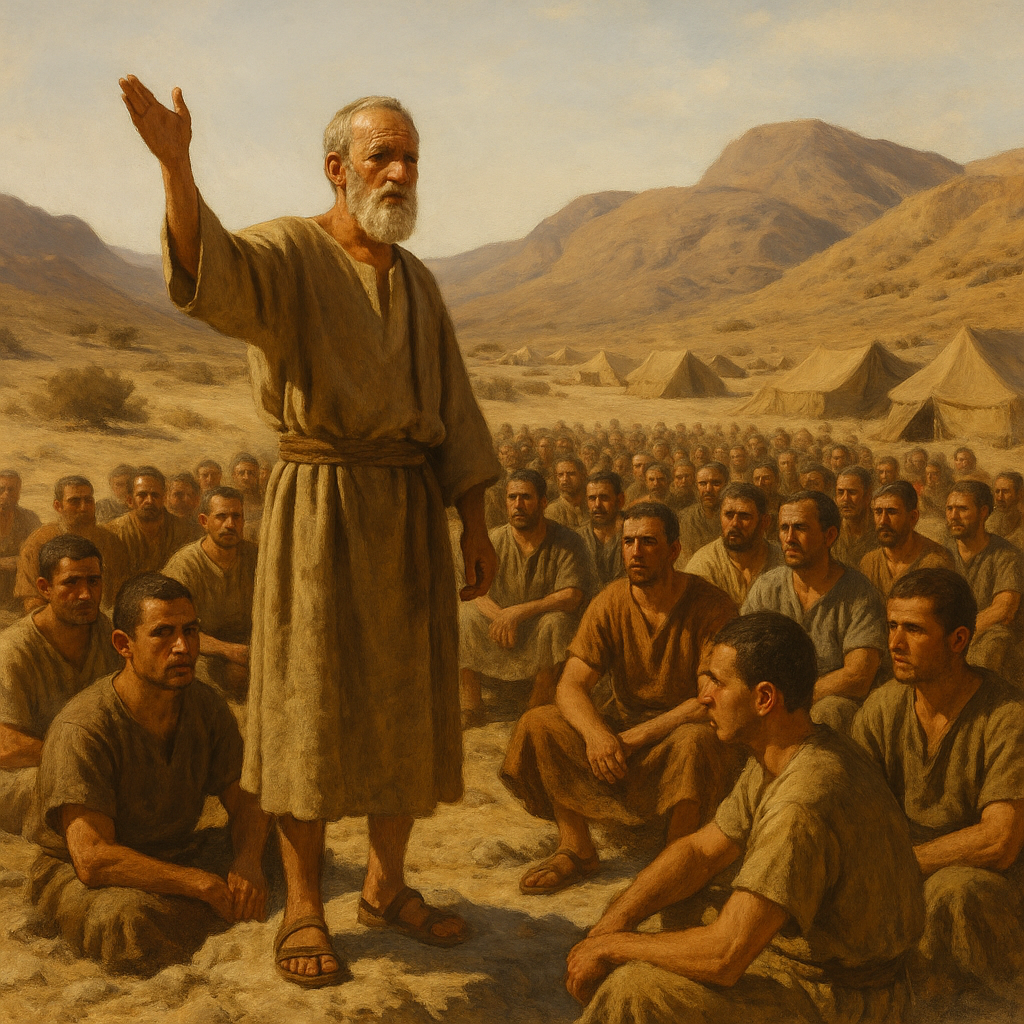
The chapter opens: “These be the words which Moses spake unto all Israel on this side Jordan in the wilderness…” (1:1). Moses addresses the second generation of Israelites on the plains of Moab, just east of the Jordan.
-
He reminds them that at Horeb (Sinai) the LORD said: “Ye have dwelt long enough at this mountain” (1:6). They were to set out to take possession of the land promised.
-
Moses recounts that he appointed leaders over the people: “So I took the chief of your tribes, wise men, and known, and made them heads over you…” (1:15). This shows orderly leadership.
-
Then Moses revisits the sending of the twelve spies and Israel’s refusal to go up and possess the land: “And ye approached unto me every one of you, and said, We will send men before us… and see the land… And the men went up and searched the land… And they returned unto us, and brought us an evil report of the land… And all the congregation bade stone them with stones” (1:22-23).
-
Because of their unbelief and rebellion, God said: “Ye shall not go over this Jordan” (1:37) and that generation died in the wilderness over forty years.
-
Moses fast-forwards to the LORD’s command: “Turn you, and take your journey into the wilderness by the way of the Red sea” (1:40). They skirted Mount Seir, wandered many days.
-
The chapter closes with the command to possess the land: “Rise up, take your journey, and pass over the river Arnon: behold, I have given into thine hand Sihon the Amorite…” (1:44) but with the caveat that the people did not go to Ammon’s land because the LORD had said: “Distress not the Moabites, neither contend with them in battle…” (1:45-46).
Historical and doctrinal background
-
Moses is delivering his farewell discourse to Israel before they actually enter Canaan.
-
The “eleven days’ journey from Horeb by the way of Mount Seir to Kadesh-Barnea” (1:2) emphasises that the wandering was not geographical necessity but because of disobedience and unbelief.
-
The sending of the spies, the negative report, and Israel’s rebellion is foundational for understanding their forty-year delay and the firmness of God’s judgment of unbelief.
-
The chapter underscores God’s sovereign giving of the land (“I have given into thine hand Sihon … and his land” 1:44) and His righteous penalty on unbelief.
Chapter 2
Summary of major events and flow of the text
-
Moses continues: “Then we turned, and took our journey into the wilderness by the way of the Red sea … we compassed Mount Seir many days” (2:1). The generation of unbelief wandered until God directed them toward the land.
-
At Mount Seir the LORD said: “You have skirted this mountain long enough; turn northward” (2:2). Then He commanded them concerning the land of their brethren, the children of Esau in Seir: “For the LORD thy God hath given Mount Seir unto Esau for a possession. … Thou shalt not meddle with them: for I will not give thee of their land, no, not so much as to set the sole of thy foot upon…” (2:5-6).
-
Moses reminds them: “And the LORD your God hath blessed you in all the work of your hand: he knoweth thy walking through this great wilderness…” (2:7). God provided while they wandered.
-
Next: “When we came to the border of the children of Ammon, … the LORD said unto me, ‘Distress not, nor meddle with them; for I will not give thee of the land of the children of Ammon…’” (2:16-19).
-
Then the conquest of the Amorite king: “And the LORD said unto me, ‘Behold, I have begun to deliver Sihon … and his land into your hand: begin to possess it’” (2:24). “So the LORD our God delivered him before us; and we smote him, his sons, and all his people … we took all his cities at that time … there was not one city which we did not take” (2:32-34).
-
But Israel did not take the land of the children of Ammon: “Only unto the land of the children of Ammon thou camest not… because the LORD had said unto me, ‘Distress them not; neither strive with them in battle’” (2:37).
-
The chapter ends: “The space in which we came was from Ar of the river Arnon unto mount Sion … than even unto Aroer, which is by the town which is in the valley of Arnon … even to Gilead … there was no city which we did not take from them, until the fear of you fell upon the land…” (2:36-37).
Historical and doctrinal background
-
This chapter essentially compresses forty years of wilderness wandering (after the generation’s refusal) into a summary of God’s providence, leading up to the new generation’s approach to the land. Matthew Henry notes: “Moses … proceeds in the rehearsal of God’s providences … making his narrative begin again when they faced about toward Canaan.”
-
God’s giving of Mount Seir to Esau (2:5) and His command for Israel not to take that land reminds us that the inheritance is by God’s sovereign disposition, not Israel’s rampage. Trapp emphasizes the doctrine of God’s allotting the nations their portion.
-
The pattern of God’s blessing (2:7) during the wilderness years underscores His faithfulness, even when Israel’s faith was weak.
-
The conquest of the Amorite king Sihon serves as a foreshadowing of the full conquest to come under Joshua, and confirms the doctrine of divine action on behalf of His people when they obey (2:24-34).
-
The selective non-conquest of Ammon and Edom: Israel acted under God’s direction, not by their own expansionism (2:19, 2:36-37). This teaches the believer that God’s mission and God’s promises define the scope of our engagement, not mere human ambition.
Key People and Places
-
Moses – Israel’s leader, set to die before entering Canaan, now delivering his final sermons to the new generation.
-
Joshua – Mentioned implicitly (1:38) as the one who will lead Israel in: “Joshua … shall go over before thee; and encourage him: for he shall cause Israel to inherit it.”
-
Sihon – The Amorite king of Heshbon whom Israel defeated by God’s hand (2:24-34).
-
Esau – Ancestor of the Edomites; his land of Seir is referenced in 2:4-6 as belonging to his descendants.
-
Horeb (Sinai) – The mountain where God first spoke to Israel after Egypt; departure point for the wilderness journey (1:6).
-
Kadesh?Barnea – The place in the wilderness where Israel’s faith failed originally (1:2, cf. Numbers 13-14).
-
Mount Seir – The territory of Esau; Israel skirted it many days (2:1-2) and were instructed not to take it.
-
River Arnon – Border region where Israel crossed into Amorite territory (2:24, 36).
-
Plains of Moab – The location “on this side Jordan” where Moses gives this sermon (1:5).
Main Doctrinal or Spiritual Themes
-
God’s sovereignty: God determines the allotment of nations (“I have given Mount Seir unto Esau for a possession” 2:5), He assigns inheritance, and executes judgment.
-
Faith and obedience: Israel’s failure to enter Canaan (chapter 1) illustrates the danger of unbelief; the victories (chapter 2) underscore the blessing of obedience.
-
Providential care: Even during the wilderness years, God “blessed you in all the work of your hand” (2:7) and “knew” their walking in the wilderness (2:7).
-
Leadership and accountability: Moses appoints leaders (1:15-17); Israel is accountable to God’s commands and to their leaders.
-
Historical remembrance: Moses reviews Israel’s past so that the next generation might learn and not repeat mistakes.
-
Separation and mission: Israel is not to take land that God has not given them (2:5-6, 2:19). They are set apart for God’s purpose, not to mimic the nations.
-
God’s promise and the land: The promised land theme is operative — the land is to be possessed by faith (1:8, 1:21, 2:24).
-
Warning and hope: The chapters both warn of the consequences of disobedience and offer hope of entering in if the people listen and obey.
Practical Applications or Lessons
-
Listen to God’s Word and act – Just as Moses emphasised listening to the LORD and obeying (cf. 1:6; 2:7), believers today must heed Scripture, not merely hear.
-
Avoid the trap of unbelief – Israel’s failure to trust and advance (1:19-33) is a strong warning: delayed obedience is dangerous; faith must act.
-
Recognise God’s faithfulness – Though Israel wandered, God did not abandon them. He blessed their efforts (2:7). We too can trust God’s sustaining grace through trials.
-
Respect God’s allotments – Israel did not take Edom’s or Ammon’s land though they could have. Likewise, Christian stewardship, mission and life must operate under God’s direction, not ambition.
-
Appoint godly leadership – Moses’ appointment of leaders (1:15-17) shows the importance of godly, wise leadership in the church and in families. We should value and support such leadership.
-
Remember your history to shape your future – Recalling the wilderness years and failures prepares Israel to enter the land; our remembrance of what God has done informs our walk today.
-
Serve with the promise in mind – The promise of entering the land (1:8; 2:24) can be viewed spiritually: we serve now in light of God’s promised inheritance and future reward.
-
Obey under God’s command, not by human strength – The victory over Sihon (2:24-34) wasn’t simply Israel’s battle; it was the LORD’s doing. In the Christian life, victory over sin and spiritual battles is through the Lord, not merely human effort.
Comments are closed